


Evaluation of Triazole and Isoxazole Derivatives as Potential Anti-infective Agents
- PMID: 30374214
- PMCID: PMC6203334
- DOI: 10.1007/s00044-018-2146-4
Evaluation of Triazole and Isoxazole Derivatives as Potential Anti-infective Agents
Abstract
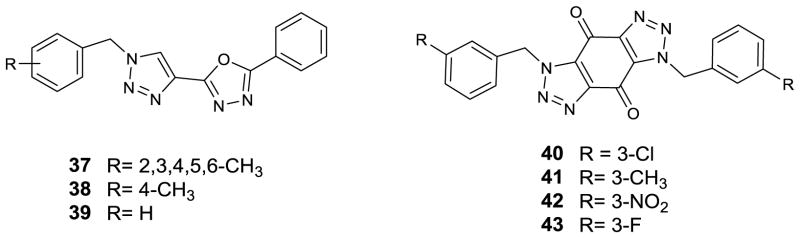
A series of isoxazole and triazole derivatives, with interesting bioactive scaffolds, were examined for their in vitro antibacterial, antifungal, and antiprotozoal activities. These compounds exhibited antitrypanosomal activity comparable to difluoromethylornithine (DMFO), a drug used in the treatment of human African trypanosomiasis. Isoxazole analogues 1, 3 and 4, and triazole derivatives 16, 17, 28, 37, 40 and 42 showed the highest antitrypanosomal activity with IC50 values of 17.89, 1.82, 10.38, 10.26, 11.77, 9.29, 3.93, 2.11, and 0.93 μM, respectively. Compounds 40 and 42 showed the most potent activity against Leishmania donovani amastigotes with IC50 values of 18.28 and 10.54 μM, respectively. Compound 42 showed the most potent activity against Leishmania donovani macrophage internalized amastigotes with an IC50 value of 8.32 μM. Conjugate triazoles 40-43 displayed potential antimalarial activity against chloroquine-resistant W2 and chloroquine sensitive D6 Plasmodium falciparum strains (IC50 value range from 0.58 to 8.36 μM). Compound 37 showed antibacterial activity against Staphylococcus aureus, MRSA and Mycobacterium intracellulare with IC50 values of 15.53, 14.22 and 47.45 μM, respectively. None of the compounds exhibited antifungal activity.
Keywords: antibacterial and antiprotozoal activity; triazole and isoxazole derivatives.
Conflict of interest statement
Conflict of Interest: The authors declare that they have no conflict of interest.
Figures



References
-
- Abu-Orabi ST. 1, 3-Dipolar cycloaddition reactions of substituted benzyl azides with acetylenic compounds. Molecules. 2002;7:302–314.
-
- Abu-Orabi ST, Al-Hamdany R, Al-Momany LA, Ta’an EA. Reactions of isoxazoline and isoxazole derivatives with hydrazine hydrate. Asian J Chem. 1999;11:1276.
-
- Abu-Orabi ST, Jibril I, Obiedat R, Hatamleh L. Cycloaddition reactions of 2, 4, 6-trimethoxybenzonitrile oxide with disubstituted acetylenes. J Chem Eng Data. 1988;33:540–541.
-
- Abu-Orabi ST, Saleh M, Al-Momani L, Jibril I, Yousef Y. Synthesis of mono-and bis-triazoles via 1, 3-dipolar cycloaddition reactions of azide derivatives with naphtho- and benzoquinone. Jordan J Chem. 2006;1:109–120.
-
- Al-Momani LA. Master Dissertation. Yarmouk University; 1995. Synthesis, study and reactions of isoxazole and isoxazoline compounds via 1,3-dipolar cycloadditions of aromatic nitrile oxides.
Grants and funding
LinkOut - more resources
Full Text Sources
Molecular Biology Databases