Review
. 2019 Feb;76(3):441-451.
doi: 10.1007/s00018-018-2940-7. Epub 2018 Oct 29.

Regulatory network of miRNA on its target: coordination between transcriptional and post-transcriptional regulation of gene expression

Affiliations
Review

Regulatory network of miRNA on its target: coordination between transcriptional and post-transcriptional regulation of gene expression

Mengfan Pu et al. Cell Mol Life Sci. 2019 Feb.

Abstract

MicroRNAs (miRNAs) are a class of endogenous small noncoding RNAs that participate in a majority of biological processes via regulating target gene expression. The post-transcriptional repression through miRNA seed region binding to 3' UTR of target mRNA is considered as the canonical mode of miRNA-mediated gene regulation. However, emerging evidence suggests that other regulatory modes exist beyond the canonical mechanism. In particular, the function of intranuclear miRNA in gene transcriptional regulation is gradually revealed, with evidence showing their contribution to gene silencing or activating. Therefore, miRNA-mediated regulation of gene transcription not only expands our understanding of the molecular mechanism underlying miRNA regulatory function, but also provides new evidence to explain its ability in the sophisticated regulation of many bioprocesses. In this review, mechanisms of miRNA-mediated gene transcriptional and post-transcriptional regulation are summarized, and the synergistic effects among these actions which form a regulatory network of a miRNA on its target are particularly elaborated. With these discussions, we aim to emphasize the importance of miRNA regulatory network on target gene regulation and further highlight the potential application of the network mode in the achievement of a more effective and stable modulation of the target gene expression.

Keywords: miRNA cellular distribution; miRNA non-seed sequence function; miRNA target recognition; miRNA-related nucleic acid drugs.


Conflict of interest statement

The authors have declared that no competing interest exists.

Figures
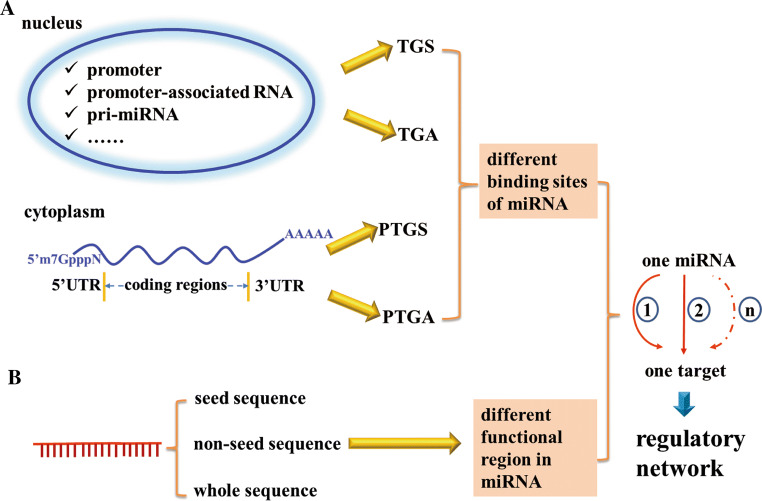
Fig. 1
Fig. 1
Multiple modes of miRNA action. The regulation by miRNA on its target can be achieved by a interacting with different binding sites including promoter, promoter-associated RNA, pri-miRNA, etc. in the nucleus to modulate target gene transcription or 5′ UTR, coding region, 3′ UTR of mRNA in the cytoplasm to modulate target gene translation. b The different functional region in miRNA including seed sequence, non-seed sequence or whole sequence. All these modes of miRNA action enable the network regulation between a miRNA and a target gene
Fig. 2
Fig. 2
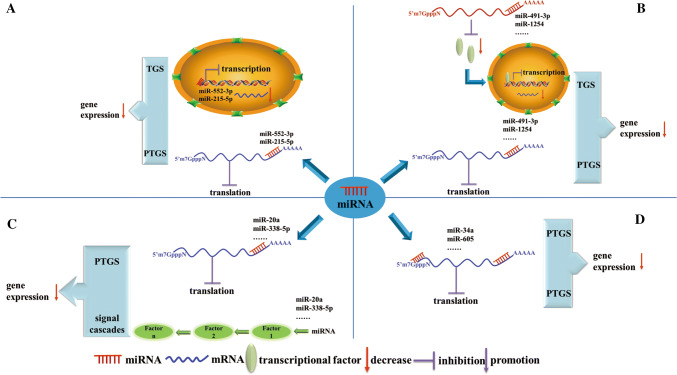
Different patterns of dual regulation on a target gene by miRNA. Currently, dual regulation of miRNA consists of coordination between 3′ UTR and promoter (a), in which miRNAs can directly regulate target gene transcription in nucleus and directly regulate target gene translation in cytoplasm; 3′ UTR and transcriptional factor (b), in which miRNAs can indirectly regulate target gene transcription in the nucleus by controlling the levels of transcriptional factors of the target in cytoplasm and directly regulate target gene translation in cytoplasm; 3′ UTR and signal cascades (c), in which miRNAs can indirectly regulate target gene mRNA or protein levels by modulating related signal pathways in the cytoplasm and directly regulate target gene translation in cytoplasm; 3′ UTR and 5′ UTR (d), in which miRNAs can directly regulate target gene translation in cytoplasm by interacting with the 3′ UTR and 5′ UTR of target mRNA

References

    1. Bartel DP. MicroRNAs: genomics, biogenesis, mechanism, and function. Cell. 2004;116(2):281–297. doi: 10.1016/S0092-8674(04)00045-5. - DOI - PubMed
    1. Lee Y, Kim M, Han J, Yeom KH, Lee S, Baek SH, Kim VN. MicroRNA genes are transcribed by RNA polymerase II. EMBO J. 2004;23(20):4051–4060. doi: 10.1038/sj.emboj.7600385. - DOI - PMC - PubMed
    1. Lee Y, Ahn C, Han J, Choi H, Kim J, Yim J, Lee J, Provost P, Radmark O, Kim S, Kim VN. The nuclear RNase III Drosha initiates microRNA processing. Nature. 2003;425(6956):415–419. doi: 10.1038/nature01957. - DOI - PubMed
    1. Carmell MA, Hannon GJ. RNase III enzymes and the initiation of gene silencing. Nat Struct Mol Biol. 2004;11(3):214–218. doi: 10.1038/nsmb729. - DOI - PubMed
    1. Gregory RI, Yan KP, Amuthan G, Chendrimada T, Doratotaj B, Cooch N, Shiekhattar R. The microprocessor complex mediates the genesis of microRNAs. Nature. 2004;432(7014):235–240. doi: 10.1038/nature03120. - DOI - PubMed

MeSH terms

LinkOut - more resources