


Rhythmic auditory cues shape neural network recruitment in Parkinson's disease during repetitive motor behavior
- PMID: 30375083
- PMCID: PMC6426668
- DOI: 10.1111/ejn.14227
Rhythmic auditory cues shape neural network recruitment in Parkinson's disease during repetitive motor behavior
Abstract
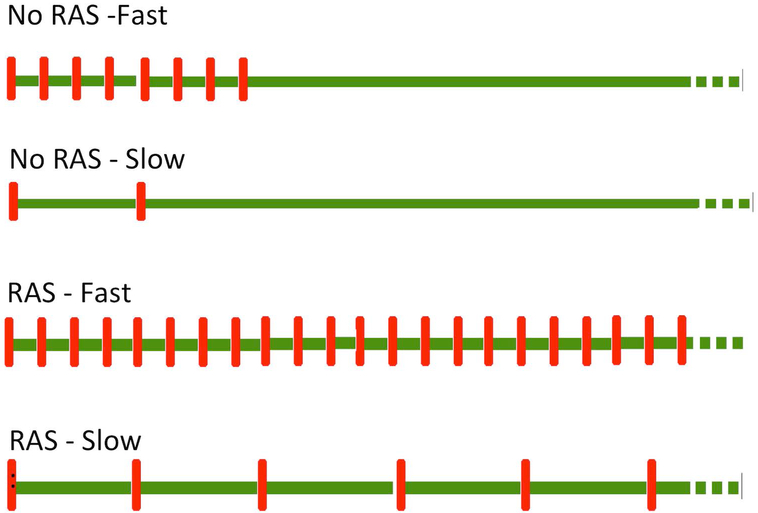
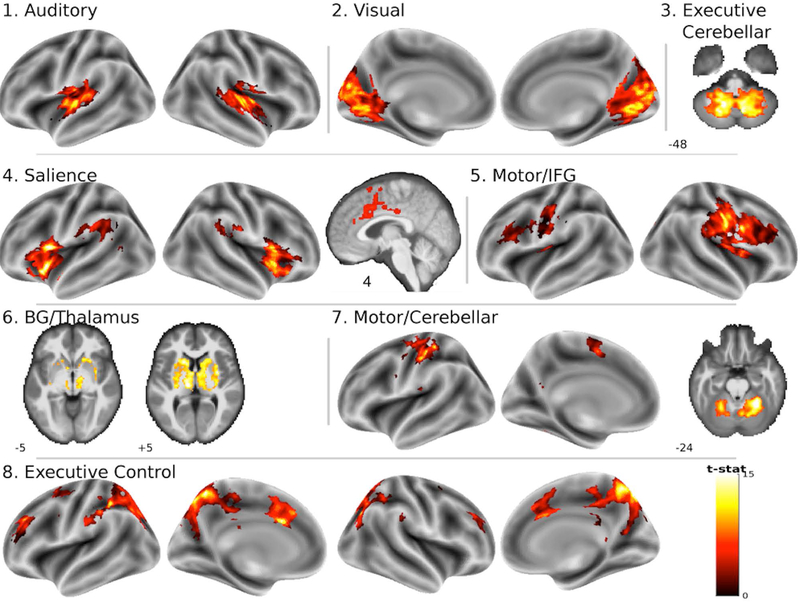
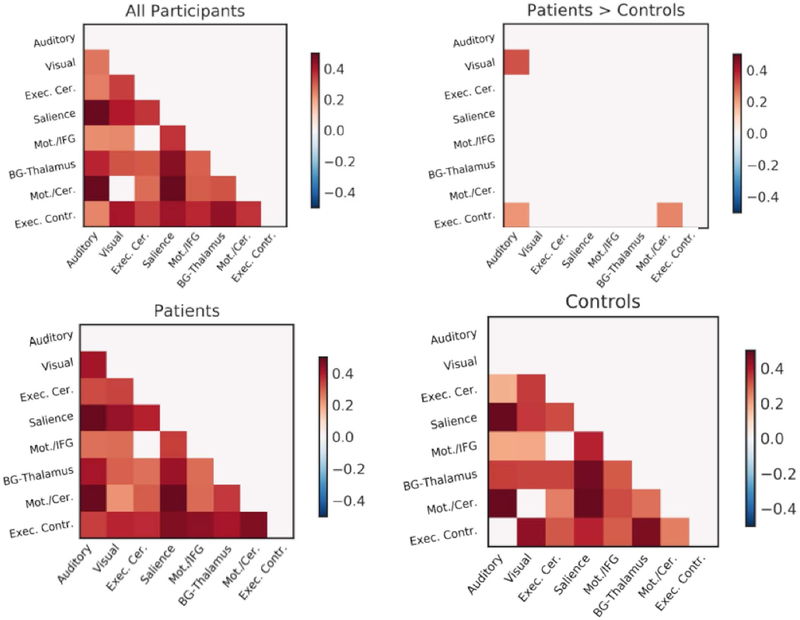
It is well established clinically that rhythmic auditory cues can improve gait and other motor behaviors in Parkinson's disease (PD) and other disorders. However, the neural systems underlying this therapeutic effect are largely unknown. To investigate this question we scanned people with PD and age-matched healthy controls using functional magnetic resonance imaging (fMRI). All subjects performed a rhythmic motor behavior (right hand finger tapping) with and without simultaneous auditory rhythmic cues at two different speeds (1 and 4 Hz). We used spatial independent component analysis (ICA) and regression to identify task-related functional connectivity networks and assessed differences between groups in intra- and inter-network connectivity. Overall, the control group showed greater intra-network connectivity in perceptual and motor related networks during motor tapping both with and without rhythmic cues. The PD group showed greater inter-network connectivity between the auditory network and the executive control network, and between the executive control network and the motor/cerebellar network associated with the motor task performance. We interpret our results as indicating that the temporal rhythmic auditory information may assist compensatory mechanisms through network-level effects, reflected in increased interaction between auditory and executive networks that in turn modulate activity in cortico-cerebellar networks.
Keywords: basal ganglia; beat; entrainment; music therapy; synchronization.
© 2018 Federation of European Neuroscience Societies and John Wiley & Sons Ltd.
Conflict of interest statement
Conflict of Interest Statement:
Authors declare no conflict of interest.
Figures
References
-
- Bell AJ, & Sejnowski TJ (1995) An information-maximization approach to blind separation and blind deconvolution. Neural Comput 7, 1129–159. - PubMed
-
- Bella SD, Benoit CE, Farrugia N, Schwartze M, & Kotz SA (2015) Effects of musically cued gait training in Parkinson’s disease: beyond a motor benefit. Ann N Y Acad Sci 1337, 77–85 - PubMed
-
- Benjamini Y, & Hochberg Y (1995) Controlling the false discovery rate: A practical and powerful approach to multiple testing. J R Stat Soc. 57, 289–300.
Publication types
MeSH terms
Grants and funding
- TL1 TR002533/TR/NCATS NIH HHS/United States
- KL2TR002534/NIH/NCATS Colorado CTSA Grants/International
- K02-NS080885-01A1/NIH/NINDS/International
- UL1TR002535/NIH/NCATS Colorado CTSA Grants/International
- UL1 TR002535/TR/NCATS NIH HHS/United States
- KL2 TR002534/TR/NCATS NIH HHS/United States
- Canadian Research Chair Tier I award from the Canadian Institutes of Health Research/International
- TL1TR002533/NIH/NCATS Colorado CTSA Grants/International
- K02 NS080885/NS/NINDS NIH HHS/United States
- Ministry of Education, China/International
- School of Psychology, South China Normal University, Guangzhou, China/International
LinkOut - more resources
Full Text Sources
Medical
Miscellaneous
