Meta-Analysis
. 2018 Oct 30;8(1):239.
doi: 10.1038/s41398-018-0283-7.

Subclinical hypothyroidism and depression: a meta-analysis

Affiliations
Meta-Analysis

Subclinical hypothyroidism and depression: a meta-analysis

T Zhao et al. Transl Psychiatry. .

Abstract

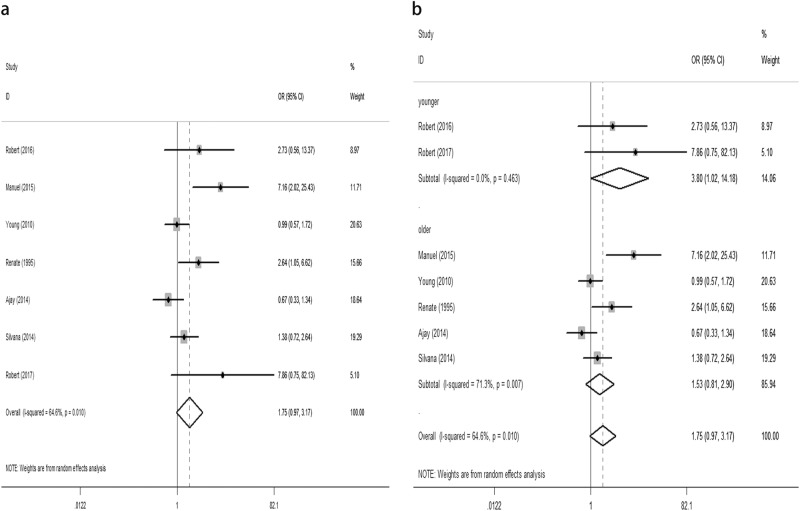
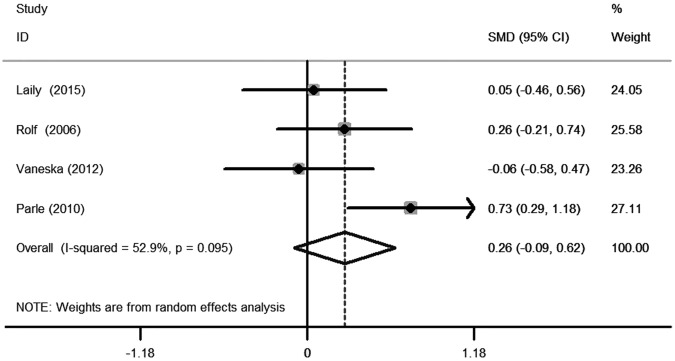
The objective of this study was to evaluate the relationship between subclinical hypothyroidism (SCH) and depression. We also analysed the effect of levothyroxine (L-T4) on depression in SCH patients. We found an insignificant difference for the composite endpoint: standard mean difference (SMD) of 0.23 (95% confidence interval (CI) -0.03, 0.48, P = 0.08, I2 = 73.6%). The odds ratio (OR) for depressive patients was 1.75 (95% CI 0.97, 3.17 P = 0.064, I2 = 64.6%). Furthermore, sub-group analysis according to age found that SCH was related to depression in younger patients (<60 years old), as defined by the diagnosis of depression: OR of 3.8 (95% CI 1.02, 14.18, P = 0.047, I2 = 0.0%) or an increase on the depressive scale: SMD of 0.42 (95% CI 0.03, 0.82, P = 0.036, I2 = 66.6%). Meanwhile, SCH did not associate with depression in older patients (≥60 years old), as defined by the diagnosis of depression: OR of 1.53 (95% CI 0.81, 2.90, P = 0.193, I2 = 71.3%) or an increase on the depressive scale: SMD of 0.03 (95%CI -0.31, 0.37, P = 0.857, I2 = 79.8%). We also found an insignificant difference in the composite endpoint between the L-T4 supplementation group and placebo group in SCH patients. The estimated SMD was 0.26 (95% CI -0.09, 0.62, P = 0.143, I2 = 52.9%). This meta-analysis demonstrates that SCH is not connected to depression. However, sub-group analysis according to age found that SCH is related to depression in younger patients, but not in older patients. Furthermore, we failed to find an effect of L-T4 supplementation treatment for SCH on depression.


Conflict of interest statement

The authors declare that they have no conflict of interest.

Figures
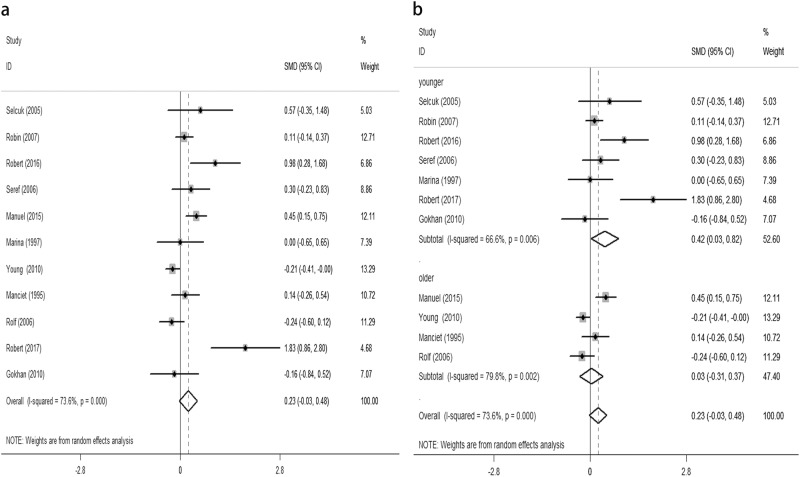
Fig. 1
Fig. 1
a Forest plots showing standard mean differences (SMD, 95% CI) for the increase of depressive score in SCH patients comparing to the normal individuals in a random effects model. X-axis: possitive values equal to the aggravation on depressive tendency. b Subgroup analyses of depressive scale based on age in a random effects model. X-axis: possitive values equal to the aggravation on depressive tendency. SMD: standard mean differences. Younger: participants with the mean age <60 years old. Older: participants with the mean or minimum age ≥60 years old
Fig. 2
Fig. 2
a Forest plots of studies comparing the number of depression patients between SCH and euthyroid individuals. The rhombus represents the OR and 95% CI obtained for the combined calculation. b Subgroup analyses of depression based on age in a random effects model. The rhombus represents the OR and 95% CI obtained for the combined calculation. Younger: participants with the mean age <60 years old. Older: participants with the mean or minimum age ≥60 years old
Fig. 3
Fig. 3
Forest plots showing standard mean differences (SMD, 95% CI) for improvement in depressive scale comparing L-T4 treatment to the placebo group in a random effects model. X-axis: positive values equal to the aggravation on depressive tendency

References

    1. Rack SK, Makela EH. Hypothyroidism and depression: a therapeutic challenge. Ann. Pharmacother. 2000;34:1142–1145. doi: 10.1345/aph.10022. - DOI - PubMed
    1. Whybrow PC, Prange AJ, Jr, Treadway CR. Mental changes accompanying thyroid gland dysfunction. A reappraisal using objective psychological measurement. Arch. General Psychiatry. 1969;20:48–63. doi: 10.1001/archpsyc.1969.01740130050004. - DOI - PubMed
    1. Shan Z, et al. Iodine status and prevalence of thyroid disorders after introduction of mandatory universal salt iodization for 16 years in China: a cross-sectional study in 10 cities. Thyroid. 2016;26:1125–1130. doi: 10.1089/thy.2015.0613. - DOI - PubMed
    1. Sawin CT, Castelli WP, Hershman JM, McNamara P, Bacharach P. The aging thyroid. Thyroid deficiency in the Framingham Study. Arch. Intern. Med. 1985;145:1386–1388. doi: 10.1001/archinte.1985.00360080056006. - DOI - PubMed
    1. Canaris GJ, Manowitz NR, Mayor G, Ridgway EC. The Colorado thyroid disease prevalence study. Arch. Intern. Med. 2000;160:526–534. doi: 10.1001/archinte.160.4.526. - DOI - PubMed

Publication types