. 2018 Oct 30;8(1):16050.
doi: 10.1038/s41598-018-34439-y.

The extreme hyper-reactivity of Cys94 in lysozyme avoids its amorphous aggregation

Affiliations

The extreme hyper-reactivity of Cys94 in lysozyme avoids its amorphous aggregation

Alessio Bocedi et al. Sci Rep. .

Abstract

Many proteins provided with disulfide bridges in the native state undergo amorphous irreversible aggregation when these bonds are not formed. Here we show that egg lysozyme displays a clever strategy to prevent this deleterious aggregation during the nascent phase when disulfides are still absent. In fact, when the reduced protein assembles into a molten globule state, its cysteines acquire strong hyper-reactivity towards natural disulfides. The most reactive residue, Cys94, reacts with oxidized glutathione (GSSG) 3000 times faster than an unperturbed protein cysteine. A low pKa of its sulfhydryl group (6.6/7.1) and a productive complex with GSSG (KD = 0.3 mM), causes a fast glutathionylation of this residue (t1/2 = 3 s) and a complete inhibition of the protein aggregation. Other six cysteines display 70 times higher reactivity toward GSSG. The discovery of extreme hyper-reactivity in cysteines only devoted to structural roles opens new research fields for Alzheimer's and Parkinson diseases.


Conflict of interest statement

The authors declare no competing interests.

Figures
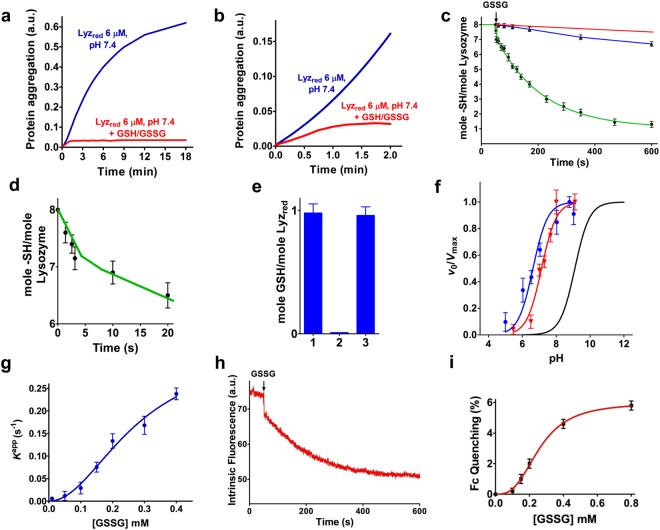
Figure 1
Figure 1
The effect of GSH/GSSG on Lyzred aggregation, pKa of Lyzred cysteines and evidence for a transient Lyzred-GSSG complex. (a) Blue line: Lyzred (6 µM) incubated in 0.2 M urea (37 °C). Red line: Same Lyzred solution after immediate addition of GSH/GSSG (2 mM/0.4 mM). (b) Expanded kinetics of the experiment shown in (a). (c) Green line: Disappearance of Lyzred sulfhydryl groups after addition of 0.4 mM GSSG to a 1.25 µM Lyzred solution (10 µM –SH groups) at pH 7.4 and 0.2 M urea (25 °C). Blue line: Disappearance of the sulfhydryl groups of free cysteine (10 µM) incubated with 0.4 mM GSSG as in the experiment with Lyzred (pH 7.4, 25 °C). Red line: Theoretical sulfhydryl groups disappearance of an unperturbed protein cysteine (10 µM) during the reaction with 0.4 mM GSSG. (d) Expanded kinetics of the experiment shown in c. (e) Reduced GSH produced after 10 s incubation of Lyzred with 0.4 mM GSSG at pH 7.4. Titration of GSH using NBD-Cl and glutathione transferase P1-1 (GSTP1-1) (see Methods) (column 1). Same experiment in the absence of GSTP1-1 (column 2). Same experiment in which the produced GSH was titrated with DTNB after filtration of the mixture on Amicon Ultra 10 kDa cut-off filter to remove the protein (column 3). (f) Average pKa of the seven reactive cysteines in Lyzred as calculated using DTNB (pKa = 6.6) (blue line); average pKa of the four reactive cysteines using NBD-Cl (pKa = 7.1) (red line). Black line is the theoretical curve for unperturbed cysteine (pKa = 9.1). v0/Vmax are the initial velocities normalized to those at full deprotonation (see Methods). (g) Apparent first order kinetic constants for the reaction of the most hyper-reactive cysteine with variable GSSG concentrations at pH 7.4 and 25 °C. (h) Quenching of the intrinsic fluorescence at 340 nm (λex = 295 nm) of Lyzred (1.25 µM, pH 7.4) after addition of GSSG 0.4 mM (25 °C). See (c) for comparison. The very fast fluorescence perturbation after the addition of GSSG occurs within one second. (i) The dependence of the fast fluorescence perturbation (occurring within 1 s) on the GSSG concentration. The error bars represent the S.D. from three independent experiments.
Figure 2
Figure 2
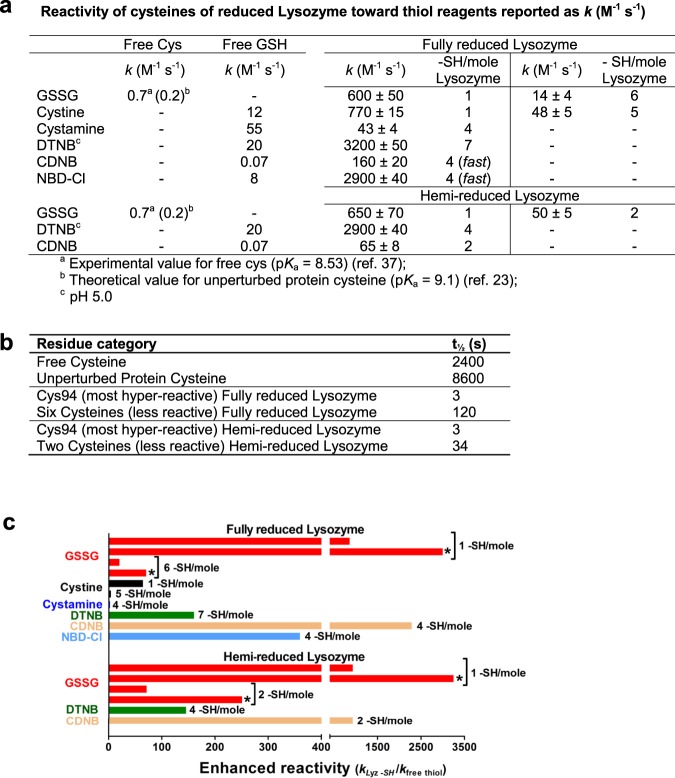
Reactivity of Lyzred toward different disulfides and thiol reagents. (a) Second order kinetic constants k (M−1 s−1) for the reaction of the cysteines of Lyzred and hemi-reduced Lyz, free Cys and free GSH with natural disulfides and other thiol reagents calculated at pH 7.4 and 25 °C (DTNB at pH 5.0). Errors are reported as S.D. from five independent experiments. (b) t1/2 for the reaction of cysteines of Lyzred and hemi-reduced Lyz with GSSG at pH 7.4 and 25 °C. (c) Second order kinetic constants of Lyzred and hemi-reduced Lyz toward GSSG normalized to the corresponding constants found for free Cys (0.7 M−1 s−1) or () calculated for unperturbed protein Cys (0.2 M−1 s−1) (see Methods section). All other bars represent the second order kinetic constants of Lyzred and hemi-reduced Lyz in its reactions with other disulfides or thiol reagents normalized to the corresponding constants calculated for GSH. Note that electrostatic factors may have a critical role in determining the different kinetic constants for the reaction of free GSH (negatively charged) with cystine (neutral) and cystamine (positively charged).
Figure 3
Figure 3
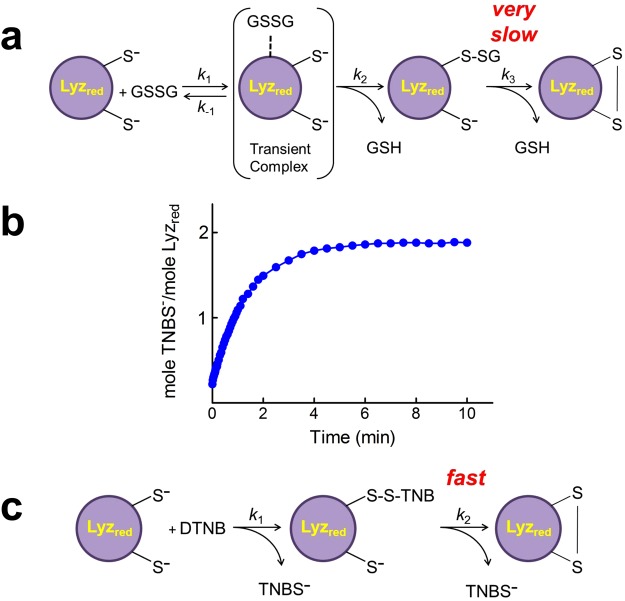
Reaction of Lyzred with stoichiometric amounts of GSSG or DTNB. (a) Representative reaction scheme of Lyzred with stoichiometric GSSG. Note that only the deprotonated sulphydryl groups are the reactive species. (b) Time course of release of TNBS when 1.25 µM DTNB reacts with 1.25 µM Lyzred at pH 5.0. (c) Representative reaction scheme of Lyzred with stoichiometric DTNB.
Figure 4
Figure 4
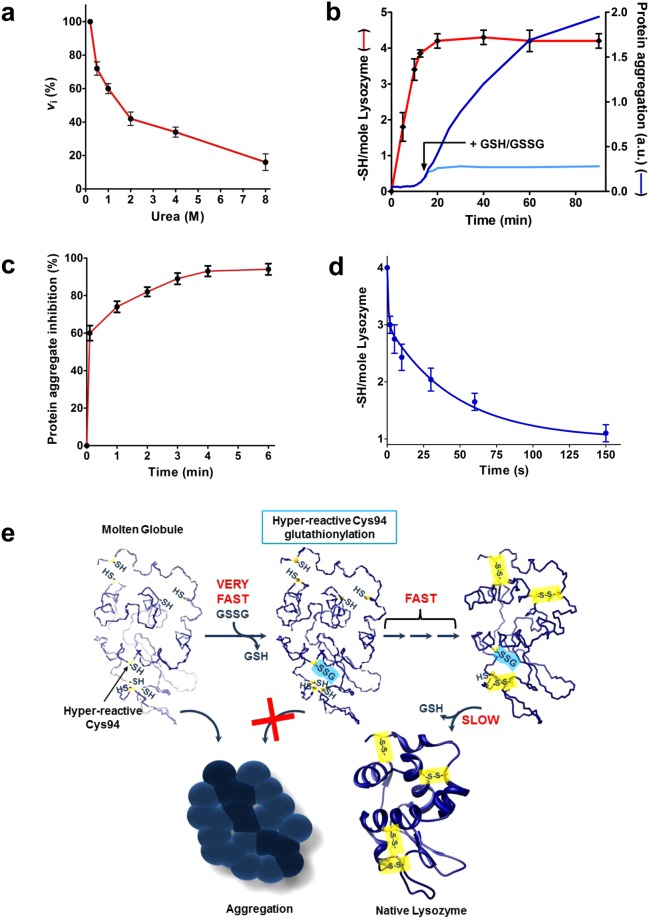
The effect of urea on the hyper-reactivity of cysteines in Lyzred and the inhibition of the aggregation of the hemi-reduced lysozyme by GSH/GSSG. (a) Inhibition of the hyper-reactivity of cysteines in Lyzred toward DTNB by variable urea concentrations (1.25 µM Lyzred was reacted with 20 mM DTNB at pH 5.0). (b) Red line: Hemi-reduction of native Lyz (6 µM) incubated with 60 µM DTT in 0.01 M borate buffer pH 8.5 without urea. No aggregation occurs during the reduction at this pH. Blue line: Aggregation of the hemi-reduced Lyz when the pH was lowered to 7.4 with phosphate buffer 0.1 M. Light blue line: Inhibition of aggregation by addition of GSH/GSSG (2 mM/0.4 mM). (c) Expanded kinetics of inhibition of the protein aggregation reported in b after addition of GSH/GSSG (2 mM/0.4 mM). (d) Disappearance of three hyper-reactive sulfhydryls in the hemi-reduced Lyz (1.25 µM) after reaction with 0.4 mM GSSG at pH 7.4. Note that the first sulfhydryl reacts within 7 seconds. Errors are reported as S.D. from three independent experiments in panels (ad). (e) Scheme of the protection mechanism of Lyzred to avoid the protein aggregation. Note that the natural Cys76-Cys94 is the last bridge to be formed,,,.

References

    1. Stefani M, Dobson CM. Protein aggregation and aggregate toxicity: new insights into protein folding, misfolding diseases and biological evolution. J. Mol. Med. 2003;81:678–699. doi: 10.1007/s00109-003-0464-5. - DOI - PubMed
    1. Dobson CM. Protein aggregation and its consequences for human disease. Prot. Pept. Lett. 2006;13:219–227. doi: 10.2174/092986606775338362. - DOI - PubMed
    1. Chiti F, Dobson CM. Protein misfolding, amyloid formation, and human disease: a summary of progress over the last decade. Ann. Rev. Biochem. 2017;86:27–68. doi: 10.1146/annurev-biochem-061516-045115. - DOI - PubMed
    1. Rambaran RN, Serpell LC. Amyloid fibrils: abnormal protein assembly. Prion. 2008;2:112–117. doi: 10.4161/pri.2.3.7488. - DOI - PMC - PubMed
    1. Mossuto MF. Disulfide bonding in neurodegenerative misfolding diseases. Int. J. Cell Biol. 2013;2013:318–319. doi: 10.1155/2013/318319. - DOI - PMC - PubMed

Publication types