


Prefrontal cortex response to drug cues, craving, and current depressive symptoms are associated with treatment outcomes in methadone-maintained patients
- PMID: 30375498
- PMCID: PMC6372589
- DOI: 10.1038/s41386-018-0252-0
Prefrontal cortex response to drug cues, craving, and current depressive symptoms are associated with treatment outcomes in methadone-maintained patients
Abstract
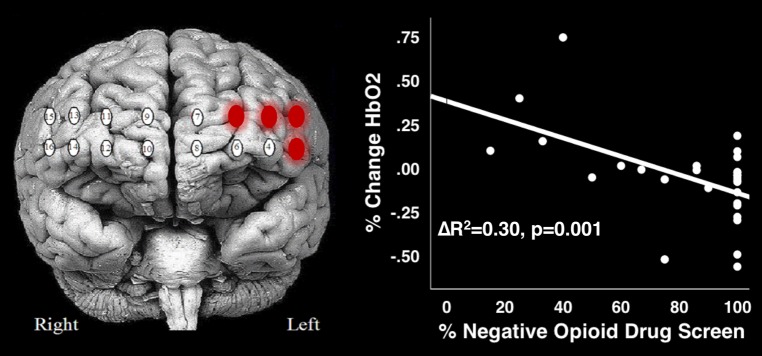
Methadone maintenance is an effective treatment for opioid use disorder, yet many methadone-maintained patients (MMPs) continue to struggle with chronic relapse. The current study evaluated whether functional near-infrared spectroscopy (fNIRS) could identify prefrontal cortex (PFC) markers of ongoing opioid use in MMPs, and whether clinical measures of depression and self-report measures of craving would also be associated with opioid use. MMPs (n = 29) underwent a drug cue reactivity paradigm during fNIRS measurements of PFC reactivity. Self-reported opioid craving (measured by a visual analog scale; 0-100) was collected before and after drug cue reactivity, and depressive symptoms were assessed via the 17-item Hamilton Depression Rating Scale (HAM-D). Hierarchical regression and partial correlations were used to evaluate associations between weekly urine drug screens over a 90-day follow-up period and fNIRS, craving, and HAM-D assessments. Neural response to drug cues in the left lateral PFC, controlling for age, sex, and days in treatment was significantly associated with percent opioid-negative urine screens during follow-up (∆F1, 24 = 13.19, p = 0.001, ∆R2 = 0.30), and correctly classified 86% of MMPs as either using opioids, or abstaining from opioids (χ2(4) = 16.28, p = 0.003). Baseline craving (p < 0.001) and HAM-D assessment (p < 0.01) were also associated with percent opioid-negative urine screens. Combining fNIRS results, baseline craving scores, and HAM-D scores created a robust predictive model (∆F3, 22 = 16.75, p < 0.001, ∆R2 = 0.59). These data provide preliminary evidence that the fNIRS technology may have value as an objective measure of treatment outcomes within outpatient methadone clinics. Depressive symptoms and drug craving were also correlated with opioid use in MMPs.
Conflict of interest statement
The authors declare that the research was conducted in the absence of any commercial or financial relationships that could be construed as a potential conflict of interest. The remaining authors declare no competing interests.
Figures
References
-
- Ball JC, Ross A. The effectiveness of methadone maintenance treatment: patients, programs, services, and outcome. Springer Science & Business Media; New York, NY 2012.
-
- Griffiths M. A ‘components’ model of addiction within a biopsychosocial framework. J Subst Use. 2005;10:191–7. doi: 10.1080/14659890500114359. - DOI
Publication types
MeSH terms
Substances
Grants and funding
- R21 DA035327/DA/NIDA NIH HHS/United States
- R01 DA040644/DA/NIDA NIH HHS/United States
- T32DA07209/U.S. Department of Health & Human Services | NIH | National Institute on Drug Abuse (NIDA)/International
- R21DA035327/U.S. Department of Health & Human Services | NIH | National Institute on Drug Abuse (NIDA)/International
- R01 DA035246/DA/NIDA NIH HHS/United States
LinkOut - more resources
Full Text Sources
Medical
Miscellaneous
