Incidence of Sport-Related Internal Organ Injuries Due to Direct-Contact Mechanisms Among High School and Collegiate Athletes Across 3 National Surveillance Systems
- PMID: 30376372
- PMCID: PMC6464299
- DOI: 10.4085/1062-6050-271-17
Incidence of Sport-Related Internal Organ Injuries Due to Direct-Contact Mechanisms Among High School and Collegiate Athletes Across 3 National Surveillance Systems
Abstract
Context: Although sport-related internal organ injuries among athletes are relatively infrequent, combining data sources enables a more comprehensive examination of their incidence.
Objective: To describe the incidence and characteristics of sport-related internal organ injuries due to direct-contact mechanisms among high school (HS) and collegiate athletes from 2005-2006 through 2014-2015.
Design: Descriptive epidemiology study.
Setting: United States HS and collegiate sports data from 3 national sports injury-surveillance systems: High School Reporting Information Online (HS RIO), the National Collegiate Athletic Association Injury Surveillance Program (ISP), and the National Center for Catastrophic Sport Injury Research.
Patients or other participants: High school and collegiate athletes in organized sports.
Main outcome measure(s): Characteristics of the athlete, event, and injury were examined and stratified by data source and sport. Descriptive statistics of internal organ injuries via direct-contact mechanisms consisted of frequencies and incidence rates (IRs) per 1 000 000 athlete-exposures and 95% confidence intervals (CIs).
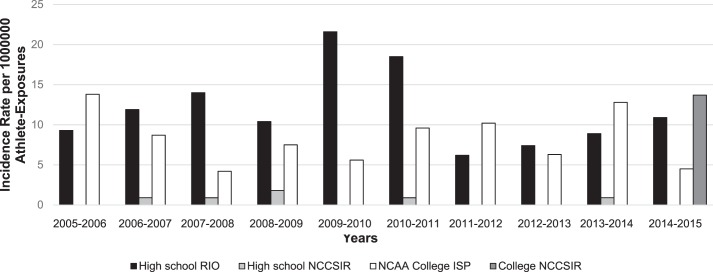
Results: During the 10-year period, 174 internal organ injuries were captured: 124 in HS RIO and 41 in the ISP; 9 were catastrophic. Most noncatastrophic injuries occurred among males (RIO = 85%, ISP = 89%), in football (RIO = 65%, ISP = 58%), and during competitions (RIO = 67%, ISP = 49%) and were due to player-player contact (RIO = 78%, ISP = 68%). The highest injury rates were in male contact sports: RIO football (IR = 11.7; 95% CI = 9.1, 14.2) and lacrosse (IR = 10.0; 95% CI = 3.1, 16.9); ISP: football (IR = 8.3; 95% CI = 5.0, 11.6) and ice hockey (IR = 7.9; 95% CI = 1.0, 14.7). A quarter of noncatastrophic injuries were season ending (RIO = 25%, ISP = 23%). Of the 9 catastrophic injuries, most occurred in HS (7/9) and football (7/9) and were due to player-player contact (6/9). Four resulted in death.
Conclusions: Direct-contact internal organ injuries occur infrequently; yet when they do occur, they may result in severe outcomes. These findings suggest that early recognition and a better understanding of the activities associated with the event and use or nonuse of protective equipment are needed.
Keywords: catastrophic injuries; epidemiology; injury surveillance.
Figures
References
-
- Thacker SB, Berkelman RL. Public health surveillance in the United States. Epidemiol Rev. 1988;10:164–190. - PubMed
-
- van Mechelen W, Hlobil H, Kemper HC. Incidence, severity, aetiology and prevention of sports injuries: a review of concepts. Sports Med. 1992;14(2):82–99. - PubMed
-
- Langley J, Cryer C. A consideration of severity is sufficient to focus our prevention efforts. Inj Prev. 2012;18(2):73–74. - PubMed
MeSH terms
Grants and funding
LinkOut - more resources
Full Text Sources
Medical