Fearful Attachment Linked to Childhood Abuse, Alexithymia, and Depression in Motor Functional Neurological Disorders
- PMID: 30376786
- PMCID: PMC6349486
- DOI: 10.1176/appi.neuropsych.18040095
Fearful Attachment Linked to Childhood Abuse, Alexithymia, and Depression in Motor Functional Neurological Disorders
Abstract
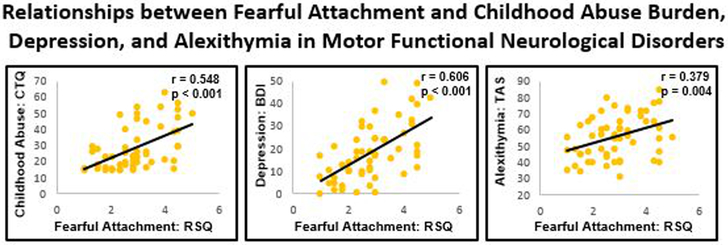
Insecure attachment is a predisposing risk factor for the development of functional neurological disorder (FND). There is limited research investigating connections between attachment styles, other predisposing vulnerabilities, and symptom severity in patients with motor FND. By using a within-group design with prospective data collection, the authors performed univariate tests followed by multivariate linear regressions to investigate neuropsychiatric factors associated with four attachment styles (secure, fearful, preoccupied, and dismissing) among 56 patients with motor FND (mean age=40.2 years [SD=13.0]; women, N=41; men, N=15). In univariate analyses, fearful attachment style was associated with self-reported adverse life event burden, alexithymia, dissociation, depression, anxiety, impaired stress coping skills, functional neurologic symptom severity, and marital status. In a multivariate stepwise linear regression analysis, childhood abuse, alexithymia, depression, and not being married independently predicted fearful attachment. In a post hoc analysis, childhood sexual and emotional abuse were each independently associated with fearful attachment tendencies. There were no independent predictors of secure, preoccupied, or dismissing attachment styles in this study population. Future studies with larger cohorts are needed to investigate nuanced relationships among predisposing vulnerabilities for the development of FND, as well as potential links between risk factors, functional neurologic symptom severity, and clinical outcomes.
Keywords: Functional Neurological Disorder Conversion Disorder Attachment Style Psychogenic Nonepileptic Seizures Functional Movement Disorder.
Conflict of interest statement
Conflicts of Interest/Disclosures:
None
Figures
References
-
- Bowlby J: Developmental psychiatry comes of age. Am J Psychiatry 1988; 145:1–10 - PubMed
-
- Edwards MJ, Bhatia KP: Functional (psychogenic) movement disorders: merging mind and brain. The Lancet Neurology 2012; 11:250–260 - PubMed
-
- Reuber M, Howlett S, Khan A, et al.: Non-epileptic seizures and other functional neurological symptoms: predisposing, precipitating, and perpetuating factors. Psychosomatics 2007; 48:230–238 - PubMed
-
- Ainsworth MDS, Blehar MC, Waters E, et al.: Patterns of attachment: A psychological study of the strange situation, Psychology Press, 2015
-
- Griffin DW, Bartholomew K: The metaphysics of measurement: The case of adult attachment. 1994;
MeSH terms
Grants and funding
LinkOut - more resources
Full Text Sources
Medical