


Autosomal dominant tubulointerstitial kidney disease-UMOD is the most frequent non polycystic genetic kidney disease
- PMID: 30376835
- PMCID: PMC6208030
- DOI: 10.1186/s12882-018-1107-y
Autosomal dominant tubulointerstitial kidney disease-UMOD is the most frequent non polycystic genetic kidney disease
Abstract
Background: Autosomal dominant tubulointerstitial kidney disease (ADTKD) caused by mutations in the UMOD gene (ADTKD-UMOD) is considered rare and often remains unrecognised. We aimed to establish the prevalence of genetic kidney diseases, ADTKD and ADTKD-UMOD in adult chronic kidney disease (CKD) patients, and to investigate characteristic features.
Methods: We sent questionnaires on family history to all patients with CKD stages 3-5 in our tertiary renal centre to identify patients with inherited renal disease. Details on clinical and family history were obtained from patient interviews and clinical records. Sanger sequencing of the UMOD gene was performed from blood or saliva samples.
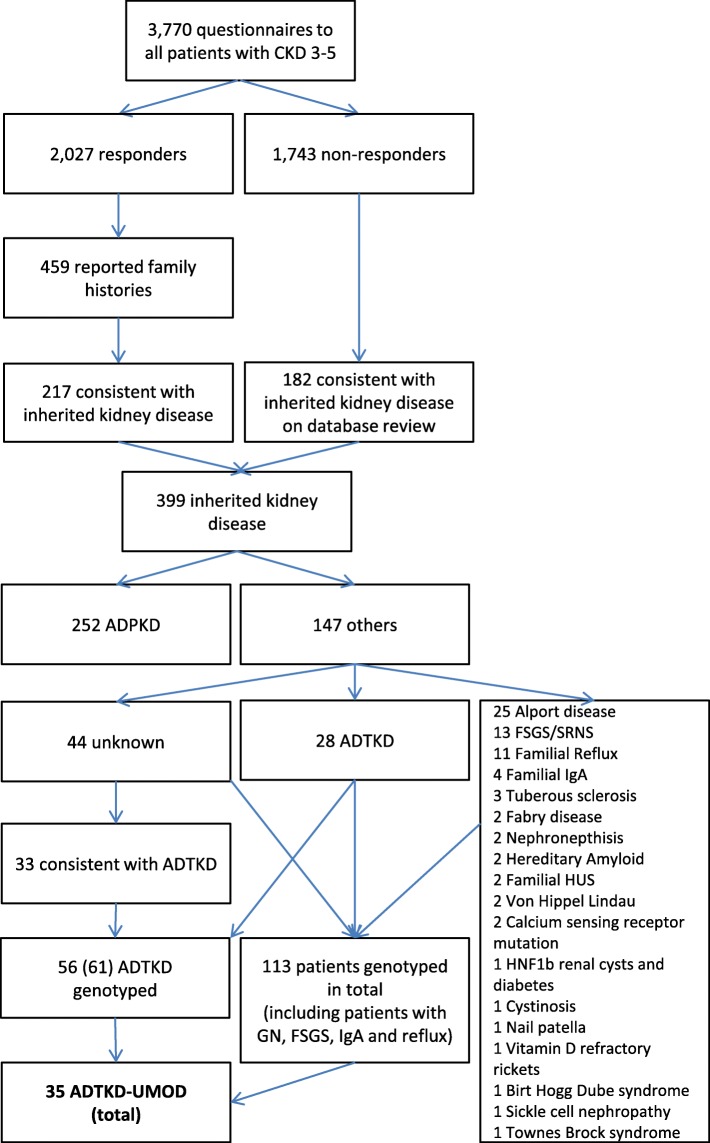
Results: 2027 of 3770 sent questionnaires were returned. 459 patients reported a family history, which was consistent with inherited kidney disease in 217 patients. 182 non-responders with inherited kidney diseases were identified through a database search. Of these 399 individuals, 252 had autosomal dominant polycystic kidney disease (ADPKD), 28 had ADTKD, 25 had Alports, and 44 were unknown, resulting in 11% of CKD 3-5 patients and 19% of end-stage renal disease patients with genetic kidney diseases. Of the unknown, 40 were genotyped, of whom 31 had findings consistent with ADTKD. 30% of unknowns and 39% of unknowns with ADTKD had UMOD mutations. Altogether, 35 individuals from 18 families were found to have ten distinct UMOD mutations (three novel), making up 1% of patients with CKD 3-5, 2% of patients with end-stage renal disease, 9% of inherited kidney diseases and 56% with ADTKD. ADTKD-UMOD was the most common genetic kidney disease after ADPKD with a population prevalence of 9 per million. Less proteinuria and haematuria, but not hyperuricaemia or gout were predictive of ADTKD-UMOD. The main limitations of the study are the single-centre design and a predominantly Caucasian population.
Conclusions: The prevalence of genetic kidney diseases and ADTKD-UMOD is significantly higher than previously described. Clinical features poorly predicted ADTKD-UMOD, highlighting the need for genetic testing guided by family history alone.
Keywords: Autosomal dominant tubulointerstitial kidney disease; Genetic kidney disease; Prevalence; UMOD.
Conflict of interest statement
Ethics approval and consent to participate
All study procedures had full UK Research Ethics Committee and local Research and Development approval (REC references 11/SC/0111 and 06/Q0406/151) and adhered to the Declaration of Helsinki. Patients gave full informed written consent to participate in the study.
Consent for publication
Not applicable.
Competing interests
The authors declare that they have no competing interests.
Publisher’s Note
Springer Nature remains neutral with regard to jurisdictional claims in published maps and institutional affiliations.
References
-
- Dahan K, Devuyst O, Smaers M, Vertommen D, Loute G, Poux JM, Viron B, Jacquot C, Gagnadoux MF, Chauveau D, et al. A cluster of mutations in the UMOD gene causes familial juvenile hyperuricemic nephropathy with abnormal expression of uromodulin. J Am Soc Nephrol. 2003;14:2883–2893. doi: 10.1097/01.ASN.0000092147.83480.B5. - DOI - PubMed
-
- Eckardt KU, Alper SL, Antignac C, Bleyer AJ, Chauveau D, Dahan K, Deltas C, Hosking A, Kmoch S, Rampoldi L, et al. Autosomal dominant tubulointerstitial kidney disease: diagnosis, classification, and management--a KDIGO consensus report. Kidney Int. 2015;88:676–683. doi: 10.1038/ki.2015.28. - DOI - PubMed
-
- Kirby A, Gnirke A, Jaffe DB, Baresova V, Pochet N, Blumenstiel B, Ye C, Aird D, Stevens C, Robinson JT, et al. Mutations causing medullary cystic kidney disease type 1 lie in a large VNTR in MUC1 missed by massively parallel sequencing. Nat Genet. 2013;45:299–303. doi: 10.1038/ng.2543. - DOI - PMC - PubMed
-
- Bingham C, Ellard S, van't Hoff WG, Simmonds HA, Marinaki AM, Badman MK, Winocour PH, Stride A, Lockwood CR, Nicholls AJ, et al. Atypical familial juvenile hyperuricemic nephropathy associated with a hepatocyte nuclear factor-1beta gene mutation. Kidney Int. 2003;63:1645–1651. doi: 10.1046/j.1523-1755.2003.00903.x. - DOI - PubMed
-
- Zivná M, Hůlková H, Matignon M, Hodanová K, Vylet'al P, Kalbácová M, Baresová V, Sikora J, Blazková H, Zivný J, et al. Dominant renin gene mutations associated with early-onset hyperuricemia, anemia, and chronic kidney failure. Am J Hum Genet. 2009;85:204–213. doi: 10.1016/j.ajhg.2009.07.010. - DOI - PMC - PubMed
Publication types
MeSH terms
Substances
Grants and funding
LinkOut - more resources
Full Text Sources
Medical
Miscellaneous
