


Updating the markers for oocyte quality evaluation: intracellular temperature as a new index
- PMID: 30377396
- PMCID: PMC6194278
- DOI: 10.1002/rmb2.12245
Updating the markers for oocyte quality evaluation: intracellular temperature as a new index
Abstract
Background: The developmental competence of an embryo is principally dictated by the oocyte. Usually, oocyte selection is based on morphological properties; however, all morphological criteria that are currently used for the grading and screening of oocytes are not able to eliminate the subjectivity. Despite recent studies of the molecular factors related to oocyte quality, it is technically difficult to develop an index based on these factors, and new indices that reflect intracellular conditions are necessary.
Methods: Morphological and molecular factors influencing developmental competence were comprehensively reviewed, and intracellular temperature was evaluated as a new marker of oocyte quality.
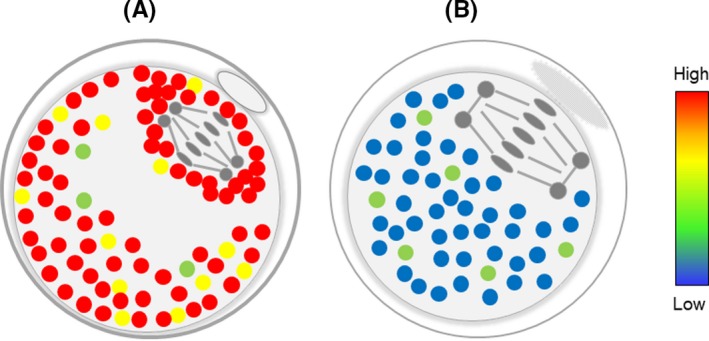
Main findings: The intracellular temperature of mature oocytes was high in fresh oocytes and decreased with time after polar body release. Under the same conditions, the intracellular temperature and its distribution differed among oocytes, suggesting that temperature represents the state of each oocyte.
Conclusion: Intracellular temperature is advantageous as an objective and quantitative indicator of oocyte quality. Further studies should evaluate the link between temperature and cellular phenomena to establish its use as an indicator of quality.
Keywords: assisted reproductive techniques; meiosis; oocyte; temperature.
Figures
References
-
- Mtango NR, Potireddy S, Latham KE. Oocyte quality and maternal control of development. Int Rev Cell Mol Biol. 2008;268:223‐290. - PubMed
-
- Edwards RG. Maturation in vitro of human ovarian oocytes. Lancet. 1965;2(7419):926‐929. - PubMed
-
- McGee EA, Hsueh AJ. Initial and cyclic recruitment of ovarian follicles. Endocr Rev. 2000;21(2):200‐214. - PubMed
-
- Miao YL, Kikuchi K, Sun QY, Schatten H. Oocyte aging: cellular and molecular changes, developmental potential and reversal possibility. Hum Reprod Update. 2009;15(5):573‐585. - PubMed
-
- Eppig JJ, Schultz RM, O'Brien M, Chesnel F. Relationship between the developmental programs controlling nuclear and cytoplasmic maturation of mouse oocytes. Dev Biol. 1994;164(1):1‐9. - PubMed
Publication types
LinkOut - more resources
Full Text Sources