


Effects of yoga on oxidative stress, motor function, and non-motor symptoms in Parkinson's disease: a pilot randomized controlled trial
- PMID: 30377537
- PMCID: PMC6198358
- DOI: 10.1186/s40814-018-0355-8
Effects of yoga on oxidative stress, motor function, and non-motor symptoms in Parkinson's disease: a pilot randomized controlled trial
Abstract
Objective: To examine the feasibility, acceptability, and preliminary effects of Hatha yoga on oxidative stress, motor function, and non-motor symptoms among individuals with Parkinson's disease (PD).
Methods: The study has a pilot randomized controlled trial design with two arms: an immediate treatment group and a wait-list control group. The yoga-for-PD program was implemented via twice weekly 60-min group-based classes for 12 weeks. Participants were assessed at baseline, 12 weeks, and 6 months post-intervention. Outcome measures included oxidative stress, motor function, physical activity, cognitive function, sleep quality, and quality of life. Data on program acceptability and yoga adherence were collected during the intervention and at 6 months post-intervention.
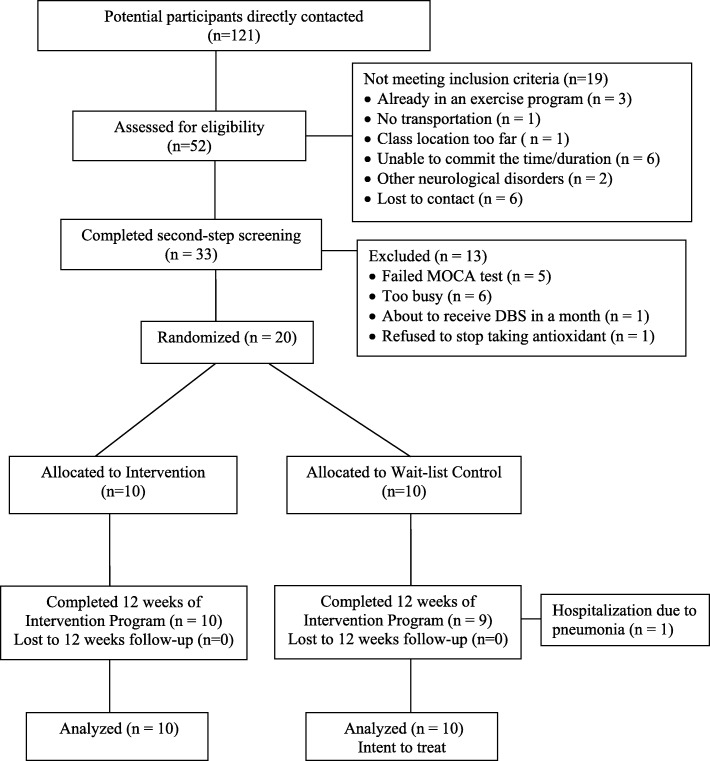
Results: Participants (n = 20) had a mean age of 63 years (SD 8, range 49-75) and disease duration 4.8 years (SD 2.9, range 1-13). All participants had mild-moderate disease severity; 18 (90%) were on dopaminergic medications. Seventeen participants (85%) attended at least 75% of the classes and 4 (20%) attended all classes. Most participants (n = 17) reported they "definitely enjoyed" the intervention program. No adverse events were reported. At 12 weeks, there were no major differences in blood oxidative stress markers between the two groups. Motor function based on the Unified Parkinson's Disease Rating Scale was better in the treatment group, but their scores on sleep and outlook in Parkinson's Disease Quality of Life (PDQUALIF) Scale and the physical activity levels based on the Longitudinal Aging Study Amsterdam Physical Activity Questionnaire were worse than those of the control group. In within-group comparisons, motor function, cognitive function, and catalase improved but three PDQUALIF domains (social and role function, sleep, and outlook) and physical activity level worsened by the end of the yoga intervention program compared to baseline. The response rate for the 6-month follow-up survey was 74% (n = 14) with six participants (43%) who signed up for a yoga class and four (29%) who practiced it independently. Health problems were the main barrier to yoga practice.
Conclusion: Yoga is feasible and acceptable and may serve as a complementary method for improving motor function in PD. Further research using a larger sample size is needed to determine its impact on oxidative stress and non-motor symptoms.
Trial registration: ClinicalTrials.gov Registration Number: NCT02509610031.
Keywords: Motor function; Non-motor symptoms; Oxidative stress; Parkinson’s disease; Yoga.
Conflict of interest statement
The study was approved by University of Minnesota Institutional Review Board (IRB study number 1506M74261). Informed written consent was obtained just prior to the initial assessment.Not applicable.The authors declare that they have no competing interests.Springer Nature remains neutral with regard to jurisdictional claims in published maps and institutional affiliations.
Figures
References
-
- Parkinson’s Disease Foundation. Understanding Parkinsons’s. New York; 2016. https://www.parkinson.org/sites/default/files/attachments/pdf-qa.pdf. Accessed 25 Jan 2018.
-
- Surmeier D. James, Guzman Jaime N., Sanchez-Padilla Javier, Goldberg Joshua A. Progress in Brain Research. 2010. What causes the death of dopaminergic neurons in Parkinson’s disease? pp. 59–77. - PubMed
Grants and funding
LinkOut - more resources
Full Text Sources
