


Engaging knowledge users in development of the CONSORT-Equity 2017 reporting guideline: a qualitative study using in-depth interviews
- PMID: 30377540
- PMCID: PMC6196421
- DOI: 10.1186/s40900-018-0118-y
Engaging knowledge users in development of the CONSORT-Equity 2017 reporting guideline: a qualitative study using in-depth interviews
Abstract
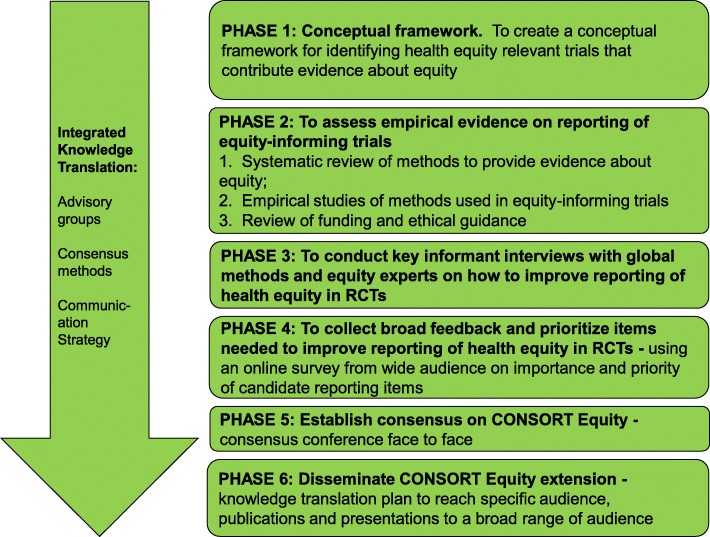
Background: Randomized controlled trials ("randomized trials") can provide evidence to assess the equity impact of an intervention. Decision makers need to know about equity impacts of healthcare interventions so that people get healthcare that is best for them. To better understand the equity impacts of healthcare interventions, a range of people who were potentially the ultimate users of research results were involved in a six-phase project to extend the CONsolidated Standards Of Reporting Trials Statement for health equity ("CONSORT-Equity 2017"). We identified these "knowledge users" as: patients and healthcare researchers, decision makers and providers. This paper reports on one project phase: specifically, a qualitative study designed to integrate the expertise of knowledge users. The experiences and perspectives of knowledge users provided many insights about the reporting of health equity issues in randomized trials. This paper describes key informant interviews with knowledge users that contribute to a better understanding of the effects of an intervention on health equity. Additionally, the paper shows how these insights were used to develop CONSORT-Equity 2017.
Methods: A qualitative study that used the framework analysis method was conducted in collaboration with an international study executive and advisory board team. In-depth semi-structured interviews were conducted with a purposive sample of key informants who: consider the research ethics of, fund, conduct, participate in, publish, or use research evidence generated in randomized trials. Transcripts were coded and analyzed using the seven-stage framework analysis method, and data reported to reflect knowledge user suggestions to develop CONSORT-Equity 2017.
Results: Thirteen key informants, of which three were patients, chose to participate in interviews. Seven themes emerged: "Differentiate the type of trial", "Prompts for health equity", "Ethics matter", "Describe unique research strategies", "Clarity of reporting", "Implications of equity for sampling and analysis", "Think beyond the immediate trial". The interviews provided direction for the extension of 16 CONSORT-Equity 2017 items.
Conclusions: Key informant interviews were used to identify new concepts that were not generated in our other studies and to develop CONSORT-Equity 2017. We encourage the use of key informant interviews in guideline development to obtain and include the real-life expertise of knowledge users.
Keywords: CONSORT; Global health; Guidelines; Health equity; Integrated knowledge translation; Interviews; Patient-involvement; Public-involvement; Randomized trials.
Conflict of interest statement
Not applicableThe authors declare that they have no competing interests.Springer Nature remains neutral with regard to jurisdictional claims in published maps and institutional affiliations.
References
-
- World Health Organization . 63rd World Health Assembly. Geneva: WHO Strategy on Research for Health; WHO Roles and responsibilities on health research: document WHA63.22 and Resolution; 2010.
-
- World Health Organization . Changing Mindsets - Strategy on Health Policy and Systems Research. ISBN 9789241504409. 2012.
-
- Pan American Health Organization . 49th Directing Council, 61st Session of the Regional Committee of WHO for the Americas. Policy on research for health: document CD49/10. Washington, DC: PAHO; 2009.
LinkOut - more resources
Full Text Sources
