Importance of Individual Elements for Perineal Protection in Childbirth: An Interventional, Prospective Trial
- PMID: 30377553
- PMCID: PMC6205860
- DOI: 10.1055/s-0038-1675352
Importance of Individual Elements for Perineal Protection in Childbirth: An Interventional, Prospective Trial
Abstract
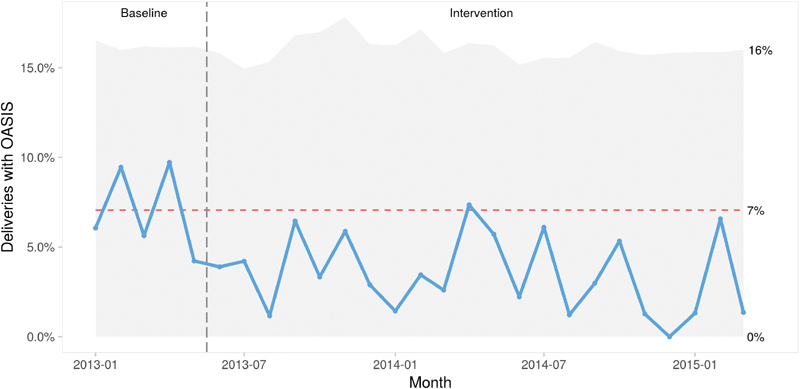
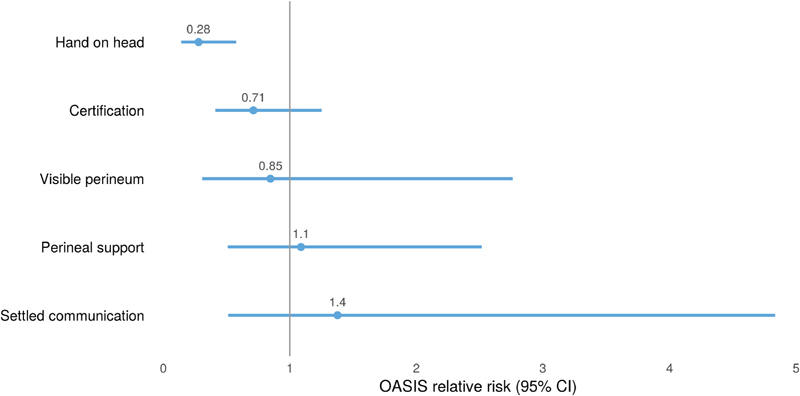
Objective To analyze the association between each element of a hands-on intervention in childbirth and the incidence of obstetric anal sphincter injuries (OASIS). Study Design We conducted a prospective, interventional quality improvement project and implemented a care bundle with five elements at an obstetric department in Denmark with 3,000 deliveries annually. We aimed at reducing the incidence of OASIS. In the preintervention period, 355 vaginally delivering nulliparous women were included. Similarly, 1,622 nulliparous women were included in the intervention period. The association of each element with the outcome was estimated using a regression analysis. Results The incidence of OASIS went down from 7.0 to 3.4% among nulliparous women delivering vaginally ( p = 0.003; relative risk = 0.48; 95% confidence interval [CI]: 0.30-0.76). Number needed to treat was 28. Logistic regression analysis showed that using hand on the head of the child significantly reduced the risk of OASIS (odds ratio = 0.28; 95% CI: 0.14-0.58). Conclusion Using a quality improvement framework, we documented the individual elements of the intervention. Hand on the infant's head reduced the risk of OASIS.
Keywords: hands-on; obstetric anal sphincter injury; quality improvement; vaginal delivery.
Conflict of interest statement
Figures
References
-
- Turner CE, Young JM, Solomon MJ, Ludlow J, Benness C, Phipps H. Vaginal delivery compared with elective caesarean section: the views of pregnant women and clinicians. BJOG. 2008;115(12):1494–1502. - PubMed
-
- Desseauve D, Proust S, Carlier-Guerin C, Rutten C, Pierre F, Fritel X.Evaluation of long-term pelvic floor symptoms after an obstetric anal sphincter injury (OASI) at least one year after delivery: a retrospective cohort study of 159 cases Gynecol Obstet Fertil 201644(7-8):385–390. - PubMed
-
- Halle TK, Salvesen KÅ, Volløyhaug I. Obstetric anal sphincter injury and incontinence 15-23 years after vaginal delivery. Acta Obstet Gynecol Scand. 2016;95(08):941–947. - PubMed
-
- Meister MRL, Cahill AG, Conner SN, Woolfolk CL, Lowder JL. Predicting obstetric anal sphincter injuries in a modern obstetric population. Am J Obstet Gynecol. 2016;215(03):3100–3.1E9. - PubMed
-
- Ramm O, Woo VG, Hung Y-Y, Chen H-C, Ritterman Weintraub ML. Risk factors for the development of obstetric anal sphincter injuries in modern obstetric practice. Obstet Gynecol. 2018;131(02):290–296. - PubMed
Publication types
LinkOut - more resources
Full Text Sources