


Penile length is preserved after implant surgery
- PMID: 30378249
- PMCID: PMC8519487
- DOI: 10.1111/bju.14604
Penile length is preserved after implant surgery
Abstract
Objective: To investigate if there is a correlation between penile size measured preoperatively and erect penis after penile implant surgery (PI). A common cause of patient dissatisfaction after PI is caused by patients complaining that surgery has shortened the penis. It has been suggested that stretched penile length preoperatively is almost the same after surgery when the prosthesis is in erect status. However, no comprehensive data supports this theory. This prospective study was done to investigate this theory.
Patients and methods: Standardised measurements of stretched penile length and girth were performed in theatre before PI implantation then re-measured at the end of the procedure with the penis in the erect position. We recorded type of PI, cylinder lengths and malleable rod diameters. All patients had data recorded on body mass index (BMI), hypertension (HTN), glycated haemoglobin (HbA1c ), and Peyronie's disease (PD).
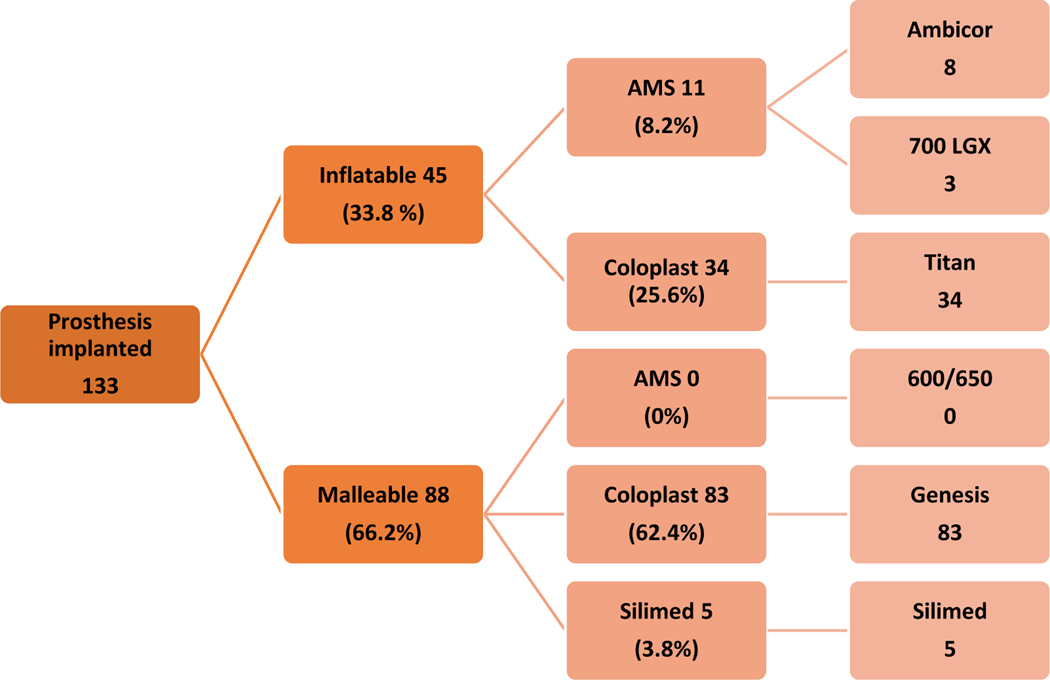
Results: In all, 133 patients were assessed; 88 (66.2%) had a malleable penile prosthesis (MPP) and 45 (33.8%) an inflatable penile prosthesis (IPP). The median age and BMI were 56 years and 30 kg/m2 , respectively. In all, 40 (30.1%) patients had HTN, 37 (27.8%) had PD, and 89 (66.9%) were diabetic. The mean (SD) pre-implant stretched length was 12.8 (1.8) cm. The mean (SD) flaccid girth was 10.3 (1.2) cm. Postoperatively, the mean (SD) erect length and girth were 13.1 (1.7) cm and 11.3 (1.3) cm, respectively. Overall, there was a significant (P < 0.05) increase in both the mean (SD) length at +0.36 (0.63) cm, and girth at +1.04 (1.02) cm. Patients who had an IPP, had a greater increase in both length (mean [SD] 0.62 [0.72] cm) and girth (mean [SD] 1.7 [1.0] cm) compared to those who had a MPP (mean [SD] 0.22 [0.53] cm and 0.7 [0.87] cm, respectively) (P < 0.05). We investigated correlations between pre- and postoperative outcomes related to BMI, HTN, diabetes, and PD. None of these variables affected outcome.
Conclusions: PI surgery does not significantly decrease penile size compared to the preoperative assessment. The outcome was not affected by co-morbidities. The preoperative length and girth correlated well with the immediate postoperative erect penis, although girth was not necessarily comparable in this series of patients measured under anaesthesia. Recording penile dimensions in the clinic and agreeing these with patients' preoperatively may be a way of improving satisfaction levels with this surgery.
Keywords: #Andrology; penile implants; penile size; predictors; satisfaction.
© 2018 The Authors BJU International © 2018 BJU International Published by John Wiley & Sons Ltd.
Conflict of interest statement
Conflict of Interest: None
Figures
References
-
- Schultheiss D, Gabouev AI, Jonas U. Nikolaj A. Bogoraz (1874–1952): pioneer of phalloplasty and penile implant surgery. J Sex Med. 2005;2:139–146. - PubMed
-
- Welliver C, Kottwitz M, Ahmad AE, Wilson SK, Kohler TS. Manufacturers’ data show increasing implanted cylinder sizes and measured corporal lengths in inflatable penile implants. World J Urol. 2016;34:993–998. - PubMed
-
- Holloway FB, Farah RN. Intermediate term assessment of the reliability, function and patient satisfaction with the AMS700 Ultrex penile prosthesis. J Urol. 1997;157:1687–1691. - PubMed
-
- Deveci S, Martin D, Parker M, Mulhall JP. Penile Length Alterations Following Penile Prosthesis Surgery. European Urology. 2007;51:1128–1131. - PubMed
MeSH terms
Grants and funding
LinkOut - more resources
Full Text Sources
Medical
Research Materials
Miscellaneous
