. 2019 Aug;45(5):495-512.
doi: 10.1111/nan.12528. Epub 2019 Mar 11.

Histological heterogeneity in a large clinical cohort of juvenile idiopathic inflammatory myopathy: analysis by myositis autoantibody and pathological features

Collaborators, Affiliations

Histological heterogeneity in a large clinical cohort of juvenile idiopathic inflammatory myopathy: analysis by myositis autoantibody and pathological features

S A Yasin et al. Neuropathol Appl Neurobiol. 2019 Aug.

Abstract

Aim: Juvenile idiopathic inflammatory myopathies have been recently reclassified into clinico-serological subgroups. Myopathological correlates of the subgroups are incompletely understood.

Methods: We studied muscle biopsies from 101 children with clinically and serologically defined juvenile idiopathic inflammatory myopathies from the UK JDM Cohort and Biomarker Study by applying the international JDM score tool, myopathological review and C5b-9 complement analysis.

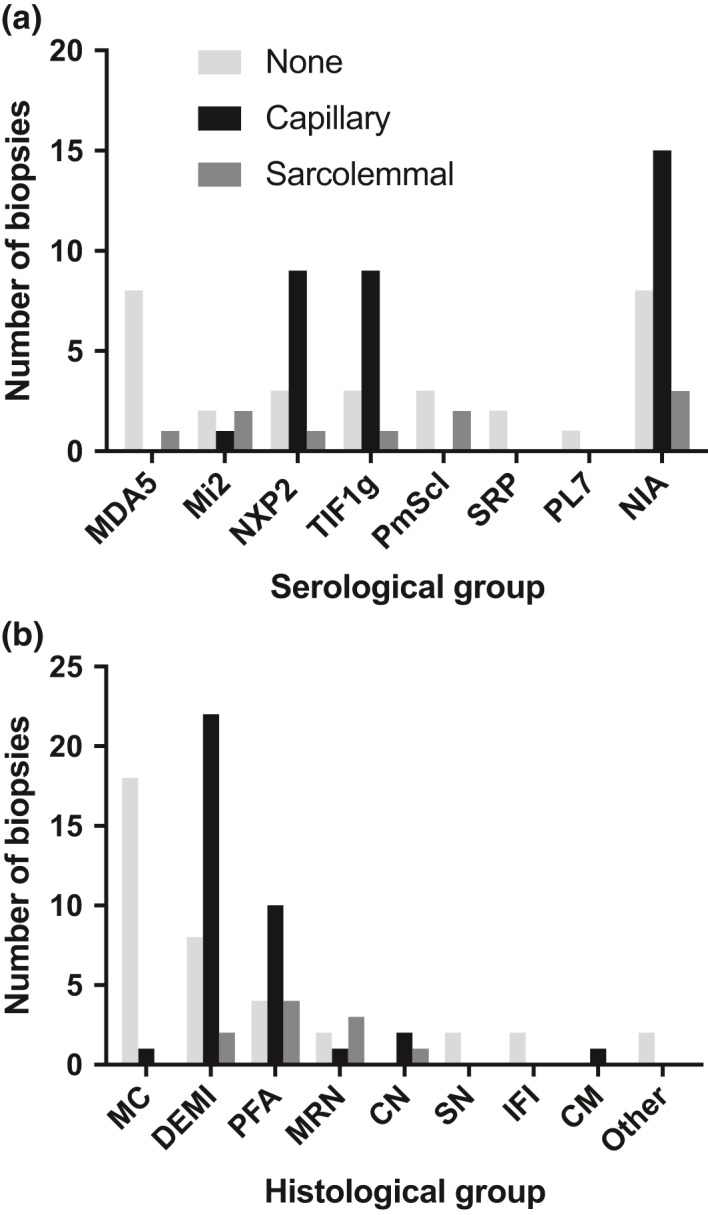
Results: Autoantibody data were available for 90/101 cases with 18/90 cases positive for anti-TIF1γ, 15/90 anti-NXP2, 11/90 anti-MDA5, 5/90 anti-Mi2 and 6/90 anti-PmScl. JDM biopsy severity scores were consistently low in the anti-MDA5 group, high in the anti-Mi2 group, and widely distributed in the other groups. Biopsies were classified histologically as perifascicular atrophy (22/101), macrophage-rich necrosis (6/101), scattered necrosis (2/101), clustered necrosis (2/101), inflammatory fibre invasion (2/101), chronic myopathic change (1/101), diffuse endomysial macrophage infiltrates (40/101) and minimal change (24/101). MDA5 cases segregated with the minimal change group and showed no capillary C5b-9-deposition. The Mi2 group displayed high severity scores and a tendency towards sarcolemmal complement deposition. NXP2 and TIF1γ groups showed a variety of pathologies with a high proportion of diffuse endomysial macrophage infiltrates and a high proportion of capillary C5b-9 deposition.

Conclusion: We have shown that juvenile idiopathic inflammatory myopathies have a spectrum of histopathological phenotypes and show distinct complement attack complex deposition patterns. Both correlate in some cases with the serological subtypes. Most cases do not show typical histological features associated with dermatomyositis (e.g. perifascicular atrophy). In contrast, more than half show relatively mild histopathological changes.

Keywords: JDM score tool; anti-SRP; dermatomyositis; immune mediated necrotizing myopathy; polymyositis; principal component analysis.


Conflict of interest statement

The authors declare no conflict of interest. The Editors of Neuropathology and Applied Neurobiology are committed to peer‐review integrity and upholding the highest standards of review. As such, this article was peer‐reviewed by independent, anonymous expert referees and the authors (TJ and JH) had no role in either the editorial decision or the handling of the paper.

Figures

Figure 1
Figure 1
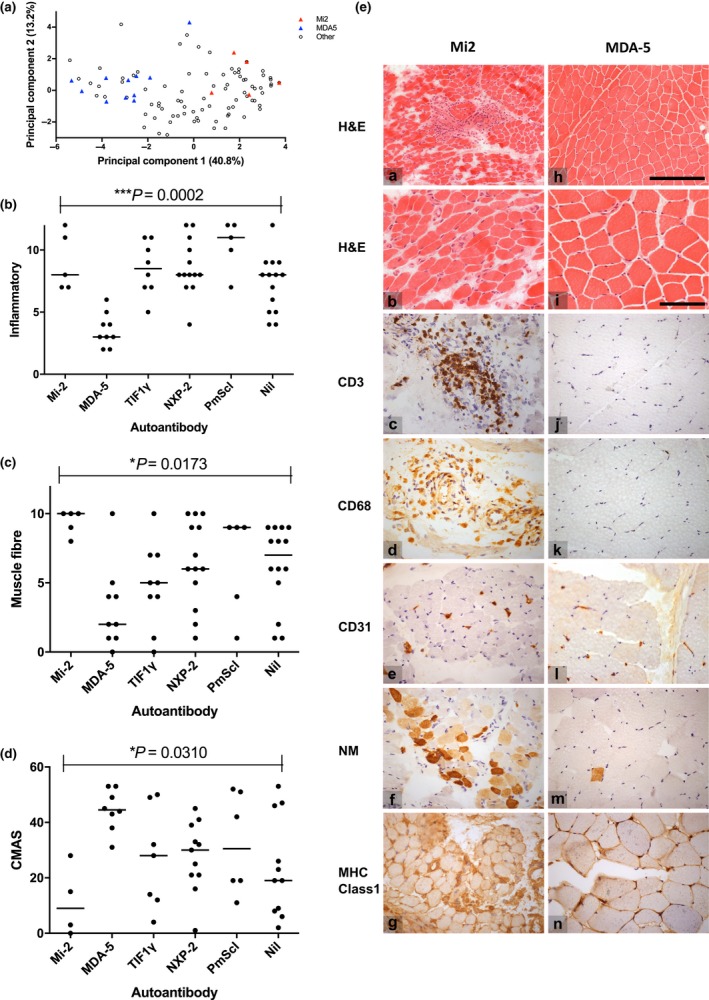
MDA5 and Mi‐2 autoantibody groups define clusters of mild and severe pathology (a) Principal component analysis of each feature of the biopsy tool for each biopsy sample. Each symbol indicates an individual case, plotted on the two principal components that capture the most variance in the data, with the percentage of variance captured given in parentheses. Triangles are coloured according to auto‐antibody groups as indicated. (b,c) Domain totals for each of the domains in the juvenile dermatomyositis biopsy score tool according to autoantibody subgroups. The inflammatory domain represents the sum of scores for CD3 and CD68 positive endomysial, perimysial and perivascular cells, the muscle fibre domain represents the sum of scores for MHC class I expression, neonatal myosin expression, perifascicular and non‐perifascicular atrophy and fibre degeneration and regeneration, and internal nucleation. Kruskal–Wallis anova was performed to compare the distribution of domain totals across myositis‐specific antibodies/myositis‐associated antibodies subgroups. Post‐hoc analysis indicated that the inflammatory domain scores differed between the anti‐Mi2 and anti‐MDA5, anti‐MDA5 and anti‐TIF1γ, and anti‐MDA5 and anti‐NXP2 cases. The muscle fibre domain scores differed between the anti‐Mi2 and anti‐MDA5 cases. Nil: no autoantibody bands detected on immunoprecipitation analyis. (d) Correlation of autoantibody group and muscle weakness, as assessed by the Childhood Myositis Assessment Scale (CMAS). Kruskal–Wallis anova was used to compare the degree of muscle weakness across autoantibody subgroups. Post‐hoc comparisons indicated that CMAS differed between the anti‐Mi2 and anti‐MDA5 cases, with Mi2 cases being much weaker. (e) Representative micrograph images of representative Mi2 (a–g) and MDA5 (h–n) muscle biopsies. Mi2 cases typically had high levels of inflammation, fibre damage and vessel abnormalities, while MDA5 cases had a much more normal appearance with only mild fibre size variation. a,b,h,i – Haematoxylin & Eosin (H&E), c,j – CD3, d,k – CD68, e,l – CD31, f,m – neonatal myosin, g,n – MHC class1. Scale bars for micrographs a and h are shown in h, length 250 μm, scale bars for b–g and i–n shown in i, length 100 μm.
Figure 2
Figure 2
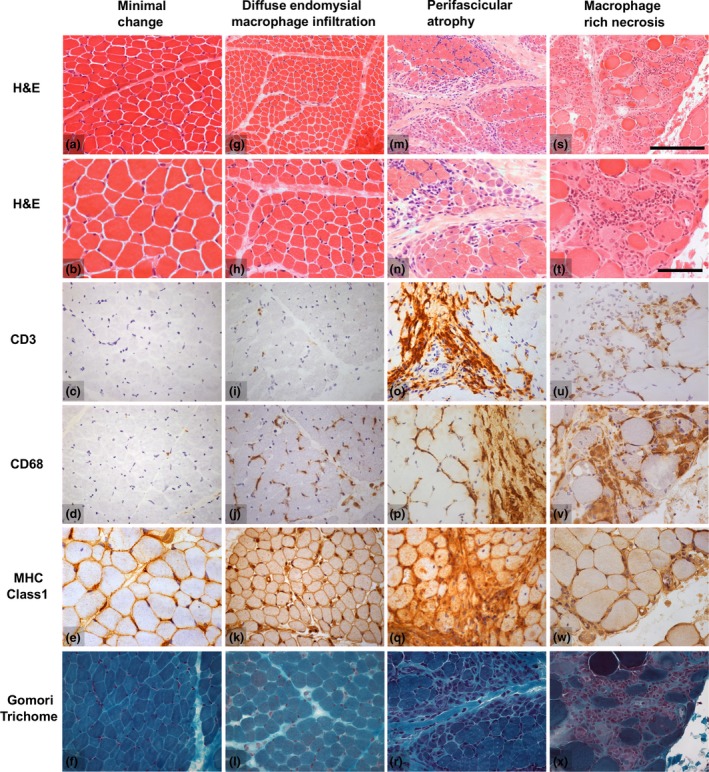
Illustrations of the histological features of the frequent histological groups in the biopsy cohort. The example of minimal change (af) demonstrates increased fibre size variability in the absence of macrophage infiltrates on CD68 immunohistochemistry. The example of diffuse endomysial macrophage infiltrates (gl) also shows mild fibre pathology, but has increased endomysial CD68 labelling combined with overexpressed MHC class I. The illustration of perifascicular atrophy (mr) shows several layers of atrophic cells in perifascicular distribution with marked peri‐ and endomysial lymphocytic infiltrates (CD3). Note that endomysial CD68 labelling is also increased and that necrosis is largely absent. The example of macrophage rich necrosis (sx) shows numerous, often intrafascicular, necrotic fibres in various stages of myophagocytosis, a dense macrophage infiltrate (CD68) and a less dense lymphocytic infiltrate (CD3). Images chosen show typical changes although do not capture the full histological variability in each group. Scalebars: for micrographs a,g,m,s, bar shown in s, length 250 μm; for remaining micrographs bar shown in t, length 100 μm.
Figure 3
Figure 3
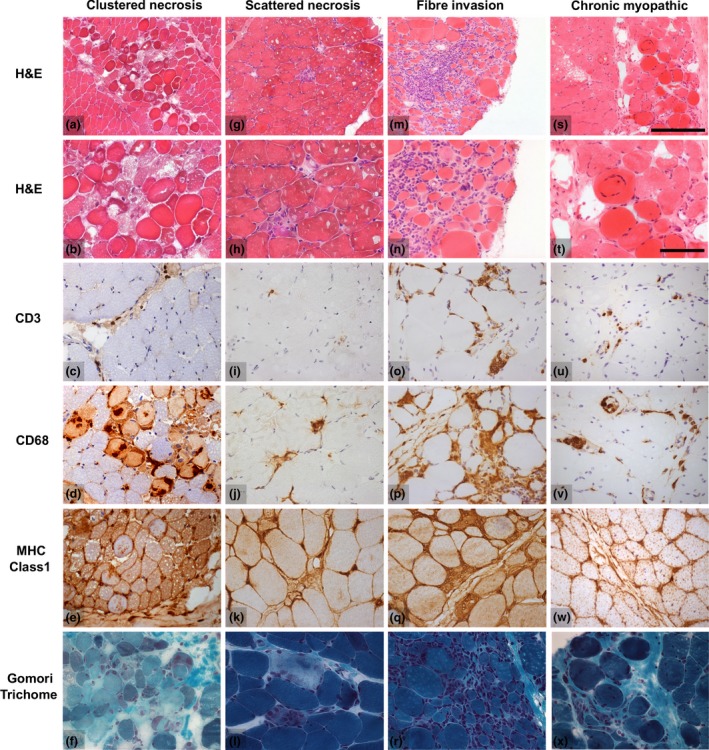
Illustrations of histological features of rare histological groups in the biopsy cohort. The example of clustered necrosis (af) illustrates an area of necrotic fibres surrounded by relatively normal appearing muscle in the absence of significant lymphocyte (CD3) or macrophage (CD68) infiltrates. Only occasional macrophages are present in necrotic fibres. Scattered necrosis (gl) is reminiscent of the findings in immune‐mediated necrotizing myopathy. The example shows two scattered necrotic fibres undergoing myophagocytosis with macrophage infiltrates (CD68) and remarkably little inflammation (CD3). Two cases demonstrated inflammatory invasion of normal appearing muscle fibres in combination with endomysial lymphocytic infiltrates (mr). These biopsies typically also had a significant number of necrotic fibres. A single biopsy showed only marked chronic myopathic change (sx) with marked fibre size variability and hypertrophy, internal nucleation, whorled fibres and endomysial fibrosis. Images chosen show typical features, although they do not capture the full histological variability in each group. Scalebars: for micrographs a,g,m,s, bar shown in s, length 250 μm; for remaining micrographs, bar shown in t, length 100 μm.
Figure 4
Figure 4
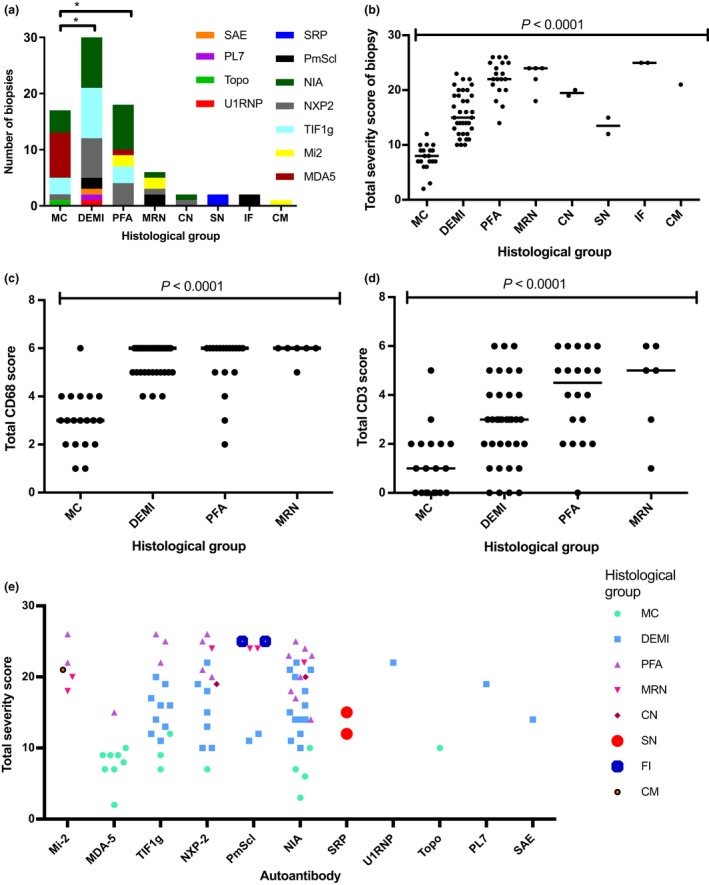
Serological profiles of the histological groups and correlation of the histological groups with the JDM severity score tool results. Patients were included in the analysis if they were untreated at the time of biopsy and if serological data were available (83/101). (a) Analysis of serological profiles of the histological groups. The MC group has a significantly different serological profile from the DEMI group (P = 0.002) and the PFA group (P = 0.041; Chi‐square test), while no statistically significant difference was apparent between DEMI and PFA (P = 0.3) or between PFA and MRN (P = 0.08); chi‐square test for all comparisons; *P < 0.05. (b) Total severity score from the international score tool as correlated with dominant fibre pathology. (c,d) Correlation of more frequent pathological patterns with lymphocytic and macrophage infiltrates. Total CD3 and CD68 scores are the sums of endomysial, perimysial and perivascular scores from the international score tool. (e) Plot of severity scores across autoantibody groups subclassified according to dominant fibre pathology. MC, minimal change; DEMI, diffuse endomysial macrophage infiltrates; PFA, perifascicular atrophy; MRN, macrophage rich necrosis; CN, clustered necrosis; SN, scattered necrosis; FI, fibre invasion; CM, chronic myopathic change.
Figure 5
Figure 5
Correlation of complement attack complex (C5b‐9) deposition pattern with serological and histological groups across the study cohort. The results of immunohistochemical staining for C5b‐9 were available for 76 patients after restriction to patients not on steroid treatment at the time of biopsy. Patient numbers whose biopsies showed capillary complement deposition, sarcolemmal complement deposition, or neither are plotted against (a) serological and (b) histological groups. For statistical analysis cases with sarcolemmal membrane attack complex deposition and without any deposition were merged into a single category in order to ensure meaningful group sizes. For results see text. MC, minimal change; DEMI, diffuse endomysial macrophage infiltrates; PFA, perifascicular atrophy; MRN, macrophage rich necrosis; CN, clustered necrosis; SN, scattered necrosis; FI, fibre invasion; CM, chronic myopathic change. NIA, no identifiable autoantibodies.
Figure 6
Figure 6
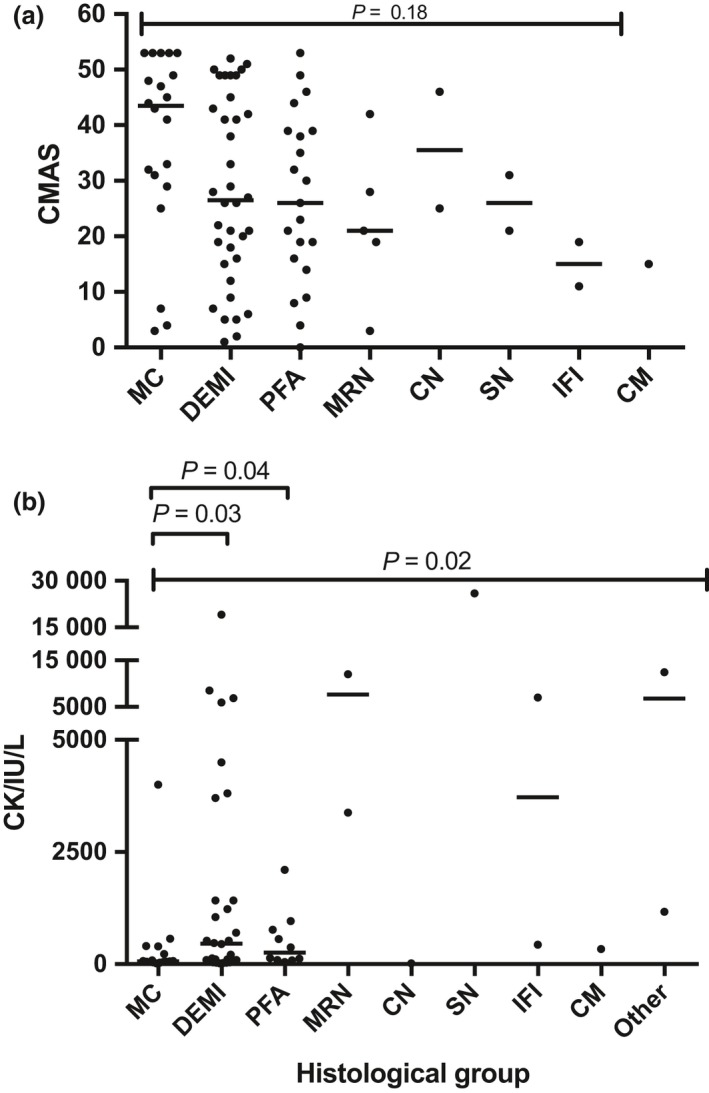
Correlation of (a) CMAS score and (b) CK levels with histological groups. CMAS scores were available for 88 untreated patients while CK levels were available for 73 untreated patients. Groups with small sample size (n < 2) were excluded from the statistical analysis. Bars indicate median; multiple comparisons by Kruskal–Wallis test, individual comparisons by Mann–Whitney test. CMAS, Childhood Myositis Assessment Scale; MC, minimal change; DEMI, diffuse endomysial macrophage infiltrates; PFA, perifascicular atrophy; MRN, macrophage rich necrosis; CN, clustered necrosis; SN, scattered necrosis; IFI, inflammatory fibre invasion; CM, chronic myopathic change.

References

    1. Rider LG, Nistala K. The juvenile idiopathic inflammatory myopathies: pathogenesis, clinical and autoantibody phenotypes, and outcomes. J Intern Med 2016; 280: 24–38 - PMC - PubMed
    1. Hoogendijk JE, Amato AA, Lecky BR, Choy EH, Lundberg IE, Rose MR, et al 119th ENMC international workshop: trial design in adult idiopathic inflammatory myopathies, with the exception of inclusion body myositis, 10–12 October 2003, Naarden, The Netherlands. Neuromuscul Disord 2004; 14: 337–45 - PubMed
    1. Mescam‐Mancini L, Allenbach Y, Hervier B, Devilliers H, Mariampillay K, Dubourg O, et al Anti‐Jo‐1 antibody‐positive patients show a characteristic necrotizing perifascicular myositis. Brain 2015; 138: 2485–92 - PubMed
    1. Mozaffar T, Pestronk A. Myopathy with anti‐Jo‐1 antibodies: pathology in perimysium and neighbouring muscle fibres. J Neurol Neurosurg Psychiatry 2000; 68: 472–8 - PMC - PubMed
    1. Stenzel W, Preusse C, Allenbach Y, Pehl D, Junckerstorff R, Heppner FL, et al Nuclear actin aggregation is a hallmark of anti‐synthetase syndrome‐induced dysimmune myopathy. Neurology 2015; 84: 1346–54 - PubMed

Publication types