


A systematic literature review of individuals' perspectives on privacy and genetic information in the United States
- PMID: 30379944
- PMCID: PMC6209148
- DOI: 10.1371/journal.pone.0204417
A systematic literature review of individuals' perspectives on privacy and genetic information in the United States
Abstract
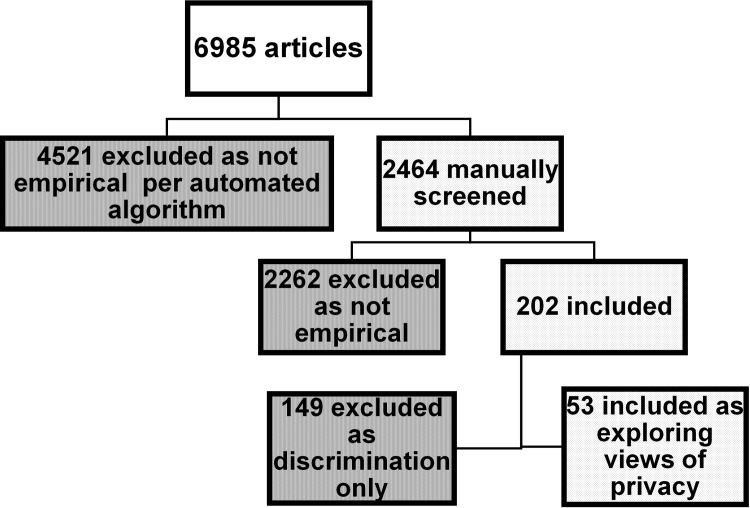
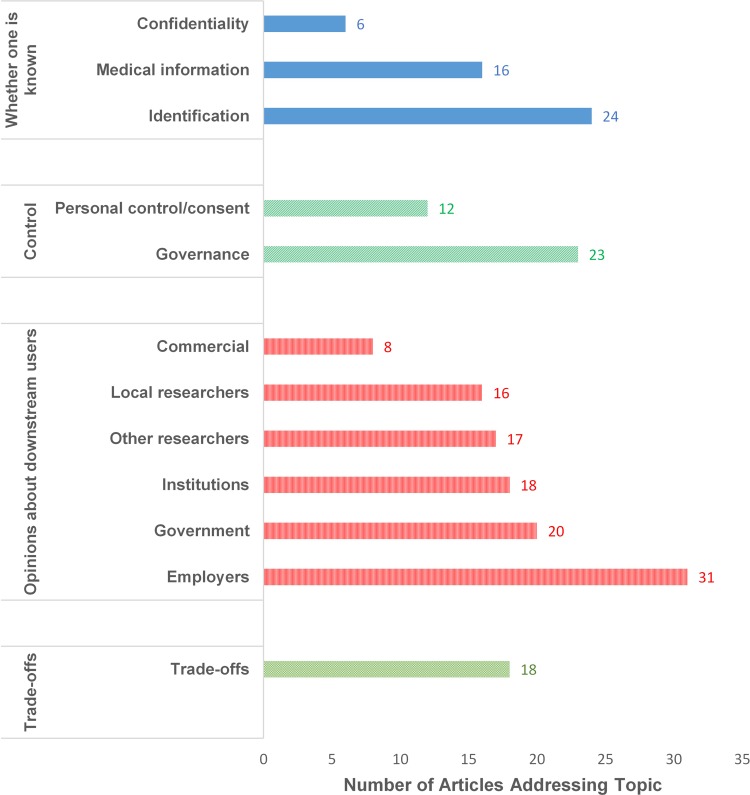
Concerns about genetic privacy affect individuals' willingness to accept genetic testing in clinical care and to participate in genomics research. To learn what is already known about these views, we conducted a systematic review, which ultimately analyzed 53 studies involving the perspectives of 47,974 participants on real or hypothetical privacy issues related to human genetic data. Bibliographic databases included MEDLINE, Web of Knowledge, and Sociological Abstracts. Three investigators independently screened studies against predetermined criteria and assessed risk of bias. The picture of genetic privacy that emerges from this systematic literature review is complex and riddled with gaps. When asked specifically "are you worried about genetic privacy," the general public, patients, and professionals frequently said yes. In many cases, however, that question was posed poorly or only in the most general terms. While many participants expressed concern that genomic and medical information would be revealed to others, respondents frequently seemed to conflate privacy, confidentiality, control, and security. People varied widely in how much control they wanted over the use of data. They were more concerned about use by employers, insurers, and the government than they were about researchers and commercial entities. In addition, people are often willing to give up some privacy to obtain other goods. Importantly, little attention was paid to understanding the factors-sociocultural, relational, and media-that influence people's opinions and decisions. Future investigations should explore in greater depth which concerns about genetic privacy are most salient to people and the social forces and contexts that influence those perceptions. It is also critical to identify the social practices that will make the collection and use of these data more trustworthy for participants as well as to identify the circumstances that lead people to set aside worries and decide to participate in research.
Conflict of interest statement
The authors have declared that no competing interests exist.
Figures
References
-
- Bielinski SJ, Olson JE, Pathak J, Weinshilboum RM, Wang L, Lyke KJ, et al. Preemptive genotyping for personalized medicine: design of the right drug, right dose, right time-using genomic data to individualize treatment protocol. Mayo Clin Proc. 2014;89(1):25–33. 10.1016/j.mayocp.2013.10.021 - DOI - PMC - PubMed
-
- Yeh P, Chen H, Andrews J, Naser R, Pao W, Horn L. DNA-Mutation Inventory to Refine and Enhance Cancer Treatment (DIRECT): a catalog of clinically relevant cancer mutations to enable genome-directed anticancer therapy. Clin Cancer Res. 2013;19(7):1894–901. 10.1158/1078-0432.CCR-12-1894 - DOI - PMC - PubMed
Publication types
MeSH terms
Grants and funding
LinkOut - more resources
Full Text Sources
