


What is new with 22q? An update from the 22q and You Center at the Children's Hospital of Philadelphia
- PMID: 30380191
- PMCID: PMC6501214
- DOI: 10.1002/ajmg.a.40637
What is new with 22q? An update from the 22q and You Center at the Children's Hospital of Philadelphia
Abstract
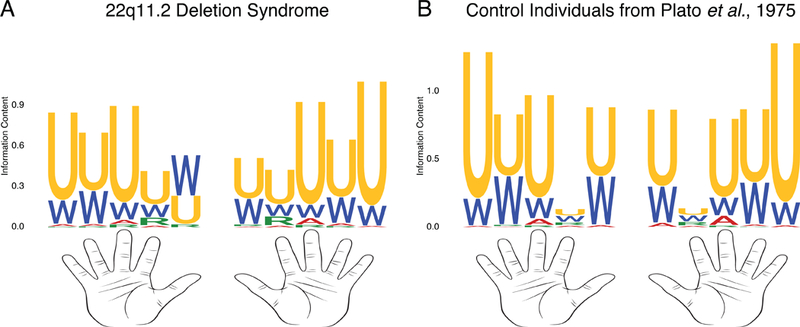
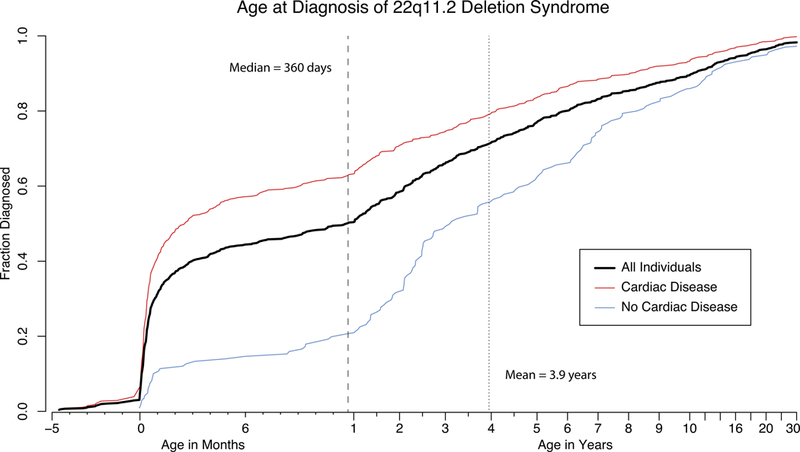
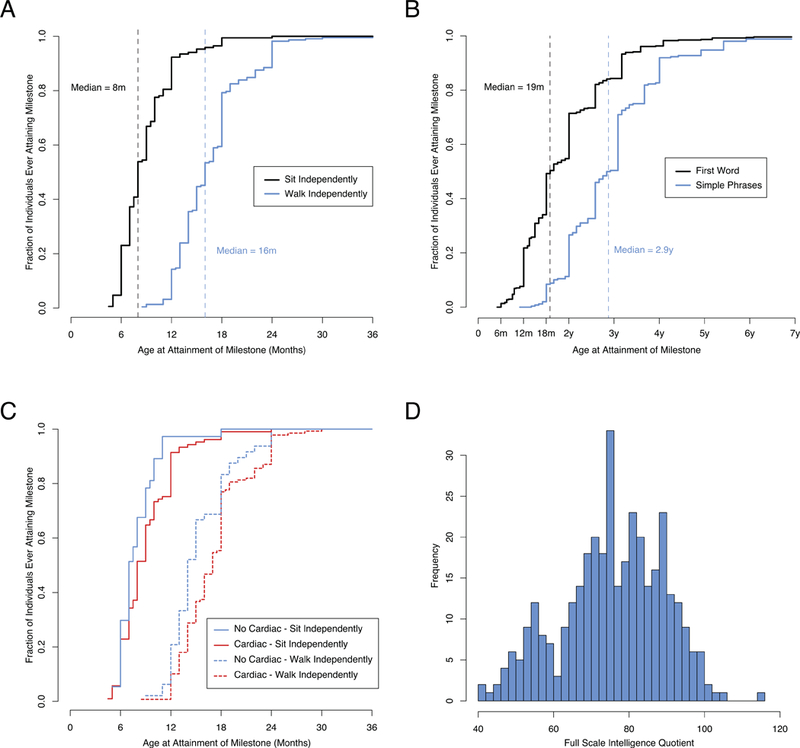
22q11.2 deletion syndrome (22q11.2DS) is a disorder caused by recurrent, chromosome-specific, low copy repeat (LCR)-mediated copy-number losses of chromosome 22q11. The Children's Hospital of Philadelphia has been involved in the clinical care of individuals with what is now known as 22q11.2DS since our initial report of the association with DiGeorge syndrome in 1982. We reviewed the medical records on our continuously growing longitudinal cohort of 1,421 patients with molecularly confirmed 22q11.2DS from 1992 to 2018. Most individuals are Caucasian and older than 8 years. The mean age at diagnosis was 3.9 years. The majority of patients (85%) had typical LCR22A-LCR22D deletions, and only 7% of these typical deletions were inherited from a parent harboring the deletion constitutionally. However, 6% of individuals harbored other nested deletions that would not be identified by traditional 22q11.2 FISH, thus requiring an orthogonal technology to diagnose. Major medical problems included immune dysfunction or allergies (77%), palatal abnormalities (67%), congenital heart disease (64%), gastrointestinal difficulties (65%), endocrine dysfunction (>50%), scoliosis (50%), renal anomalies (16%), and airway abnormalities. Median full-scale intelligence quotient was 76, with no significant difference between individuals with and without congenital heart disease or hypocalcemia. Characteristic dysmorphic facial features were present in most individuals, but dermatoglyphic patterns of our cohort are similar to normal controls. This is the largest longitudinal study of patients with 22q11.2DS, helping to further describe the condition and aid in diagnosis and management. Further surveillance will likely elucidate additional clinically relevant findings as they age.
Keywords: 22q11.2; DiGeorge; genomic disorder; multidisciplinary; syndrome.
© 2018 Wiley Periodicals, Inc.
Figures
References
-
- Amati F, Conti E, Novelli A, Bengala M, Diglio MC, Marino B, Giannotti A, Gabrielli O, Novelli G, Dallapiccola B 1999. Atypical deletions suggest five 22q11.2 critical regions related to the DiGeorge/velo-cardio-facial syndrome. Eur J Hum Genet 7: 903–909. - PubMed
-
- American Academy of Pediatrics Council on Children With Disabilities, Cartwright JD 2007. Provision of educationally related services for children and adolescents with chronic diseases and disabling conditions. Pediatrics 119: 1218–1223. - PubMed
-
- Baldini A 2005. Dissecting contiguous gene defects: TBX1. Curr. Opin. Genet. Dev. 15: 279–284. - PubMed
MeSH terms
Grants and funding
LinkOut - more resources
Full Text Sources
