


Associations between Positive Health-Related Effects and Soundscapes Perceptual Constructs: A Systematic Review
- PMID: 30380601
- PMCID: PMC6266166
- DOI: 10.3390/ijerph15112392
Associations between Positive Health-Related Effects and Soundscapes Perceptual Constructs: A Systematic Review
Abstract
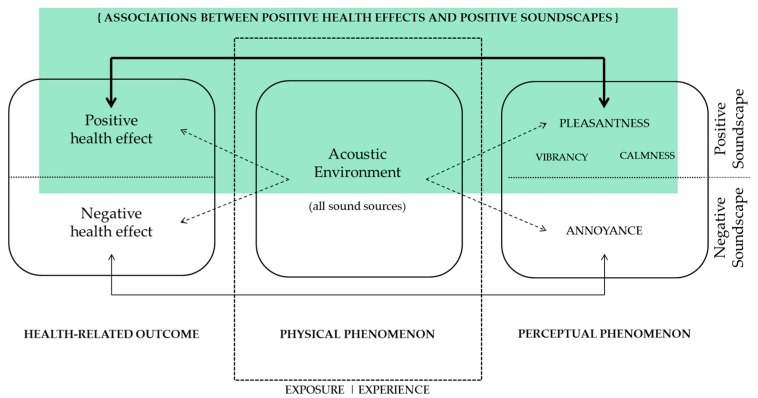
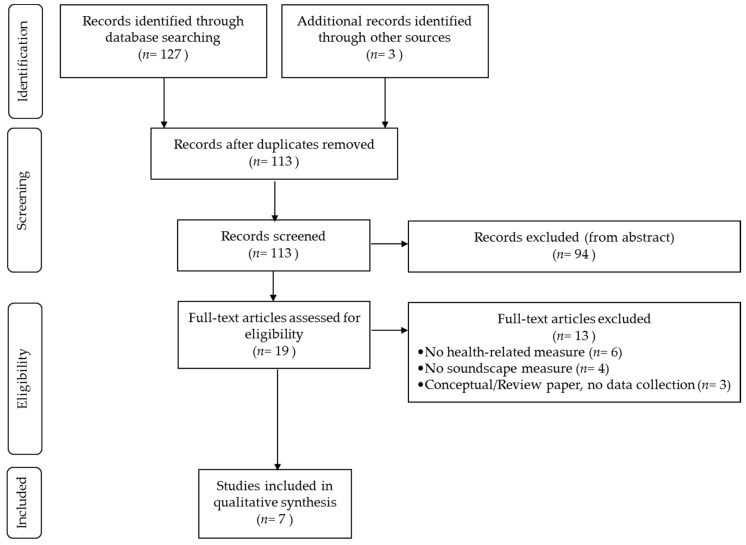
In policy-making and research alike, environmental sounds are often considered only as psychophysical stressors, leading to adverse health effects. The soundscape approach, on the other hand, aims to extend the scope of sound-related research to consider sounds as resources, promoting healthy and supportive environments. The ISO 12913-1 standard defined soundscapes as acoustic environments "as perceived by people, in context." The aim of this study was assessing associations between positive soundscapes (e.g., pleasant, calm, less annoying) and positive health-related effects (e.g., increased restoration, reduced stress-inducing mechanisms, etc.). Studies collecting data about individual responses to urban acoustic environments, and individual responses on psychophysical well-being were selected, looking at cases where positive effects were observed. The Web of Science, Scopus and PubMed databases were searched for peer-reviewed journal papers published in English between 1 January 1991 and 31 May 2018, with combinations of the keywords "soundscape" and at least one among "health", "well-being" or "quality of life." An additional manual search was performed on the reference lists of the retrieved items. Inclusion criteria were: (1) including at least one measure of soundscape dimensions as per the ISO 12913-1 definition; (2) including at least one health-related measure (either physiological or psychological); (3) observing/discussing a "positive" effect of the soundscape on the health-related outcome. The search returned 130 results; after removing duplicates, two authors screened titles and abstracts and selected 19 papers for further analysis. Seven studies were eventually included, with 2783 participants in total. Each study included at least a valence-related soundscape measure. Regarding the health-related measures, four studies included physiological monitoring and the remaining three included self-reported psychological measures. Positive soundscapes were associated with faster stress-recovery processes in laboratory experiments, and better self-reported health conditions in large-scale surveys. Due to the limited number of items and differences in measures across studies, no statistical analysis was performed, and a qualitative approach to data synthesis was sought. Results support the claim that, in contrast with looking at noise only as an environmental stressor, sound perception can act as an enhancer of the human experience in the urban realm, from a health-related point of view.
Keywords: environmental noise; public health; quality of life; restoration; soundscape; well-being.
Conflict of interest statement
The authors declare no conflict of interest. The funder had no role in the design of the study; in the collection, analyses, or interpretation of data; in the writing of the manuscript, and in the decision to publish the results.
Figures
References
-
- Wothge J., Belke C., Möhler U., Guski R., Schreckenberg D. The Combined Effects of Aircraft and Road Traffic Noise and Aircraft and Railway Noise on Noise Annoyance—An Analysis in the Context of the Joint Research Initiative NORAH. Int. J. Environ. Res. Public Health. 2017;14:871. doi: 10.3390/ijerph14080871. - DOI - PMC - PubMed
-
- World Health Organization . Guidelines for Community Noise. World Health Organization; Geneve, Switzerland: 1999.
-
- European Commission—WG2 Dose/Effect . Position Paper on Dose Response Relationships between Transportation Noise and Annoyance. Office for Official Publications of the European Communities; Luxembourg: 2002.
Publication types
MeSH terms
LinkOut - more resources
Full Text Sources
Medical
