


Sleep Disorders Among People With Migraine: Results From the Chronic Migraine Epidemiology and Outcomes (CaMEO) Study
- PMID: 30381821
- PMCID: PMC6615030
- DOI: 10.1111/head.13435
Sleep Disorders Among People With Migraine: Results From the Chronic Migraine Epidemiology and Outcomes (CaMEO) Study
Abstract
Objectives: We examined the cross-sectional association of sleep apnea and indices of sleep quality with both episodic migraine (EM) and chronic migraine (CM).
Background: Sleep apnea and abnormal patterns of sleep, such as insomnia, were associated with migraine onset, severity, and progression in previous research.
Methods: The Chronic Migraine Epidemiology & Outcomes Study, a longitudinal study, used a series of web-based surveys to assess migraine symptoms, burden, and patterns of health care utilization. Quota sampling was used from September 2012 to November 2013 to generate a representative sample of the US population. Persons who screened positive for sleep apnea on the Berlin Questionnaire are said to be at "high risk" for sleep apnea. Respondents indicated if they believed that they had sleep apnea, if a physician had diagnosed it, and if and how they were treated. Other aspects of sleep quality were assessed using the Medical Outcomes Study (MOS) Sleep Measures.
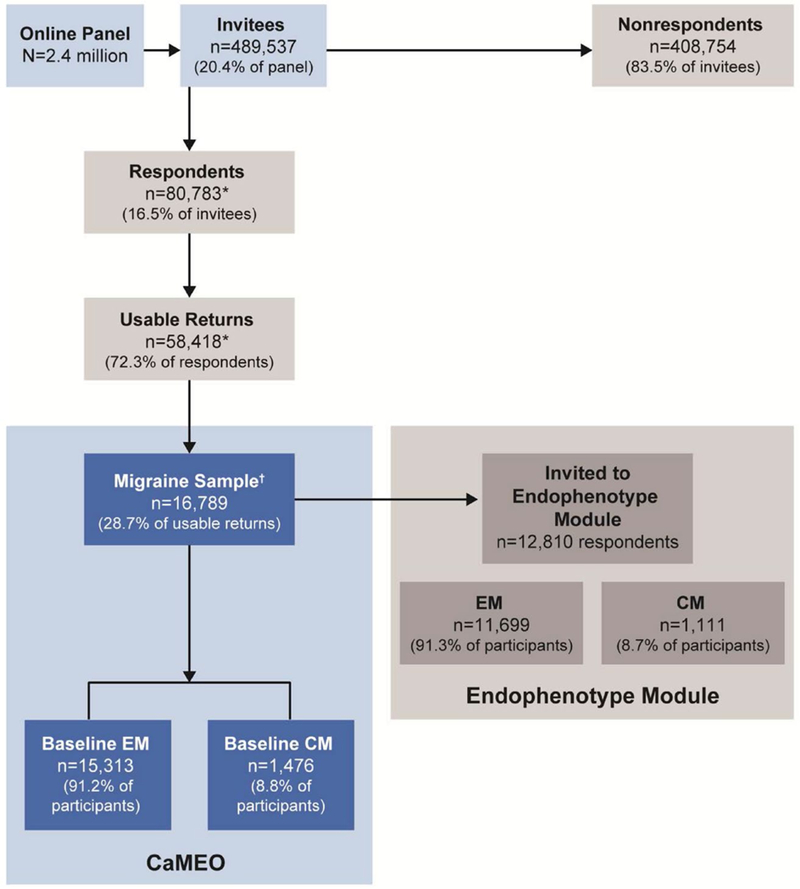
Results: Of 12,810 eligible respondents with migraine and data on sleep, 11,699 with EM (91.3%) and 1111 with CM (8.7%) provided valid data for this analyses. According to the Berlin Questionnaire, 4739/12,810 (37.0%) were at "high risk" for sleep apnea, particularly persons with CM vs EM (575/1111 [51.8%] vs 4164/11,699 [35.6%]), men vs women (1431/3220 [44.4%] vs 3308/9590 [34.5%]), people with higher body mass index, and older people (all P < .001). Among respondents to the MOS Sleep Measures, persons with CM were more likely to report poor sleep quality than those with EM, including sleep disturbance (mean [SD] values: 53.2 [26.9] vs 37.9 [24.3]), snoring (38.0 [33.9] vs 31.0 [32.1]), shortness of breath (34.9 [29.8] vs 15.3 [20.6]), somnolence (44.1 [23.4] vs 32.2 [21.2]), and less likely to report sleep adequacy (34.0 [24.2] vs 39.2 [22.1]).
Conclusions: Compared with respondents with EM, a larger proportion of those with CM were at "high risk" for sleep apnea and reported poor sleep quality. This reflects an association between CM vs EM and sleep apnea and poor sleep quality; the potential relationships are discussed.
Keywords: CaMEO; migraine; sleep apnea; sleep disorders; sleep quality; snoring.
© 2018 American Headache Society.
Conflict of interest statement
Figures
References
-
- Lipton RB, Bigal ME, Diamond M, Freitag F, Reed ML, Stewart WF. Migraine prevalence, disease burden, and the need for preventive therapy. Neurology. 2007;68:343–349. - PubMed
-
- GBD 2016 Disease and Injury Incidence and Prevalence Collaborators. Global, regional, and national incidence, prevalence, and years lived with disability for 328 diseases and injuries for 195 countries, 1990–2016: A systematic analysis for the Global Burden of Disease Study 2016. Lancet. 2017;390:1211–1259. - PMC - PubMed
-
- Headache Classification Committee of the International Headache Society. The International Classification of Headache Disorders, 3rd edition. Cephalalgia. 2018;38:1–211. - PubMed
-
- Singh NN, Sahota P. Sleep-related headache and its management. Curr Treat Options Neurol. 2013;15:704–722. - PubMed
Publication types
MeSH terms
Grants and funding
LinkOut - more resources
Full Text Sources
Medical
