


doi: 10.1186/s12915-018-0603-7.
Open questions: why should we care about ER-phagy and ER remodelling?
Affiliations
- PMID: 30382915
- PMCID: PMC6211458
- DOI: 10.1186/s12915-018-0603-7
Item in Clipboard
Open questions: why should we care about ER-phagy and ER remodelling?
BMC Biol.
.
Abstract
The endoplasmic reticulum (ER) is one of the most complex organelles in the eukaryotic cell. Recent findings suggest that a process called ER-phagy plays a major role in maintaining the ER's shape and function.
Conflict of interest statement
Competing interests
Ivan Dikic is a Visiting Scholar at Genentech Inc. (South San Francisco, USA) and a Consultant of Rheostat Therapeutics Inc.
Publisher’s Note
Springer Nature remains neutral with regard to jurisdictional claims in published maps and institutional affiliations.
Figures
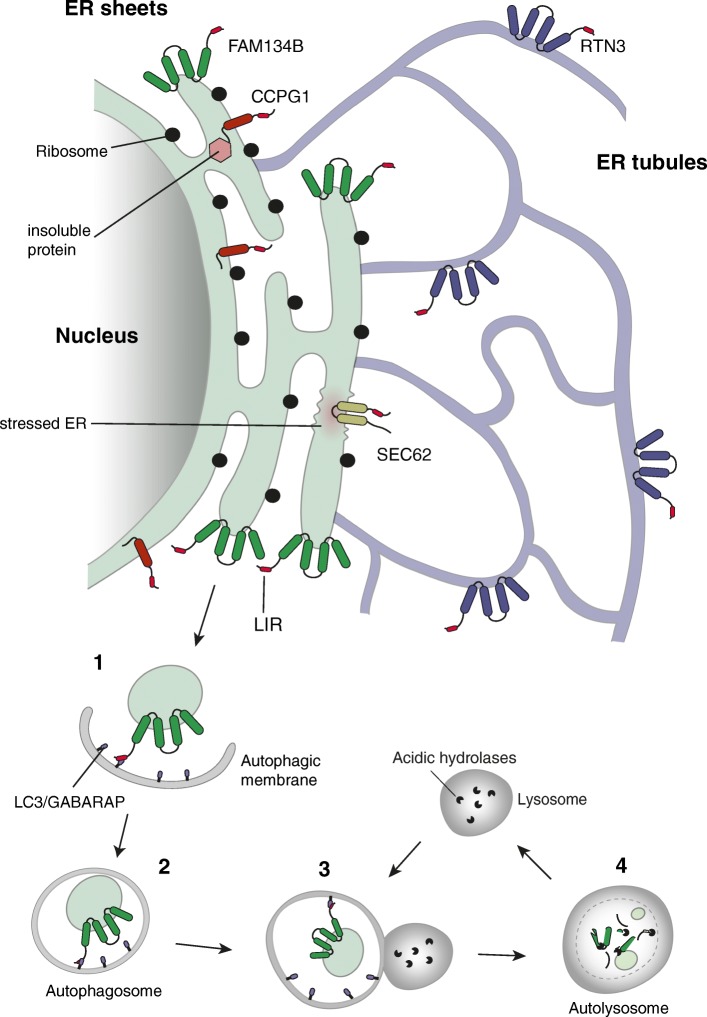
ER-phagy is mediated by ER-phagy receptors localized to distinct subdomains of the ER. FAM134B is restricted to the curved edges of ER sheets. RTN3 is found exclusively on ER tubules. Sec62 is localized to ER sheets following ER-stress. CCPG1 is found in areas of the ER with high content of insoluble proteins. The currently known receptors do not interact or functionally cooperate with each other. All of them contain LIR domains that are able to bind to LC3/GABARAP-decorated autophagic membranes. The process of ER-phagy can be summarized in four steps: 1) cargo sequestration via interaction between LIR and LC3/GABARAP; 2) closure of the autophagic membrane (aka isolation membrane) around the cargo; 3) fusion of the resulting autophagosome with the lysosome; 4) degradation of the enclosed ER fragments by lysosomal hydrolases and acidic pH
References
Publication types
MeSH terms
LinkOut - more resources
Full Text Sources
