


Persistent Parasitemia Despite Dramatic Reduction in Malaria Incidence After 3 Rounds of Indoor Residual Spraying in Tororo, Uganda
- PMID: 30383230
- PMCID: PMC6420168
- DOI: 10.1093/infdis/jiy628
Persistent Parasitemia Despite Dramatic Reduction in Malaria Incidence After 3 Rounds of Indoor Residual Spraying in Tororo, Uganda
Abstract
Background: Indoor residual spraying of insecticide (IRS) has been associated with reductions in the incidence of malaria, but its impact on malaria parasitemia is unclear.
Methods: We followed 469 participants from August 2011 to May 2016 in Tororo, Uganda, a historically high malaria transmission setting. Three rounds of IRS with bendiocarb were implemented from December 2014 to December 2015. Symptomatic malaria episodes were identified by passive surveillance. Parasitemia was identified by active surveillance every 1-3 months using microscopy and Plasmodium falciparum-specific loop-mediated isothermal amplification.
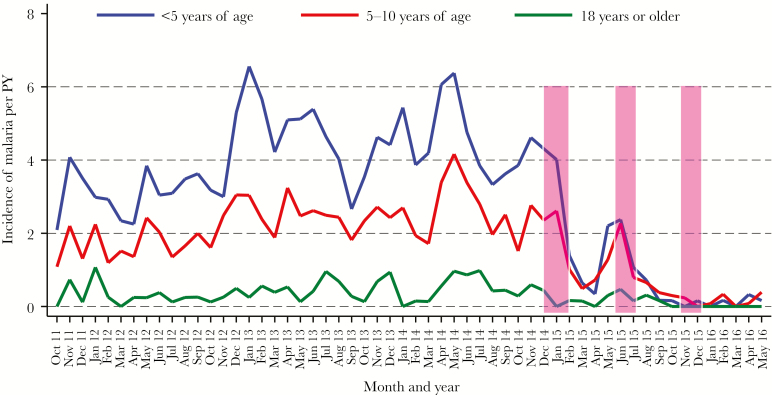
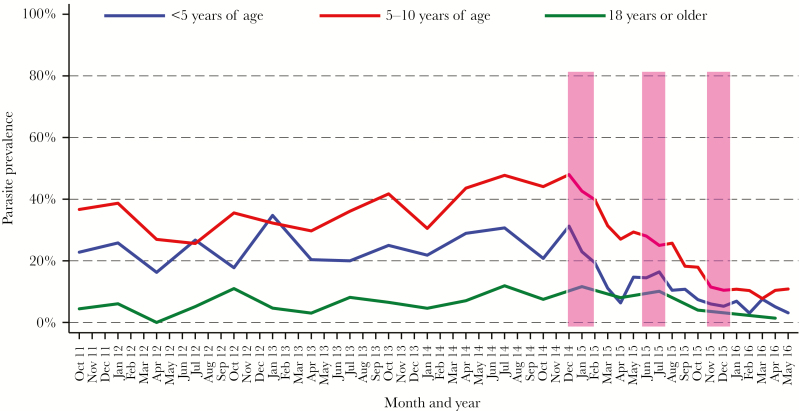
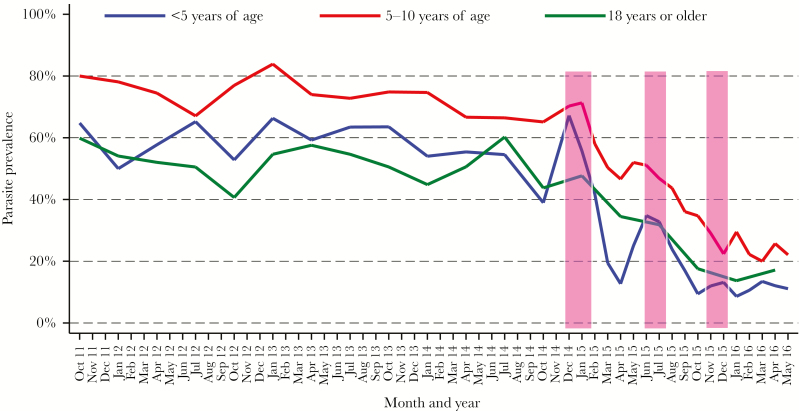
Results: IRS was associated with a significant decline in the incidence of symptomatic malaria irrespective of age (episodes per person per year declined from 3.98 to 0.13 in children aged <5 years, 2.30 to 0.15 in children aged 5-10 years, and 0.41 to 0 in adults; P < .001 for all). IRS significantly reduced the prevalence of parasitemia, but the prevalence remained high (pre-IRS to post-third round: 58.5% to 11.3% in children aged <5 years, 73.3% to 23.7% in children aged 5-10 years, and 52.2% to 15.4% in adults; P < .001 for all).
Conclusions: Although IRS was associated with significant reductions in the incidence of malaria and prevalence of parasitemia, a proportion of the population remained parasitemic, providing a potential reservoir for malaria transmission.
Keywords: indoor residual spraying; infectious reservoir; malaria; parasitemia.
© The Author(s) 2018. Published by Oxford University Press for the Infectious Diseases Society of America. All rights reserved. For permissions, e-mail: journals.permissions@oup.com.
Figures
References
-
- World Health Organization. World malaria report 2017 http://www.who.int/malaria/publications/world-malaria- report-2017/repor.... Accessed 15 February 2018.
-
- Ministry of Health Uganda. The Uganda malaria indicator survey 2014–2015 http://www.ubos.org/2015/11/06/the-uganda-malaria-indicator-survey-2014–.... Accessed 15 February 2018.
-
- Bruce-Chwatt LJ. Malaria eradication. In: Essential malariology. London: Hodder-Arnold, 1985.
