


The effect of Imaginary Working Qigong on the psychological well-being of college students: Study protocol for a randomized controlled trial
- PMID: 30383672
- PMCID: PMC6221622
- DOI: 10.1097/MD.0000000000013043
The effect of Imaginary Working Qigong on the psychological well-being of college students: Study protocol for a randomized controlled trial
Abstract
Introduction: College students are special populations that are particularly prone to have significantly high level of psychological distress than their community peers. Apparently, the best way to manage stress and mental state is through self-care. The characteristic of Qigong is self-directed and self-healing, which is a traditional Chinese mind-body exercise, which has the potential as a stress management intervention. Imaginary Working Qigong, as a kind of static Qigong, is more perception-oriented and can bring about benign sensations of mind and body so as to eliminate stress completely and induce physiological and mental relaxation. In this study protocol, we will systematically examine the feasibility and acceptability of Imaginary Working Qigong on psychological outcomes of the college students and deeply explore molecular biological mechanisms underlying the effects of mind adjustment induced Imaginary Working Qigong.
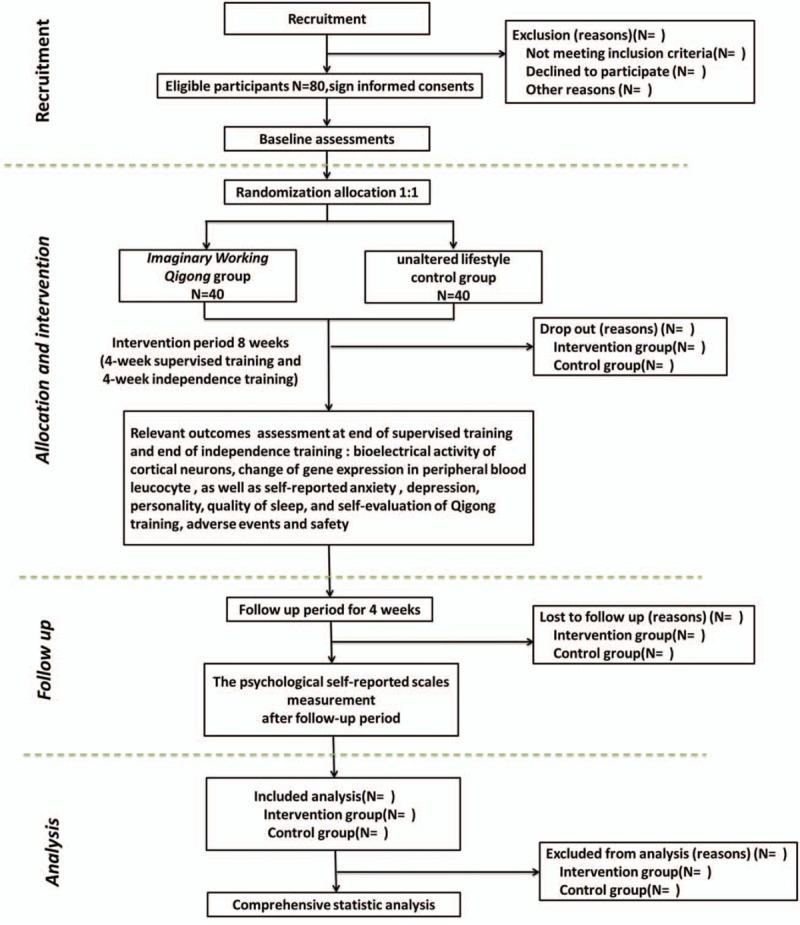
Methods/designs: We will conduct a randomized, assessor and statistician-blinded, parallel-controlled trial exploring the beneficial mind adjustment of Imaginary Working Qigong in college students.A total of 80 eligible college students from Beijing University of Chinese Medicine will be recruited and randomly allocated into Imaginary Working Qigong training or unaltered lifestyle control group according 1:1 allocation ratio with allocation concealment. Imaginary Working Qigong training will last 8 weeks. The study period is 12 weeks including a 4-week supervised training, 4-week independence training, and a 4-week follow-up. Relevant psychological outcomes measurement will take place at baseline, 5 weeks (at the end of supervised training), 9 weeks (at the end of independence training), and 13 weeks (after the 4-week follow-up period) by blinded independent outcome assessors.
Conclusion: This is the first randomized controlled trial protocol from the perspective of Qigong connotation to systematically evaluate the effects and relevant molecular mechanism of Imaginary Working Qigong for the mental health of a college student population. If our study demonstrates a significant intervention effect, this would provide preliminary higher-quality evidence and establish a further guidance for the application of Imaginary Working Qigong program among a college student population.
Ethics and dissemination: The study protocol and consent forms have been approved by the medical and animal experiment ethic committee of BUCM (approval number: BJZYYDX-LL2014005).
Conflict of interest statement
This study is independent from the sponsor and competing interests.
The authors declare that they have no conflicts of interest to disclose.
References
-
- Liébanapresa C, Fernándezmartínez ME, Gándara AR, et al. Psychological distress in health sciences college students and its relationship with academic engagement. Rev Esc Enferm 2014;48:715–22. - PubMed
-
- Brooks JH, Dubois DL. Individual and environmental predictors of adjustment during the first year of college. J Coll Stud Dev 1995;36:347–60.
Publication types
MeSH terms
LinkOut - more resources
Full Text Sources
Medical
