. 2018 Nov 1;14(11):e1007774.
doi: 10.1371/journal.pgen.1007774. eCollection 2018 Nov.

How many individuals share a mitochondrial genome?

Affiliations

How many individuals share a mitochondrial genome?

Mikkel M Andersen et al. PLoS Genet. .

Abstract

Mitochondrial DNA (mtDNA) is useful to assist with identification of the source of a biological sample, or to confirm matrilineal relatedness. Although the autosomal genome is much larger, mtDNA has an advantage for forensic applications of multiple copy number per cell, allowing better recovery of sequence information from degraded samples. In addition, biological samples such as fingernails, old bones, teeth and hair have mtDNA but little or no autosomal DNA. The relatively low mutation rate of the mitochondrial genome (mitogenome) means that there can be large sets of matrilineal-related individuals sharing a common mitogenome. Here we present the mitolina simulation software that we use to describe the distribution of the number of mitogenomes in a population that match a given mitogenome, and investigate its dependence on population size and growth rate, and on a database count of the mitogenome. Further, we report on the distribution of the number of meioses separating pairs of individuals with matching mitogenome. Our results have important implications for assessing the weight of mtDNA profile evidence in forensic science, but mtDNA analysis has many non-human applications, for example in tracking the source of ivory. Our methods and software can also be used for simulations to help validate models of population history in human or non-human populations.


Conflict of interest statement

The authors have declared that no competing interests exist.

Figures
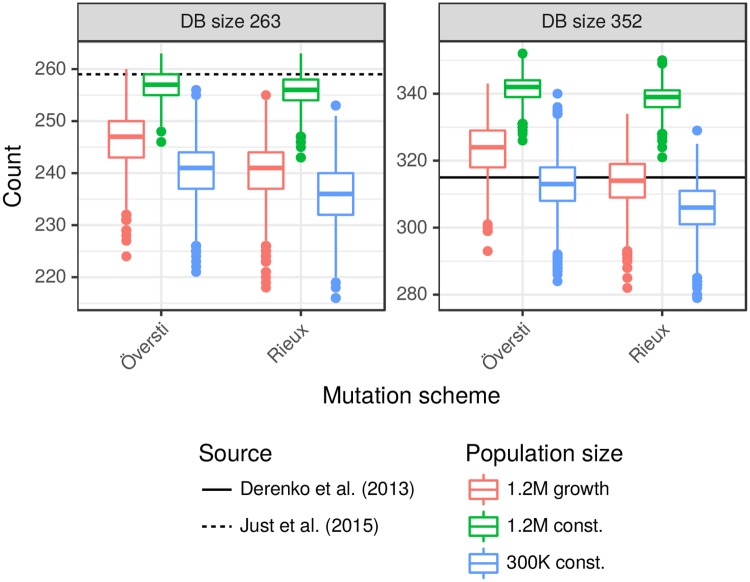
Fig 1
Fig 1. Comparison of simulated with US and Iranian databases.
Boxplots show the distribution of the number of distinct haplotypes arising from 2,500 random databases of sizes 263 and 351 obtained under our three demographic and two mutation models. The horizontal reference lines show the numbers of distinct haplotypes in US [15] and Iranian [16] databases of those sizes. See S1 Fig for distributions of the numbers of singletons and doubletons and details on how the boxplots were constructed.
Fig 2
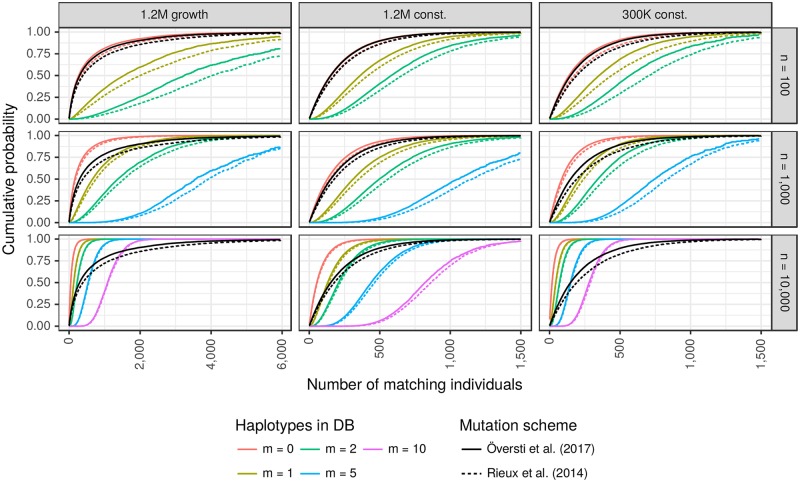
Fig 2. Cumulative distributions of the number of matching individuals.
Black lines show unconditional distributions. Coloured lines show the distributions conditional on m matching mitogenomes in a reference database of size n, for up to five values of m (see legend for colour codes) and three values of n (one per row). Quantiles of the distributions shown in the middle column are given in Table 2 and S3 Table for the mutation models of [13] and [14], respectively. See text for references to additional tables for the other demographic scenarios.
Fig 3
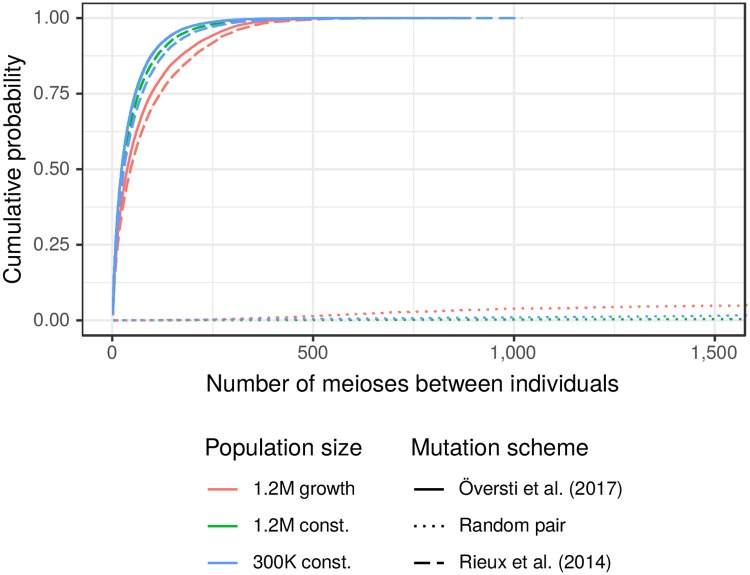
Fig 3. Number of meioses between pairs of individuals.
The dotted lines correspond to random pairs of individuals, the solid and dashed lines are for pairs observed to have matching mitogenomes. See Table 3 for quantiles.

References

    1. Butler JM, Levin BC. Forensic applications of mitochondrial DNA. Trends in Biotechnology. 1998;16(4):158–162. 10.1016/S0167-7799(98)01173-1 - DOI - PubMed
    1. Carracedo A, Bär W, Lincoln P, Mayr W, Morling N, Olaisen B, et al. DNA Commission of the International Society for Forensic Genetics: guidelines for mitochondrial DNA typing. Forensic Science International. 2000;110(2):79–85. 10.1016/S0379-0738(00)00161-4 - DOI - PubMed
    1. Parson W, Gusmão L, Hares DR, Irwin JA, Mayr WR, Morling N, et al. DNA Commission of the International Society for Forensic Genetics: Revised and extended guidelines for mitochondrial DNA typing. Forensic Science International: Genetics. 2014;13:134–142. 10.1016/j.fsigen.2014.07.010 - DOI - PubMed
    1. Gilbert MTP, Kivisild T, Grønnow B, Andersen PK, Metspalu E, Reidla M, et al. Paleo-Eskimo mtDNA Genome Reveals Matrilineal Discontinuity in Greenland. Science. 2008;320(5884):1787–1789. 10.1126/science.1159750 - DOI - PubMed
    1. Heupink TH, Subramanian S, Wright JL, Endicott P, Westaway MC, Huynen L, et al. Ancient mtDNA sequences from the First Australians revisited. Proceedings of the National Academy of Sciences. 2016;113(25):6892–6897. 10.1073/pnas.1521066113 - DOI - PMC - PubMed

Publication types

Substances