


Incarceration history and risk of HIV and hepatitis C virus acquisition among people who inject drugs: a systematic review and meta-analysis
- PMID: 30385157
- PMCID: PMC6280039
- DOI: 10.1016/S1473-3099(18)30469-9
Incarceration history and risk of HIV and hepatitis C virus acquisition among people who inject drugs: a systematic review and meta-analysis
Abstract
Background: People who inject drugs (PWID) experience a high prevalence of incarceration and might be at high risk of HIV and hepatitis C virus (HCV) infection during or after incarceration. We aimed to assess whether incarceration history elevates HIV or HCV acquisition risk among PWID.
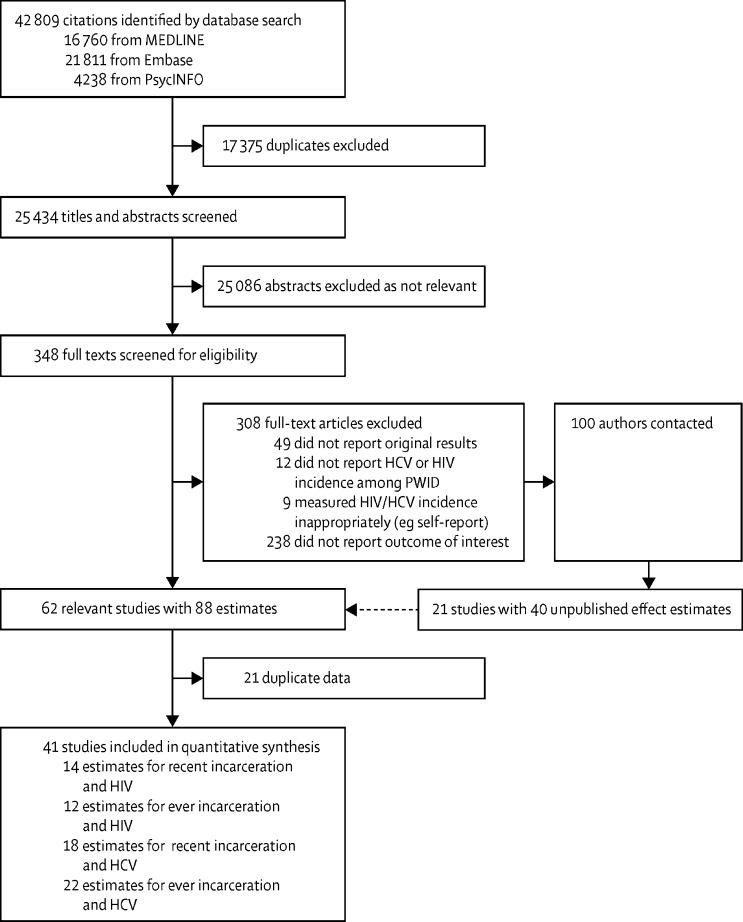
Methods: In this systematic review and meta-analysis, we searched MEDLINE, Embase, and PsycINFO databases for studies in any language published from Jan 1, 2000 until June 13, 2017 assessing HIV or HCV incidence among PWID. We included studies that measured HIV or HCV incidence among community-recruited PWID. We included only studies reporting original results and excluded studies that evaluated incident infections by self-report. We contacted authors of cohort studies that met the inclusion or exclusion criteria, but that did not report on the outcomes of interest, to request data. We extracted and pooled data from the included studies using random-effects meta-analyses to quantify the associations between recent (past 3, 6, or 12 months or since last follow-up) or past incarceration and HIV or HCV acquisition (primary infection or reinfection) risk among PWID. We assessed the risk of bias of included studies using the Newcastle-Ottawa Scale. Between-study heterogeneity was evaluated using the I2 statistic and the P-value for heterogeneity.
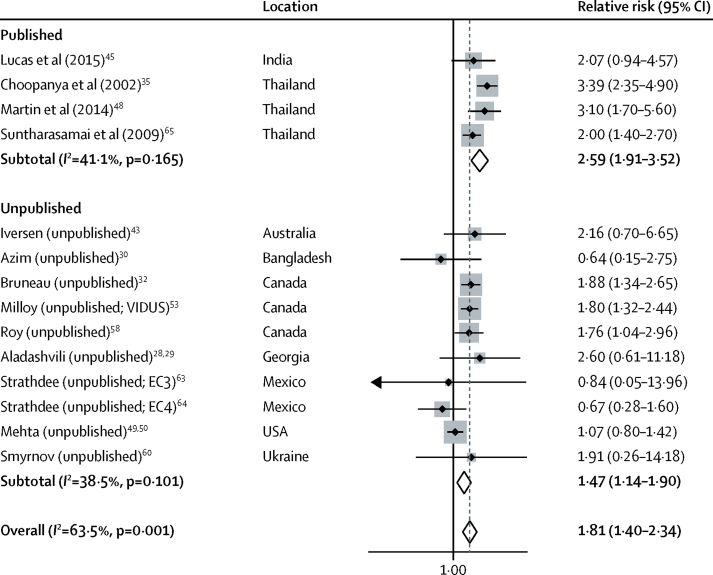
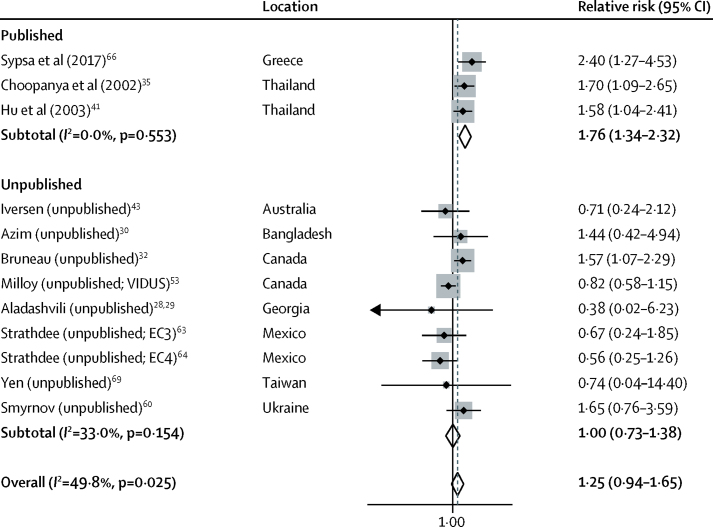
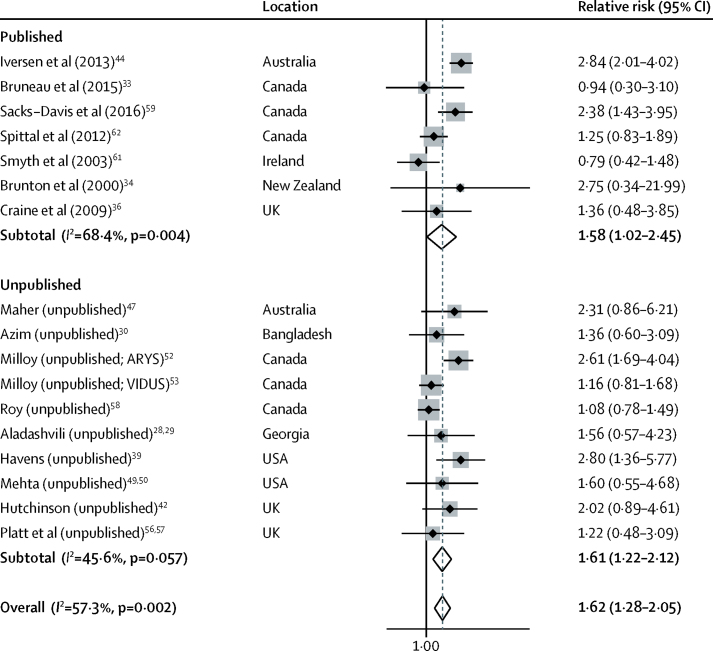
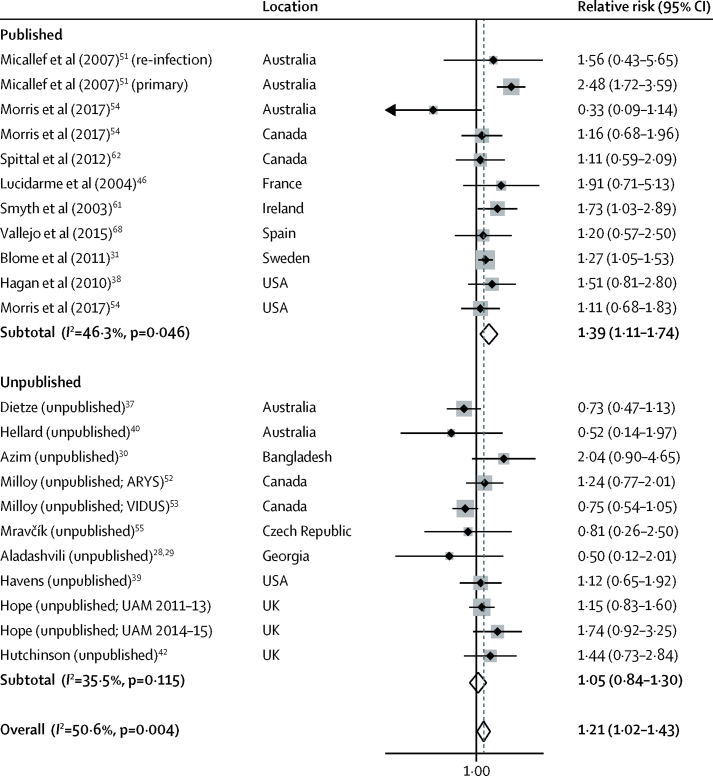
Findings: We included published results from 20 studies and unpublished results from 21 studies. These studies originated from Australasia, western and eastern Europe, North and Latin America, and east and southeast Asia. Recent incarceration was associated with an 81% (relative risk [RR] 1·81, 95% CI 1·40-2·34) increase in HIV acquisition risk, with moderate heterogeneity between studies (I2=63·5%; p=0·001), and a 62% (RR 1·62, 95% CI 1·28-2·05) increase in HCV acquisition risk, also with moderate heterogeneity between studies (I2=57·3%; p=0·002). Past incarceration was associated with a 25% increase in HIV (RR 1·25, 95% CI 0·94-1·65) and a 21% increase in HCV (1·21, 1·02-1·43) acquisition risk.
Interpretation: Incarceration is associated with substantial short-term increases in HIV and HCV acquisition risk among PWID and could be a significant driver of HCV and HIV transmission among PWID. These findings support the need for developing novel interventions to minimise the risk of HCV and HIV acquisition, including addressing structural risks associated with drug laws and excessive incarceration of PWID.
Funding: Engineering and Physical Sciences Research Council, National Institute for Health Research, National Institutes of Health.
Copyright © 2018 The Author(s). Published by Elsevier Ltd. This is an Open Access article under the CC BY 4.0 license. Published by Elsevier Ltd.. All rights reserved.
Figures
Comment in
-
Incarceration, drug use, and infectious diseases: a syndemic still not addressed.Lancet Infect Dis. 2018 Dec;18(12):1301-1302. doi: 10.1016/S1473-3099(18)30538-3. Epub 2018 Oct 29. Lancet Infect Dis. 2018. PMID: 30385159 No abstract available.
-
Understanding HIV and hepatitis C virus risk among incarcerated young men with histories of injecting drug use.Lancet Infect Dis. 2019 Feb;19(2):130-131. doi: 10.1016/S1473-3099(18)30801-6. Epub 2019 Jan 30. Lancet Infect Dis. 2019. PMID: 30722998 No abstract available.
References
-
- Degenhardt L, Charlson F, Stanaway J. Estimating the burden of disease attributable to injecting drug use as a risk factor for HIV, hepatitis C, and hepatitis B: findings from the Global Burden of Disease Study 2013. Lancet Infect Dis. 2016;16:1385–1398. - PubMed
-
- UNAIDS UNAIDS data. 2017. http://www.unaids.org/sites/default/files/media_asset/20170720_Data_book...
Publication types
MeSH terms
Grants and funding
- R01 DA029910/DA/NIDA NIH HHS/United States
- R01 DA033679/DA/NIDA NIH HHS/United States
- R01 DA043125/DA/NIDA NIH HHS/United States
- R21 DA042702/DA/NIDA NIH HHS/United States
- 12/3070/13/DH_/Department of Health/United Kingdom
- R01 DA012568/DA/NIDA NIH HHS/United States
- R01 DA033862/DA/NIDA NIH HHS/United States
- RP-PG-0616-20008/DH_/Department of Health/United Kingdom
- U01 DA036297/DA/NIDA NIH HHS/United States
- R01 DA024598/DA/NIDA NIH HHS/United States
- R01 DA030762/DA/NIDA NIH HHS/United States
- R01 DA031074/DA/NIDA NIH HHS/United States
- R37 DA019829/DA/NIDA NIH HHS/United States
- R01 DA041271/DA/NIDA NIH HHS/United States
- K24 DA017072/DA/NIDA NIH HHS/United States
- P30 AI036214/AI/NIAID NIH HHS/United States
- R01 DA037773/DA/NIDA NIH HHS/United States
- R21 DA041953/DA/NIDA NIH HHS/United States
LinkOut - more resources
Full Text Sources
Medical
Miscellaneous
