. 2018 Nov 2;362(6414):598-602.
doi: 10.1126/science.aaq0620.

Universal protection against influenza infection by a multidomain antibody to influenza hemagglutinin

Affiliations

Universal protection against influenza infection by a multidomain antibody to influenza hemagglutinin

Nick S Laursen et al. Science. .

Abstract

Broadly neutralizing antibodies against highly variable pathogens have stimulated the design of vaccines and therapeutics. We report the use of diverse camelid single-domain antibodies to influenza virus hemagglutinin to generate multidomain antibodies with impressive breadth and potency. Multidomain antibody MD3606 protects mice against influenza A and B infection when administered intravenously or expressed locally from a recombinant adeno-associated virus vector. Crystal and single-particle electron microscopy structures of these antibodies with hemagglutinins from influenza A and B viruses reveal binding to highly conserved epitopes. Collectively, our findings demonstrate that multidomain antibodies targeting multiple epitopes exhibit enhanced virus cross-reactivity and potency. In combination with adeno-associated virus-mediated gene delivery, they may provide an effective strategy to prevent infection with influenza virus and other highly variable pathogens.


Conflict of interest statement

Competing interests: Janssen Vaccines & Prevention B.V. has a pending patent application (WO/2016/124768) relating to certain molecules described in this manuscript.

Figures

Fig. 1.
Fig. 1.. In vitro neutralization of influenza A and B viruses by individual and genetically fused sdAbs.
In vitro potencies of SD36, SD38, SD83 and SD84 and genetically fused sdAbs SD38-SD36 and SD83-SD84 against selected influenza A and B viruses. Both SD38-SD36 and SD83-SD84 are statistically more potent (*: p-value <0.05) compared to each of their individual components (comparisons shown by the brackets) (see SI Materials and Methods). Data are representative of at least three independent experiments performed in quadruplicates.
Fig. 2.
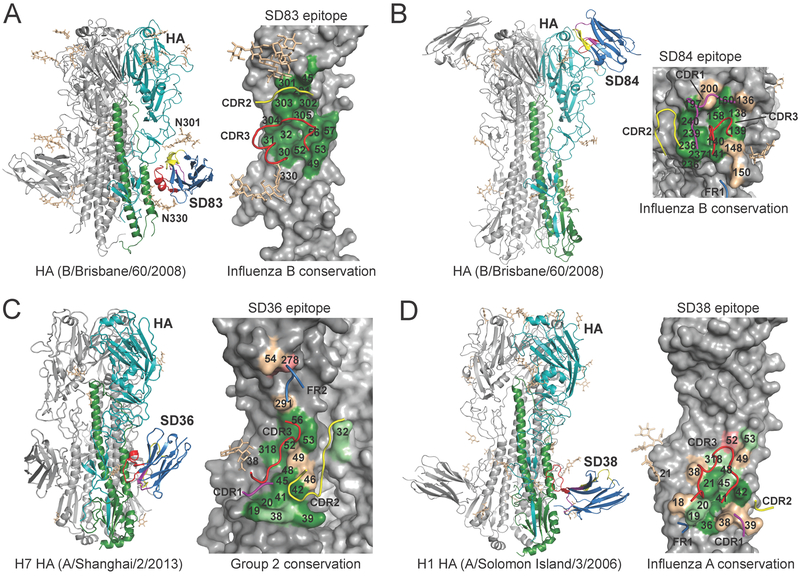
Fig. 2.. Crystal structures of sdAbs in complex with HAs and conservation of their epitopes.
(A) Crystal structure of SD83 with influenza B HA (B/Brisbane/60/08) at 2.2-Å resolution. One HA-SD83 protomer of the trimeric complex is colored with HA1 in green, HA2 in cyan, and SD83 in blue (left). CDR1 is colored in magenta, CDR2 in yellow, and CDR3 in red. The other HA protomers are colored in gray. N-linked glycans are shown in beige in stick representation. The epitope of SD83 is mapped onto the influenza B HA and colored by conservation across influenza B HAs (right). Dark green, over 95% conserved; light green, 75%–95% conserved; wheat, 50%–75% conserved and salmon, 35%–50% conserved. Only the CDR loops involved in the interaction are shown. (B) Crystal structure of SD84h with influenza B HA (B/Brisbane/60/08) as well as with CR9114 Fab at 4.1-Å resolution (left). Epitope of SD84h mapped onto the influenza B HA colored by conservation across influenza B HAs (right). For clarity, CR9114 Fab, which binds to the conserved HA stem region, is not shown. (C) Crystal structure of SD36 with H7 HA (A/Shanghai/2/13) at 2.65-Å resolution (left). Epitope of SD36 mapped onto the H7 HA colored by conservation across influenza A group 2 HAs (right). (D) Crystal structure of SD38 with H1 HA (A/Solomon Islands/3/06) at 2.8-Å resolution (left). Epitope of SD38 mapped onto the H1 HA colored by conservation across influenza A HAs (right).
Fig. 3.
Fig. 3.. In vitro neutralization of influenza A and B viruses by pan-influenza MDAbs MD2407 and MD3606 versus CR9114.
In vitro potencies of MD2407 (left), MD3606 (middle), and CR9114 (right) against a panel of 60 influenza A group 1 (blue), A group 2 (green), and B (red) viruses. Influenza strains tested together with their IC50 values are compiled in table S9. Both MD3606 and MD2407 are statistically more potent (p-value <0.05) than CR9114 (see SI Materials and Methods). Data are representative of at least three independent experiments performed in quadruplicate.
Fig. 4.
Fig. 4.. Prophylactic efficacy of recombinant and AAV-expressed MD3606 in mice challenged with influenza virus.
Survival curves of BALB/c mice (n = 8 per group) treated i.v. with the indicated doses of recombinant MD3606 1 day before challenge with a lethal dose (25 LD50) of (A) H1N1 (A/Puerto Rico/8/34-MA), (B) H3N2 (A/Hong Kong/1/68-MA), (C) H7N9 (A/Anhui/1/13), or (D) B (B/Florida/4/06-MA) virus. Survival curves of BALB/c mice (n = 5–8 per group) treated intranasally with the indicated doses of AAV9.MD3606h vector (expressed as genome copies (GC) per mouse) 7 days before challenge with a lethal dose (5 LD50) of (E) H1N1 (A/Puerto Rico/8/34-MA), (F) H3N2 (A/Hong Kong/1/68-MA), or (G) B (B/Lee/40-MA) virus. *Treatment significantly different from vehicle or naïve control (p-value <0.05) (see SI Materials and Methods).

Comment in

References

    1. World Health Organization (WHO), http://www.who.int/mediacentre/factsheets/fs211/en.
    1. Liu J et al., Highly pathogenic H5N1 influenza virus infection in migratory birds. Science 309, 1206 (2005). - PubMed
    1. Chen H et al., Avian flu: H5N1 virus outbreak in migratory waterfowl. Nature 436, 191–192 (2005). - PubMed
    1. Gao R et al., Human infection with a novel avian-origin influenza A (H7N9) virus. N. Engl. J. Med 368, 1888–1897 (2013). - PubMed
    1. Osterholm MT, Kelley NS, Sommer A, Belongia EA, Efficacy and effectiveness of influenza vaccines: a systematic review and meta-analysis. Lancet Infect Dis 12, 36–44 (2012). - PubMed

Publication types

MeSH terms