


Management of recurrent prostate cancer after radiotherapy: long-term results from CALGB 9687 (Alliance), a prospective multi-institutional salvage prostatectomy series
- PMID: 30385835
- PMCID: PMC6494708
- DOI: 10.1038/s41391-018-0106-1
Management of recurrent prostate cancer after radiotherapy: long-term results from CALGB 9687 (Alliance), a prospective multi-institutional salvage prostatectomy series
Abstract
Background: To evaluate efficacy and morbidity prospectively in a contemporary multi-institutional salvage radical prostatectomy (SRP) series.
Methods: Forty-one men were enrolled between 1997 and 2006, who suffered biopsy-proven recurrent prostate cancer (CaP) after receiving ≥ 60c Gy radiation as primary treatment for cT1-2NXM0 disease. Surgical morbidity, quality of life, biochemical progression-free survival (BPFS) and overall survival (OS) were evaluated.
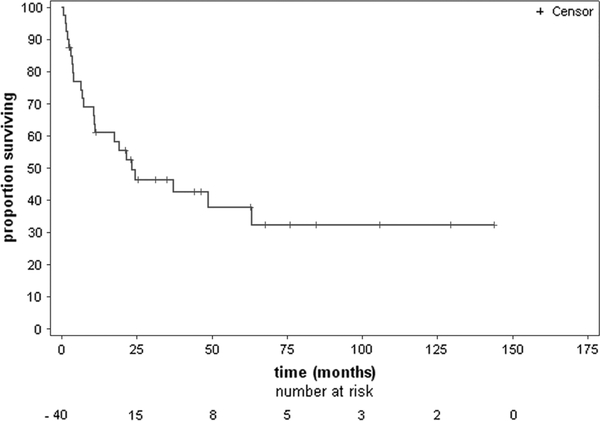
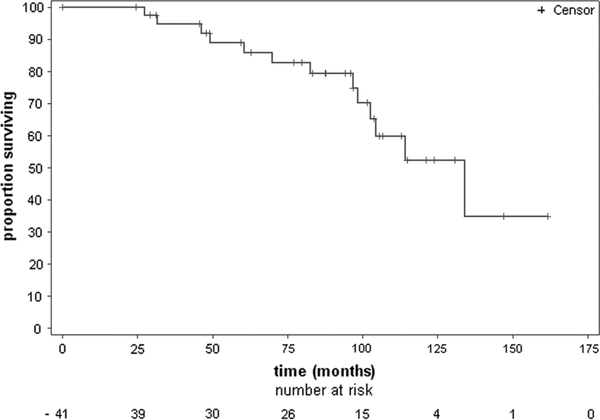
Results: Twenty-four men had undergone external beam radiotherapy, 11 brachytherapy, and six both. Median time between radiation and SRP was 64 months. Median age at SRP was 64 years. Pathologic staging revealed 44% pT2, 54% pT3, and 3% pT4. Surgical margins were positive in 17 and 88% were pN0. Twenty-two percent required intraoperative blood transfusion. Three rectal and one obturator nerve injuries occurred. Seventeen of 38 evaluable patients (45%) had urinary incontinence ( ≥ 3 pads/day) prior to SRP; 88% reported urinary incontinence at 6 months, 85% at 12 months, 63% at 24 months after SRP. Furthermore, 37% of men reported impotence prior to SRP; 78% reported impotence at 6 months, 82% at 12 months, and 44% at 24 months after SRP. The 2-, 5- and 10-year BPFS rates were 51, 39, and 33% respectively; the 2-, 5- and 10-year OS rates were 100, 89, and 52%, respectively, at median follow-up 91 months.
Conclusions: Modern surgical techniques continue to be associated with significant peri-operative complication rates. Nevertheless, SRP may benefit carefully selected patients through durable oncologic control.
Conflict of interest statement
Compliance with ethical standards
Figures
References
-
- Meng MV, Elkin EP, Latini DM, Duchane J, Carroll PR. Treatment of patients with high risk localized prostate cancer: results from cancer of the prostate strategic urological research endeavor (CaPSURE). J Urol. 2005;173:1557–61. - PubMed
-
- Kupelian PA, Buchsbaum JC, Patel C, Elshaikh M, Reddy CA, Zippe C et al. Impact of biochemical failure on overall survival after radiation therapy for localized prostate cancer in the PSA era. Int J Radiat Oncol Biol Phys. 2002;52:704–11. - PubMed
-
- Zelefsky MJ, Fuks Z, Hunt M, Lee HJ, Lombardi D, Ling CC et al. High dose radiation delivered by intensity modulated conformal radiotherapy improves the outcome of localized prostate cancer. J Urol. 2001;166:876–81. - PubMed
-
- Shipley WU, Thames HD, Sandler HM, Hanks GE, Zietman AL, Perez CA et al. Radiation therapy for clinically localized prostate cancer: a multi-institutional pooled analysis. JAMA. 1999;281:1598–604. - PubMed
Publication types
MeSH terms
Grants and funding
- U10 CA047577/CA/NCI NIH HHS/United States
- UG1 CA233290/CA/NCI NIH HHS/United States
- CA33601/CA/NCI NIH HHS/United States
- P30 CA016056/CA/NCI NIH HHS/United States
- U10 CA031946/CA/NCI NIH HHS/United States
- U10 CA033601/CA/NCI NIH HHS/United States
- U10 CA180821/CA/NCI NIH HHS/United States
- P30 CA008748/CA/NCI NIH HHS/United States
- U10 CA180791/CA/NCI NIH HHS/United States
- U10 CA041287/CA/NCI NIH HHS/United States
- U10 CA047559/CA/NCI NIH HHS/United States
- U10 CA077651/CA/NCI NIH HHS/United States
- UG1 CA233191/CA/NCI NIH HHS/United States
- U10 CA180882/CA/NCI NIH HHS/United States
- CA47577/CA/NCI NIH HHS/United States
- CA60138/CA/NCI NIH HHS/United States
- CA59518/CA/NCI NIH HHS/United States
- CA77651/CA/NCI NIH HHS/United States
- U10 CA180866/CA/NCI NIH HHS/United States
LinkOut - more resources
Full Text Sources
Medical
Miscellaneous
