


Higher baseline dietary fat and fatty acid intake is associated with increased risk of incident prostate cancer in the SABOR study
- PMID: 30385837
- PMCID: PMC6685438
- DOI: 10.1038/s41391-018-0105-2
Higher baseline dietary fat and fatty acid intake is associated with increased risk of incident prostate cancer in the SABOR study
Abstract
Background: To study the association of nutrient intake measured by baseline food frequency questionnaire and risk of subsequent prostate cancer (PCa) in the SABOR (San Antonio Biomarkers of Risk) cohort study.
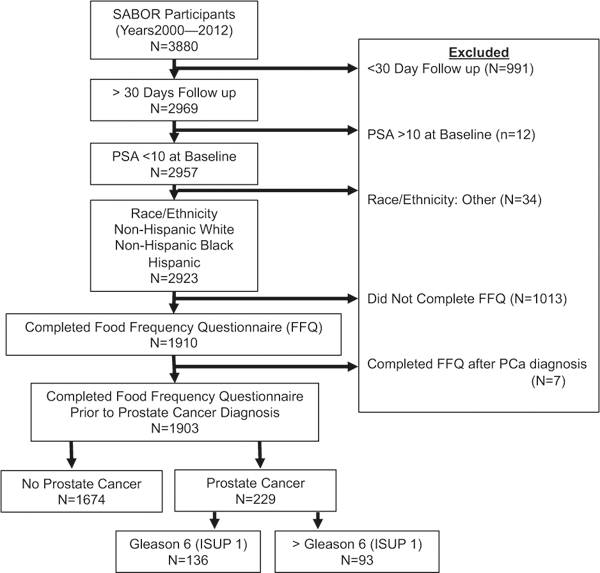
Methods: After IRB approval, more than 1903 men enrolled in a prospective cohort from 2000 to 2010 as part of the SABOR clinical validation site for the National Cancer Institute Early Detection Research Network. Food and nutrient intakes were calculated using a Food Frequency Questionnaire. Cox proportional hazards modeling and covariate-balanced propensity scores were used to assess the associations between all nutrients and PCa.
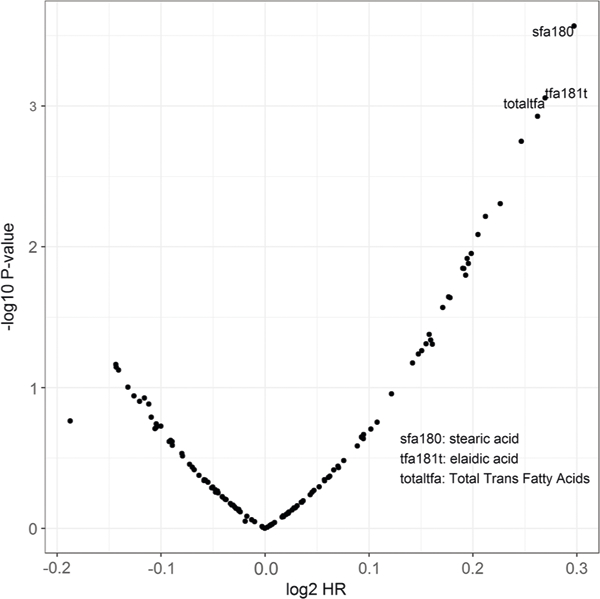
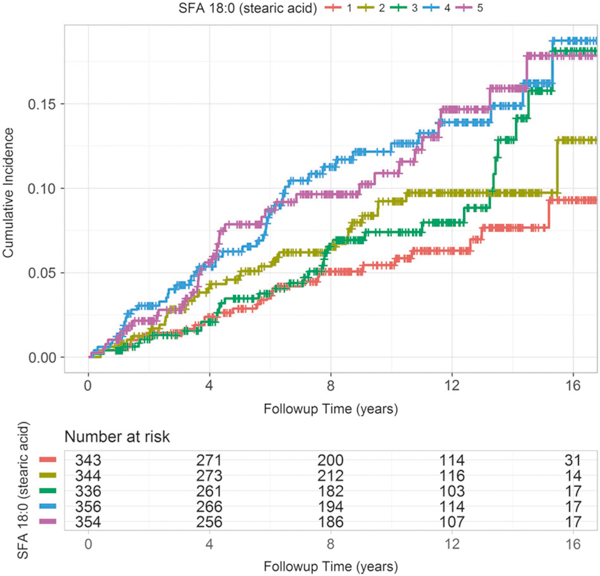
Results: A total of 229 men were diagnosed with PCa by prostate biopsy. Among all nutrients, increased risk of PCa was associated with intake of dietary fat scaled by the total caloric intake, particularly saturated fatty acid (SFA) [HR 1.19; 95% CI, 1.07-1.32), P value < 0.001, False discovery rate (FDR) 0.047] and trans fatty acid (TFA) [HR per quintile 1.21; (95% CI) (1.08-1.35), P < 0.001, FDR 0.039]. There was an increased risk of PCa with increasing intake of monounsaturated fatty acid (MUFA) (HR per quintile 1.14; 95% CI 1.03-1.27, P = 0.01, FDR 0.15) and cholesterol [HR per quintile 1.13; 95% confidence interval (95% CI) (1.02-1.26), P-value 0.02, FDR 0.19].
Conclusion: After examining a large, population-based cohort for PCa diagnosis, we identified dietary total fat and certain fatty acids as associated with increased risk of PCa. We found no factors that were protective from PCa. Dietary modification of fatty acid intake may reduce risk of PCa.
Conflict of interest statement
Figures
Comment in
-
Dysregulated metabolism: a relevant player in prostate cancer progression and clinical management.Transl Androl Urol. 2019 Mar;8(Suppl 1):S109-S111. doi: 10.21037/tau.2018.12.05. Transl Androl Urol. 2019. PMID: 31143683 Free PMC article. No abstract available.
-
Dietary intake and prostate cancer, continued pursuit for evidence.Transl Androl Urol. 2019 Jul;8(Suppl 3):S246-S249. doi: 10.21037/tau.2019.01.08. Transl Androl Urol. 2019. PMID: 31392135 Free PMC article. No abstract available.
References
-
- Bray F, Jemal A, Grey N, Ferlay J, Forman D. Global cancer transitions according to the Human Development Index (2008–2030): a population-based study. Lancet Oncol. 2012;13:790–801. - PubMed
-
- Center MM, Jemal A, Lortet-Tieulent J, Ward E, Ferlay J, Brawley O, et al. International variation in prostate cancer incidence and mortality rates. Eur Urol. 2012;61:1079–92. - PubMed
-
- Ferlay J, Soerjomataram I, Dikshit R, Eser S, Mathers C, Rebelo M, et al. Cancer incidence and mortality worldwide: sources, methods and major patterns in GLOBOCAN 2012. Int J Cancer. 2015;136:E359–386. - PubMed
-
- Lichtenstein P, Holm NV, Verkasalo PK, Iliadou A, Kaprio J, Koskenvuo M, et al. Environmental and heritable factors in the causation of cancer—analyses of cohorts of twins from Sweden, Denmark, and Finland. N Engl J Med. 2000; 343:78–85. - PubMed
-
- Rose DP, Boyar AP, Wynder EL. International comparisons of mortality rates for cancer of the breast, ovary, prostate, and colon, and per capita food consumption. Cancer. 1986;58:2363–71. - PubMed
Publication types
MeSH terms
Substances
Grants and funding
LinkOut - more resources
Full Text Sources
Medical
