. 2018 Nov 1;8(1):16185.
doi: 10.1038/s41598-018-33450-7.

Impact of long-term daylight deprivation on retinal light sensitivity, circadian rhythms and sleep during the Antarctic winter

Affiliations

Impact of long-term daylight deprivation on retinal light sensitivity, circadian rhythms and sleep during the Antarctic winter

A Kawasaki et al. Sci Rep. .

Abstract

Long-term daylight deprivation such as during the Antarctic winter has been shown to lead to delayed sleep timing and sleep fragmentation. We aimed at testing whether retinal sensitivity, sleep and circadian rest-activity will change during long-term daylight deprivation on two Antarctic bases (Concordia and Halley VI) in a total of 25 healthy crew members (mean age: 34 ± 11y; 7f). The pupil responses to different light stimuli were used to assess retinal sensitivity changes. Rest-activity cycles were continuously monitored by activity watches. Overall, our data showed increased pupil responses under scotopic (mainly rod-dependent), photopic (mainly L-/M-cone dependent) as well as bright-blue light (mainly melanopsin-dependent) conditions during the time without direct sunlight. Circadian rhythm analysis revealed a significant decay of intra-daily stability, indicating more fragmented rest-activity rhythms during the dark period. Sleep and wake times (as assessed from rest-activity recordings) were significantly delayed after the first month without sunlight (p < 0.05). Our results suggest that during long-term daylight deprivation, retinal sensitivity to blue light increases, whereas circadian rhythm stability decreases and sleep-wake timing is delayed.


Conflict of interest statement

The authors declare no competing interests.

Figures
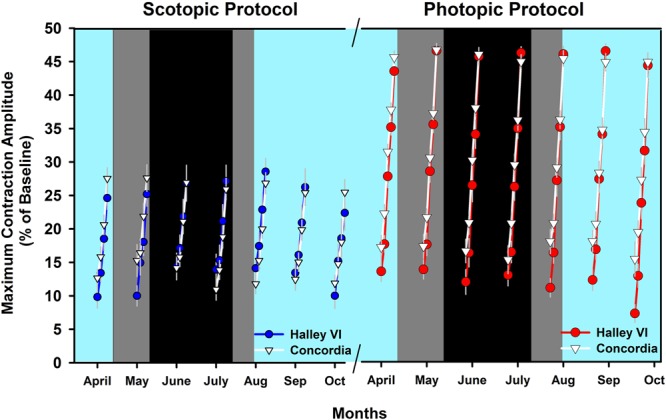
Figure 1
Figure 1
Maximum contraction amplitudes, averaged per condition and light stimulus for the rod-weighted protocol (scotopic; left) and cone weighted protocol (photopic; right). Red and blue filled circles depict averages for Halley VI and white filled triangles indicate results from Concordia (mean ± SEM). The cyan background indicates the weeks with direct sunlight (the data points are centered to the middle of each month), and the dark background is the period without direct sunlight. Within this period without direct sunlight, the black background indicates complete absence of sunlight (nautical/astronomical twilight) and the dark gray background indicates civil twilight (see legend of Supplemental Fig. S1 for definitions of civil, nautical and astronomical twilight).
Figure 2
Figure 2
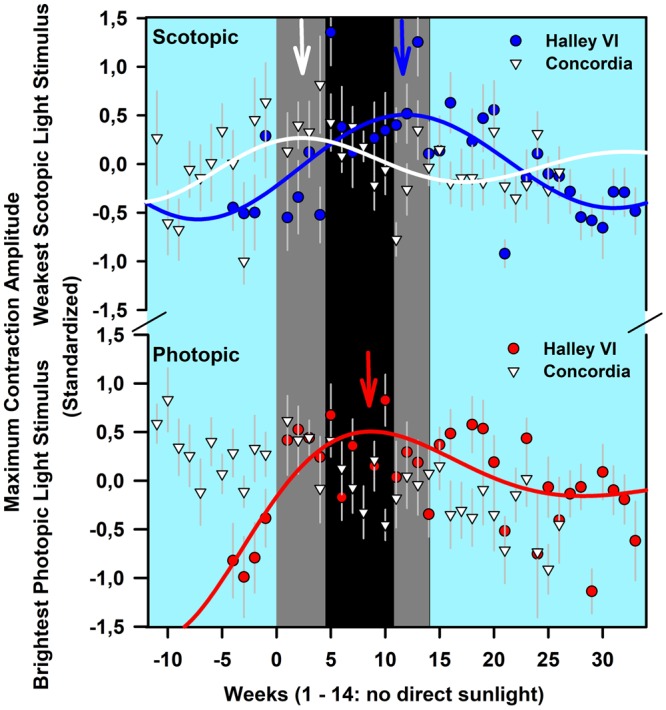
Maximum contraction amplitudes on standardized data (z-scores) for all weeks for the weakest light stimulus (−4 log cd/m2) of the rod-weighted protocol (upper graph; please note two upper error bars from Halley VI are partly cut) and the brightest red light stimulus of the cone weighted protocol (2.6 log cd/m2; lower graph). Red and Blue filled circles depict averages for Halley VI and white filled triangles indicate results from Concordia. The arrows indicate the greatest maximum contraction amplitudes (see text for exact hours and R2-values). The first week from Halley VI was excluded because it contained only one participant. Otherwise, means per station ± SEM are shown. The solid lines indicate the regression line from nonlinear sine fits. For the cone-weighted protocol there was a linear association for the Concordia station (not shown). The cyan background indicates weeks with direct sunlight, and the dark background is the period without direct sunlight. Within this period without direct sunlight, the black background indicates complete absence of sunlight (nautical/astronomical twilight) and the dark gray background indicates civil twilight (see legend of Supplemental Fig. S1 for definitions of civil, nautical and astronomical twilight). The blue, red and white arrows at the top indicate the week with the maximum contraction amplitudes (derived from fitted lines; see text for exact numbers).
Figure 3
Figure 3
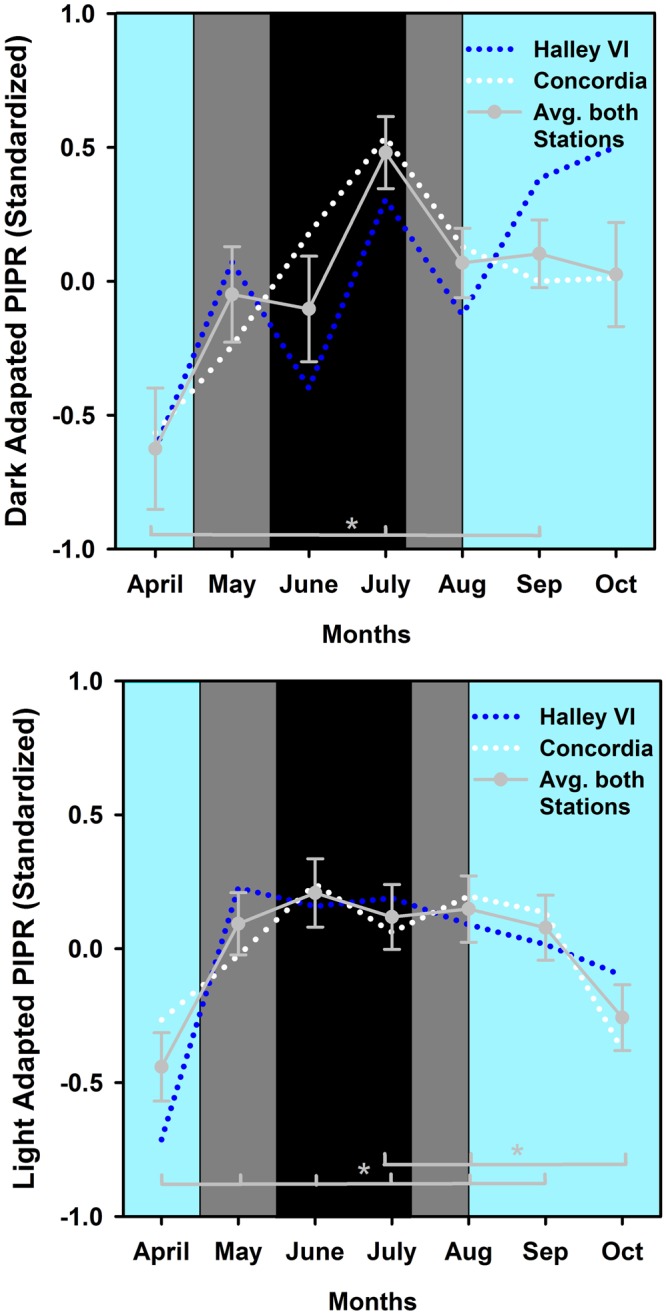
(a,b) Monthly bins for dark (a) and light adapted PIPR [(b); average of both light stimuli on standardized data (z-scores)]. The data is plotted per month and the months are labeled as approximate calendar months (the data points are centered to the middle of each month). The dotted blue line represents Halley VI and the dotted white Concordia station. The solid gray line and circles indicate the average of both stations and SEM (n = 24). The cyan background indicates weeks with direct sunlight, the dark grey areas indicate weeks without direct sunlight but civil twilight and the black area shows the time without direct sunlight and without civil twilight.
Figure 4
Figure 4
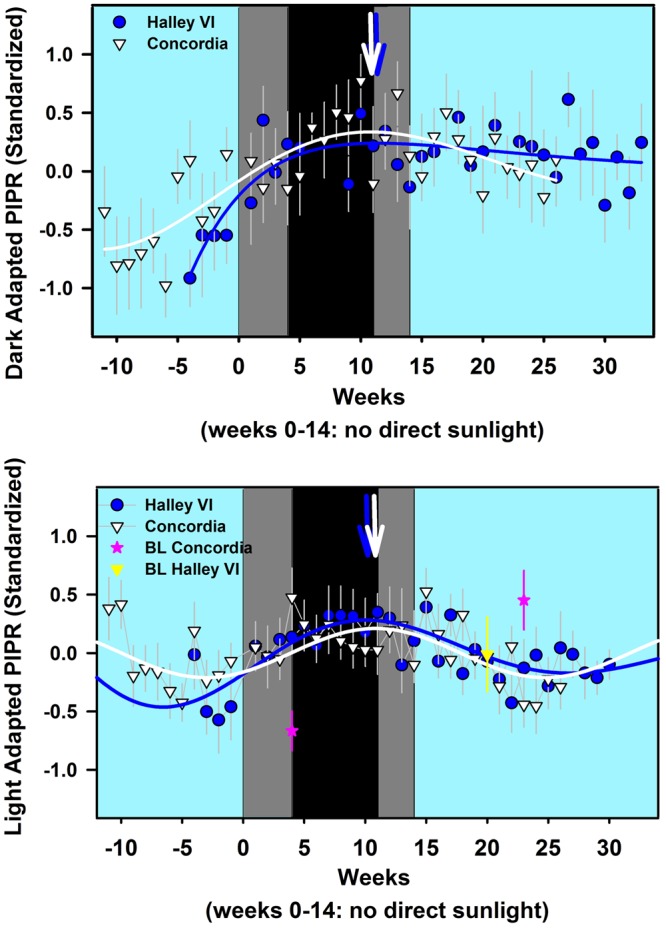
(a,b) Nonlinear curve fits for dark adapted PIPR (a) and light adapted PIPR (b) across all week on standardized data (z-scores) as a function of time for both stations (Halley VI: solid blue line; Concordia: solid white line; n = 24) Blue and white symbols indicate weekly averages for both stations (± SEM). The pink stars indicate baseline values for Concordia, taken during the pre-and post mission measures and the yellow triangle indicates the pre-mission measures for Halley VI (no post-mission recordings, see methods). The blue and white arrows at the top indicate the week with the maximum PIPR (derived from fitted lines; see text for exact numbers). The cyan background indicates weeks with direct sunlight, the light grey areas indicate weeks without direct sunlight but civil twilight and the black area shows the time without direct sunlight and without civil twilight.
Figure 5
Figure 5
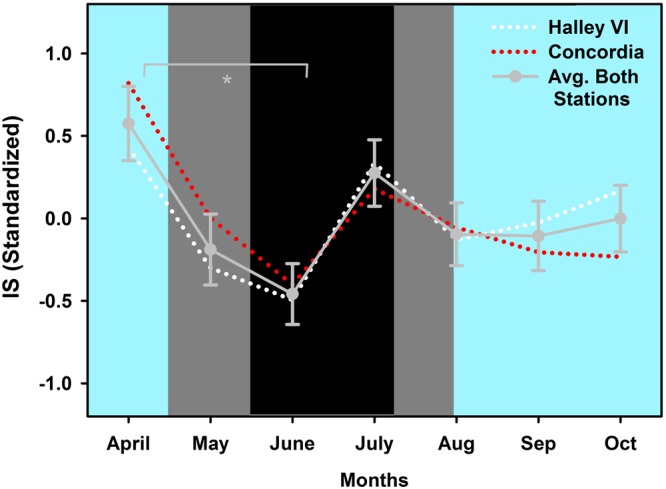
Inter-daily stability for both stations on standardized data (z-scores; white dotted line: Halley VI; red dotted line: Concordia) and averaged across stations (grey solid line and grey circles; ±SEM) across 7 months. *Significant main effect of TIME between month 1 (April) and month 3 (June; p < 0.05). The cyan background indicates weeks with direct sunlight, the grey areas indicate weeks without direct sunlight but civil twilight and the black area shows the time without direct sunlight and without civil twilight.
Figure 6
Figure 6
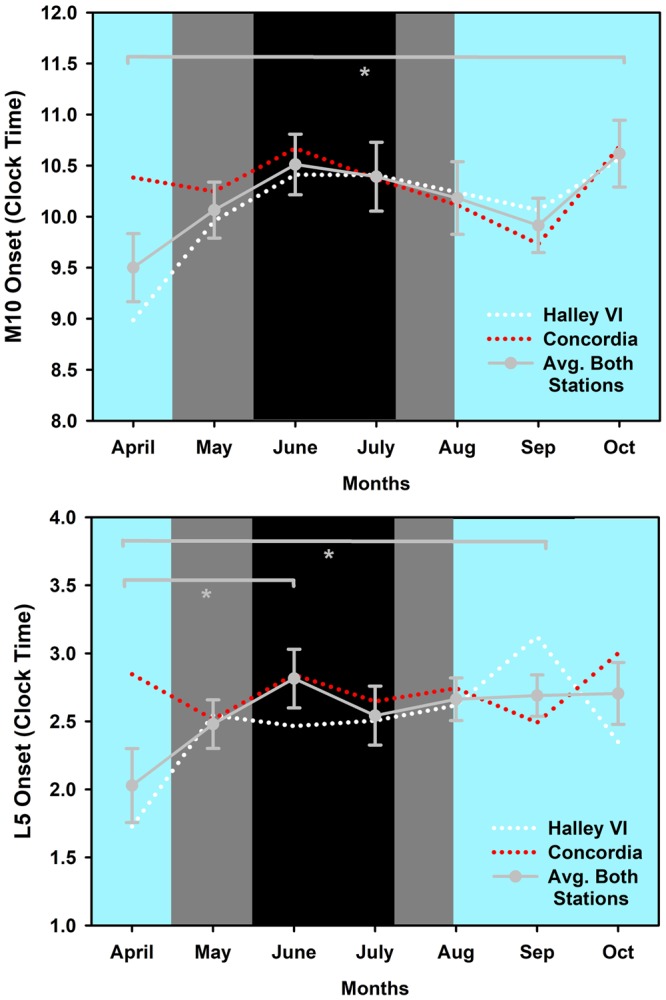
(a,b) These Figures show the time onset for the 10 hours with highest activity (M10on; a) and the time onset for the 5 hours with lowest activity (L5on; b). Those are shown in clock time and averaged per month for both stations (means, SEM).

References

    1. Davies T, Smyth T. Why artificial light at night should be a focus for global change research in the 21st century. Glob Chang Biol. 2018;24:872–882. doi: 10.1111/gcb.13927. - DOI - PubMed
    1. Beute F, de Kort Y. The natural context of wellbeing: Ecological momentary assessment of the influence of nature and daylight on affect and stress for individuals with depression levels varying from none to clinical. Health Place. 2018;49:7–18. doi: 10.1016/j.healthplace.2017.11.005. - DOI - PubMed
    1. Lunn R, et al. Health consequences of electric lighting practices in the modern world: a report on the National Toxicology Program’s workshop on shift work at night, artificial light at night, and circadian disruption. The Science of the total environment. 2017;608:1073–1084. doi: 10.1016/j.scitotenv.2017.07.056. - DOI - PMC - PubMed
    1. Smolensky M, Sackett-Lundeen L, Portaluppi F. Nocturnal light pollution and underexposure to daytime sunlight: Complementary mechanisms of circadian disruption and related diseases. Chronobiol Int. 2015;32:1029–1048. doi: 10.3109/07420528.2015.1072002. - DOI - PubMed
    1. Boubekri M, Cheung IN, Reid K, Wang C, Zee P. Impact of windows and daylight exposure on overall health and sleep quality of office workers: a case-control pilot study. J Clin Sleep Med. 2014;10:603–611. - PMC - PubMed

Publication types