. 2018 Oct 17:9:2177.
doi: 10.3389/fimmu.2018.02177. eCollection 2018.

Active Human Complement Reduces the Zika Virus Load via Formation of the Membrane-Attack Complex

Affiliations

Active Human Complement Reduces the Zika Virus Load via Formation of the Membrane-Attack Complex

Britta Schiela et al. Front Immunol. .

Abstract

Although neglected in the past, the interest on Zika virus (ZIKV) raised dramatically in the last several years. The rapid spread of the virus in Latin America and the association of the infection with microcephaly in newborns or Guillain-Barré Syndrome in adults prompted the WHO to declare the ZIKV epidemic to be an international public health emergency in 2016. As the virus gained only limited attention in the past, investigations on interactions of ZIKV with human complement are limited. This prompted us to investigate the stability of the virus to human complement. At low serum concentrations (10%) which refers to complement concentrations found on mucosal surfaces, the virus was relatively stable at 37°C, while at high complement levels (50% serum concentration) ZIKV titers were dramatically reduced, although the virus remained infectious for about 4-5 min under these conditions. The classical pathway was identified as the main actor of complement activation driven by IgM antibodies. In addition, direct binding of C1q to both envelope and NS1 proteins was observed. Formation of the MAC on the viral surface and thus complement-mediated lysis and not opsonization seems to be essential for the reduction of viral titers.

Keywords: C1q; IgM; MAC; Zika virus; complement; lysis.


Figures
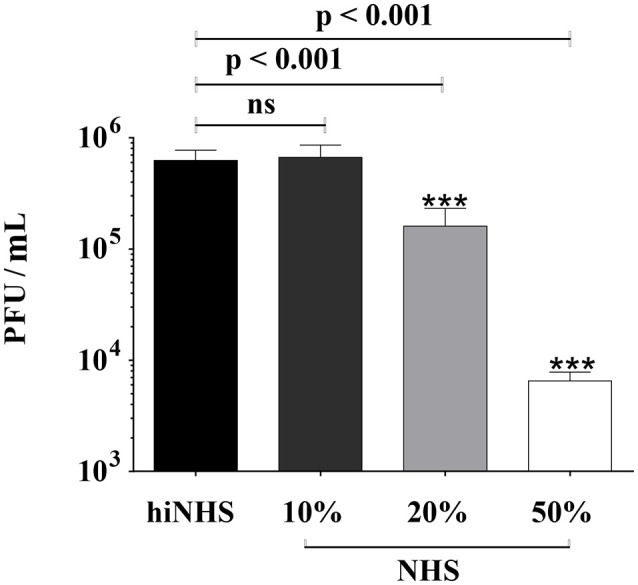
Figure 1
Figure 1
Effect of human serum on ZIKV infectivity. ZIKV [1 x 10⁶ PFU/mL] was incubated with active normal human serum (NHS) or 50% heat-inactivated NHS (hiNHS) for 1 h at 37°C. Thereafter, 10-fold dilutions of pre-incubated virus-serum mixtures were titrated on Vero cells. Plaques were visualized 4 days post infection using crystal violet staining. Data were analyzed with one-way-ANOVA with Bonferroni post-hoc comparison (***p < 0.001; ns indicates not significant). Mean data of at least 3 independent experiments are shown. The error bars represent the standard deviation.
Figure 2
Figure 2
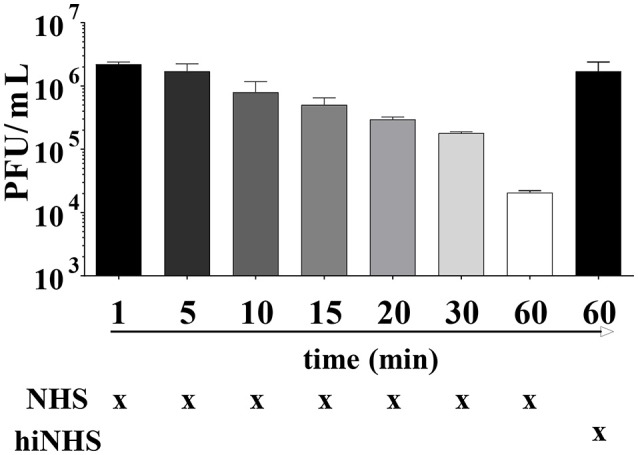
Time as a limiting factor on ZIKV infectivity. ZIKV [1 x 10⁶ PFU/mL] was mixed with 50% active or heat-inactivated NHS and incubated for different time points (ranging from 1 min to 1 h) at 37°C. Virus-containing samples were then serially diluted and titrated on Vero cells. After 1 h incubation at 37°C, the cells were overlaid with agarose. Viral concentration was determined 4 days post infection using crystal violet staining. Mean data of 3 independent experiments are shown. The error bars represent the standard deviation.
Figure 3
Figure 3
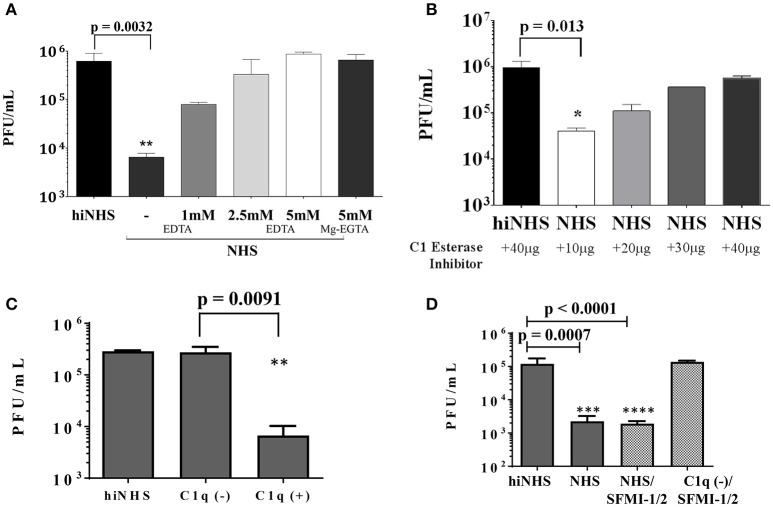
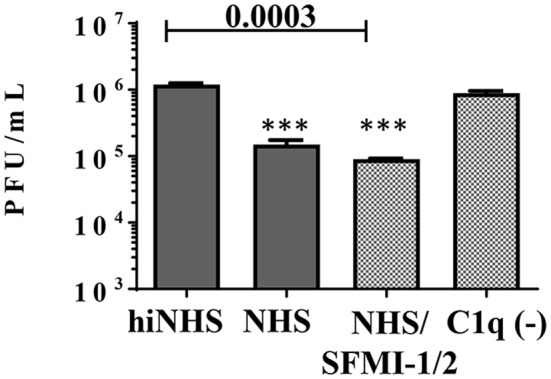
(A) EDTA inhibition confirms complement contribution to viral lysis. ZIKV [1 x 10⁶ PFU/mL] was incubated with active or heat-inactivated human serum in the presence of increasing amounts of EDTA or Mg2+-EGTA. DMEM (not shown) and hiNHS were used as controls. (B) To prevent activation of the classical and lectin complement pathways, active or heat-inactivated human serum was pre-incubated with increasing amounts of C1 esterase inhibitor as indicated. (C) In the absence of C1q, most of the virus remained infectious whereas addition of purified C1q (70 μg/mL) restored the lytic effect on the virus. HiNHS was set to 100%. (D) Blocking of the lectin pathway by synthetic peptides (SFMI-1/2) did not rescue the virus. Combination of C1q-depleted serum and SFMI-1/2 served as additional control showing that the peptides had no effect on the infectivity of the virus. In all experiments, the viral titer was determined by plaque assays using Vero cells. Data were analyzed with one-way-ANOVA with Bonferroni post-hoc comparison (**p < 0.005). All virus lysis experiments were conducted in duplicates and repeated three times. The data represent mean values, and the error bars show standard deviations.
Figure 4
Figure 4
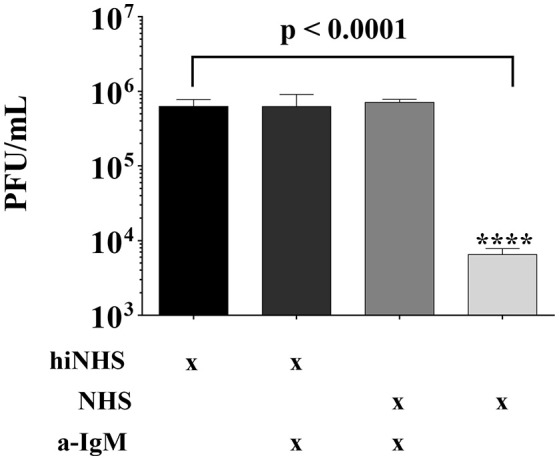
Natural IgM blocking results in ZIKV rescue. Anti-human IgM blocking antibodies were incubated with 50% NHS or hiNHS for 30 min on ice before ZIKV was added. After incubation of 1 h at 37°C, the virus-serum mixture was serially diluted and titrated on Vero cells. After 1 h r incubation at 37°C, the cells were overlaid with agarose. Viral concentration was determined4 days post infection using crystal violet staining. All virus lysis experiments were conducted in triplicate, and the error bars show standard deviations.
Figure 5
Figure 5
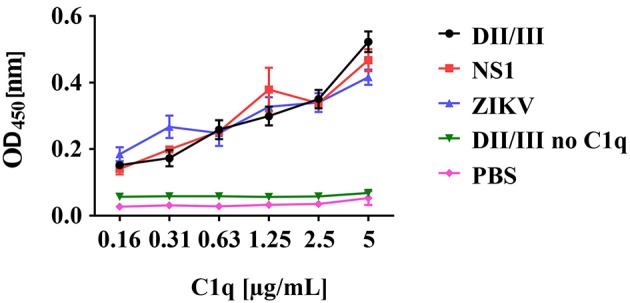
Binding of C1q to recombinant ZIKV envelope (E) and NS1 proteins. ZIKV proteins or viral particles were coated to ELISA plates and incubated with decreasing amounts of C1q as indicated. Bound C1q was detected using a polyclonal anti-C1q antibody followed by a HRP-labeled goat anti-rabbit IgG and visualized by TMB. The absorbance was measured at 450 nm, using a Bio-Rad plate reader. Data show the mean of two experiments performed in duplicate.
Figure 6
Figure 6
Dissecting the role of the lectin and classical pathways on ZIKV derived from the human cell line A549. NHS (50%) reduced the viral titer for about one order of magnitude. Inhibition of the lectin pathway by a peptide mix of SFMI-1 and 2 had no effect. By contrast, C1q depletion rescued the virus and most of the virus remained infectious. Viral titer was determined by plaque assays using Vero cells. Data were analyzed with one-way-ANOVA with Bonferroni post-hoc comparison (**p < 0.005). All virus lysis experiments were conducted in duplicates and repeated two times. The data represent mean values, and the error bars show standard deviations.
Figure 7
Figure 7
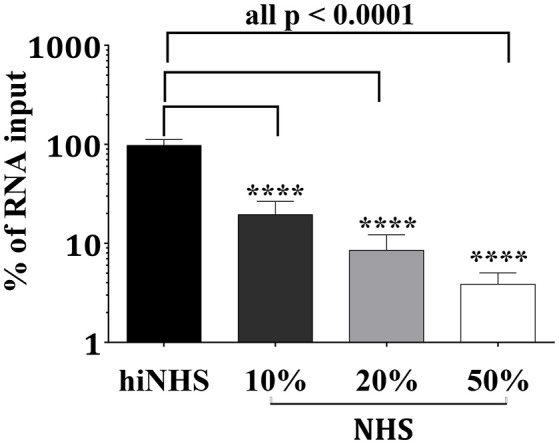
Reduction of viral infectivity is linked to decreased RNA levels. After incubating ZIKV with active or heat-inactivated human serum, the viral RNA was digested by addition of RNases. Three hours after incubation at 37°C, the remaining genomic material was extracted and quantified by RT-PCR. The RNA copy number was calculated from the amount of RNA obtained by incubation of the virions with 50% hiNHS, which was set to 100%. Results are given as % of RNA loss. Data were analyzed with one-way-ANOVA with Bonferroni post-hoc comparison (****p < 0.0001). All virus lysis experiments were conducted in triplicate. The data represent mean values, and the error bars show standard deviations.
Figure 8
Figure 8
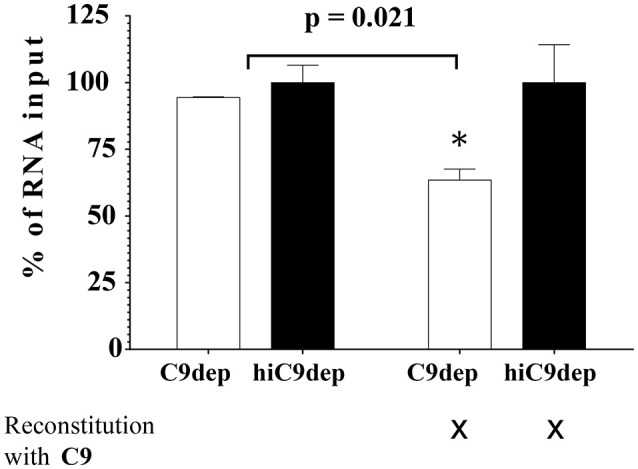
Blocking the assembly of MAC leads to virus rescue. ZIKV [1 x 10⁶ PFU/mL] was exposed to either 50% C9-depleted (C9dep) human serum or 50% heat-inactivated C9-depleted (hiC9dep) serum for 1 h at 37°C. As a control, the depleted serum was reconstituted with purified C9 protein, adjusted to its natural concentration in serum [60 μg/mL]. During incubation, the RNA of lysed ZIKV was digested by external RNase addition. Subsequently, the amount of complement lysis-resistant virions was determined by RT-PCR. The RNA copy number was calculated by incubation of the virions with 50% hiNHS, which was set to 100%. Results are given as % of RNA loss. All assays were performed in triplicate. The data represent mean values, and the error bars show standard deviations.

References

    1. Lindenbach BD, Rice CM. Molecular biology of flaviviruses. Adv Virus Res. (2003) 59:23–61. 10.1016/S0065-3527(03)59002-9 - DOI - PubMed
    1. Kuno G, Chang GJ. Biological transmission of arboviruses: reexamination of and new insights into components, mechanisms, and unique traits as well as their evolutionary trends. Clin Microbiol Rev. (2005) 18:608–37. 10.1128/CMR.18.4.608-637.2005 - DOI - PMC - PubMed
    1. Hasan SS, Sevvana M, Kuhn RJ, Rossmann MG. Structural biology of Zika virus and other flaviviruses. Nat Struct Mol Biol. (2018) 25:13–20. 10.1038/s41594-017-0010-8 - DOI - PubMed
    1. Avirutnan P, Mehlhop E, Diamond MS. Complement and its role in protection and pathogenesis of flavivirus infections. Vaccine (2008) 26(Suppl. 8):I100–7. 10.1016/j.vaccine.2008.11.061 - DOI - PMC - PubMed
    1. Conde JN, Silva EM, Barbosa AS, Mohana-Borges R. The Complement system in flavivirus infections. Front Microbiol. (2017) 8:213. 10.3389/fmicb.2017.00213 - DOI - PMC - PubMed

Publication types