. 2018 Oct 17:9:479.
doi: 10.3389/fgene.2018.00479. eCollection 2018.

Parental Mosaicism in PAX6 Causes Intra-Familial Variability: Implications for Genetic Counseling of Congenital Aniridia and Microphthalmia

Affiliations

Parental Mosaicism in PAX6 Causes Intra-Familial Variability: Implications for Genetic Counseling of Congenital Aniridia and Microphthalmia

María Tarilonte et al. Front Genet. .

Abstract

Mutations in PAX6 are involved in several developmental eye disorders. These disorders have considerable phenotypic variability, ranging from panocular forms of congenital aniridia and microphthalmia to isolated anomalies of the anterior or posterior segment. Here, we describe 3 families with variable inter-generational ocular expression of aniridia, iris coloboma, or microphthalmia, and an unusual transmission of PAX6 mutations from an unaffected or mildly affected parent; all of which raised suspicion of gonosomal mosaicism. We first identified two previously known nonsense mutations and one novel likely pathogenic missense variant in PAX6 in probands by means of targeted NGS. The subsequent segregation analysis by Sanger sequencing evidenced the presence of highly probable mosaic events in paternal blood samples. Mosaicism was further confirmed by droplet digital PCR analysis in several somatic tissues of mosaic fathers. Quantification of the mutant allele fraction in parental samples showed a marked deviation from 50%, with a range between 12 and 29% depending on cell type. Gonosomal mosaicsm was definitively confirmed in one of the families thanks to the availability of a sperm sample from the mosaic father. Thus, the recurrence risk in this family was estimated to be about one-third. This is the first report confirming parental PAX6 mosaicism as a cause of disease recurrence in aniridia and other related phenotypes. In addition, we demonstrated that post-zygotic mosaicism is a frequent and underestimated pathogenic mechanism in aniridia, explaining intra-familial phenotypic variability in many cases. Our findings may have substantial implications for genetic counseling in congenital aniridia. Thus, we also highlight the importance of comprehensive genetic screening of parents for new sporadic cases with aniridia or related developmental eye disease to more accurately assess recurrence risk. In conclusion, somatic and/or gonosomal mosaicism should be taken into consideration as a genetic factor to explain not only families with unaffected parents despite multiple affected children but also variable expressivity, apparent de novo cases, and even uncharacterized cases of aniridia and related developmental eye disorders, apparently lacking PAX6 mutations.

Keywords: PAX6; aniridia; microphthalmia; parental mosaicism; post-zygotic variants; variable expressivity.


Figures
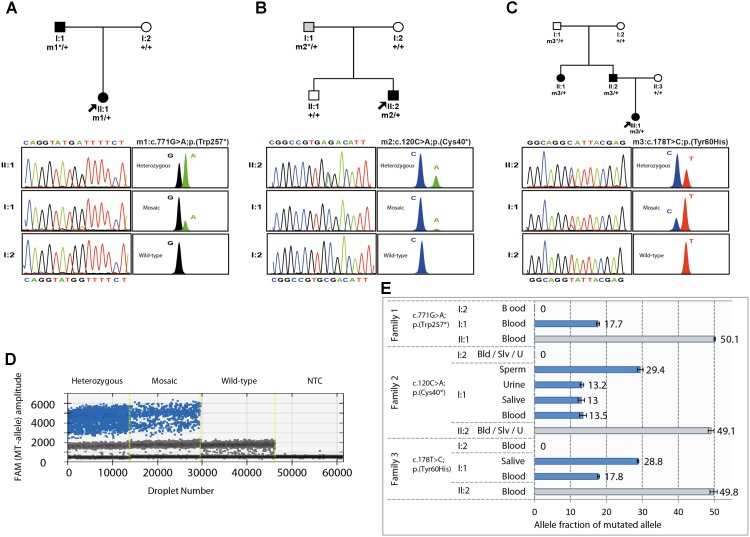
FIGURE 1
FIGURE 1
Pedigrees, familial segregation, and mosaicism analysis of the three families carrying the PAX6 variants. (A–C) Family pedigree and segregation analysis of the heterozygous and mosaic PAX6 variants, c.771G>A (p.Trp257) from family 1 (A); c.120C>A (p.Cys40) from family 2 (B); and c.178T>C (p.Tyr60His) from family 3 (C) are shown. PAX6 variants were numbered according to RefSeq transcript NM_000280.4, using for nucleotide numbering + 1 for the translation initiation codon. Individuals with congenital aniridia or microphthalmia are indicated with black symbols, and the mosaic individual with isolated iris coloboma is indicated in gray. Probands are indicated by arrows. Sanger and SNaPshot electropherograms are shown for wild-type, heterozygous, and mosaic individuals. m1, m2 and m3 represent mutated alleles, +, wild-type alleles and indicates mosaic alleles. (D,E). Absolute quantification of the allele abundance by Digital Droplet PCR (ddPCR) assays using Taqman SNP Genotyping assays. (D) Example of the 1-D fluorescence amplitude plot of droplets for mutant allele detection in the FAM channel in Family 2 for the heterozygous carrier (II:2), the mosaic father (I:1), a wild-type homozygous carrier (I:2), and no template control (NTC). FAM-positive droplets (blue), containing the mutant allele, exhibit increased fluorescence compared to negative droplets (gray). (E) Allele fraction of mutated allele was calculated for the FAM-positive droplets versus VIC-positive droplets (wild-type alleles). Depending on tissue availability, somatic cells from blood (Bld), saliva (Slv), sperm and urine (U) samples were tested in the suspected mosaic individuals (I:1) from each family and compared to their respective probands and healthy individuals as fully heterozygous and wild-type controls. In Family 2, sperm cells from the mosaic father were tested to calculate the recurrence risk.

References

    1. Acuna-Hidalgo R., Bo T., Kwint M. P., van de Vorst M., Pinelli M., Veltman J. A., et al. (2015). Post-zygotic point mutations are an underrecognized source of de novo genomic variation. Am. J. Hum. Genet. 97 67–74. 10.1016/j.ajhg.2015.05.008 - DOI - PMC - PubMed
    1. Acuna-Hidalgo R., Veltman J. A., Hoischen A. (2016). New insights into the generation and role of de novo mutations in health and disease. Genome Biol. 17:241. 10.1186/s13059-016-1110-110.1186/s13059-016-1110-1 - DOI - PMC - PubMed
    1. Ansari M., Rainger J., Hanson I. M., Williamson K. A., Sharkey F., Harewood L., et al. (2016). Genetic analysis of ‘PAX6-Negative’ individuals with Aniridia or Gillespie syndrome. PLoS One 11:e0153757. 10.1371/journal.pone.0153757 - DOI - PMC - PubMed
    1. Azuma N., Yamaguchi Y., Handa H., Tadokoro K., Asaka A., Kawase E., et al. (2003). Mutations of the PAX6 gene detected in patients with a variety of optic-nerve malformations. Am. J. Hum. Genet. 72 1565–1570. 10.1086/375555 - DOI - PMC - PubMed
    1. Beryozkin A., Levy G., Blumenfeld A., Meyer S., Namburi P., Morad Y., et al. (2016). Genetic analysis of the Rhodopsin gene identifies a mosaic dominant retinitis Pigmentosa mutation in a healthy individual. Invest. Ophthalmol. Vis. Sci. 57 940–947. 10.1167/iovs.15-18702 - DOI - PMC - PubMed

LinkOut - more resources
