


Esophageal shortening after rapid drink test during esophageal high-resolution manometry: A relevant finding?
- PMID: 30386605
- PMCID: PMC6206544
- DOI: 10.1177/2050640618796752
Esophageal shortening after rapid drink test during esophageal high-resolution manometry: A relevant finding?
Abstract
Background: Esophageal shortening (ES) might be observed during high-resolution manometry (HRM), in particular after the rapid drink test (RDT). We aimed to assess its diagnostic value in patients referred for HRM.
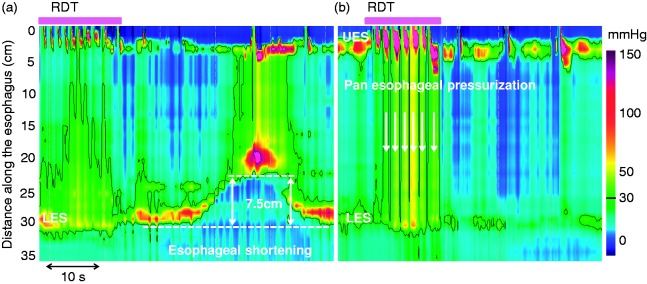
Methods: HRM of patients without previous esophagogastric surgery or endoscopic treatment was retrospectively reviewed using the Chicago Classification v3.0. ES and pan-esophageal pressurization were analyzed during the RDT (200-ml free drinking in a sitting position).
Results: A total of 2141 cases (1291 females, mean age 54 years) were reviewed. During the RDT, ES occurred in 4% and pan-esophageal pressurization in 14% of patients. ES was almost exclusively encountered in patients with impaired esophagogastric junction relaxation or major disorders of peristalsis. Among 31 patients with ES and no definite diagnosis of achalasia, 19 had follow-up and 13 (68%) changed diagnostic category: two adenocarcinoma of the cardia, and 11 cases of atypical achalasia. The positive predictive value of ES for a significant esophageal disorder was 95%.
Conclusion: ES is rarely observed during the RDT. When present, it is associated with major motility disorders, especially achalasia. When the diagnostic criteria for achalasia are not fulfilled, further complementary examinations should be performed to rule out incomplete forms of achalasia or an infiltrative process of the cardia.
Keywords: Achalasia; dysphagia; esophageal motility disorder; human; predictive positive value.
Figures
References
-
- Sugarbaker DJ, Rattan S, Goyal RK. Swallowing induces sequential activation of esophageal longitudinal smooth muscle. Am J Physiol 1984; 247(5 Pt 1): G515–G519. - PubMed
-
- Edmundowicz SA, Clouse RE. Shortening of the esophagus in response to swallowing. Am J Physiol 1991; 260(3 Pt 1): G512–G516. - PubMed
-
- Dodds WJ, Dent J, Hogan WJ, et al. Mechanisms of gastroesophageal reflux in patients with reflux esophagitis. N Engl J Med 1982; 307: 1547–1552. - PubMed
LinkOut - more resources
Full Text Sources
