Review
. 2018 Oct 16:6:460.
doi: 10.3389/fchem.2018.00460. eCollection 2018.

Recent Applications of Diversity-Oriented Synthesis Toward Novel, 3-Dimensional Fragment Collections

Affiliations
Review

Recent Applications of Diversity-Oriented Synthesis Toward Novel, 3-Dimensional Fragment Collections

Sarah L Kidd et al. Front Chem. .

Abstract

Fragment-based drug discovery (FBDD) is a well-established approach for the discovery of novel medicines, illustrated by the approval of two FBBD-derived drugs. This methodology is based on the utilization of small "fragment" molecules (<300 Da) as starting points for drug discovery and optimization. Organic synthesis has been identified as a significant obstacle in FBDD, however, in particular owing to the lack of novel 3-dimensional (3D) fragment collections that feature useful synthetic vectors for modification of hit compounds. Diversity-oriented synthesis (DOS) is a synthetic strategy that aims to efficiently produce compound collections with high levels of structural diversity and three-dimensionality and is therefore well-suited for the construction of novel fragment collections. This Mini-Review highlights recent studies at the intersection of DOS and FBDD aiming to produce novel libraries of diverse, polycyclic, fragment-like compounds, and their application in fragment-based screening projects.

Keywords: compound collections; diversity-oriented synthesis; fragment-based drug discovery; medicinal chemistry; organic synthesis.


Figures
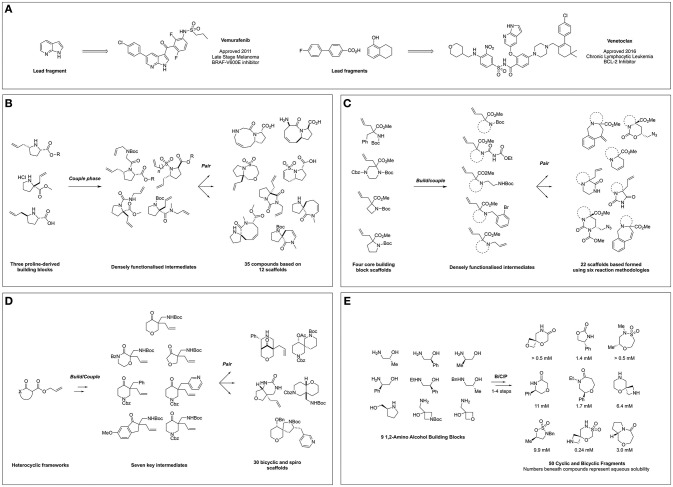
Figure 1
Figure 1
FBDD-derived drugs and diversity-oriented synthesis of novel fragment libraries. (A) Clinically approved drugs derived from FBDD and their lead fragments. (B) Hung et al. (2011) Report on DOS of fragment-like molecules. (C) Foley et al. (2015) Lead-like modular route to novel scaffolds. (D) Mayol-Llinàs et al. (2017) Lead-like scaffold DOS for CNS and FBDD. (E) Haftchenary et al. (2016) DOS of aqueous soluble fragments from 1,2-amino alcohols.
Figure 2
Figure 2
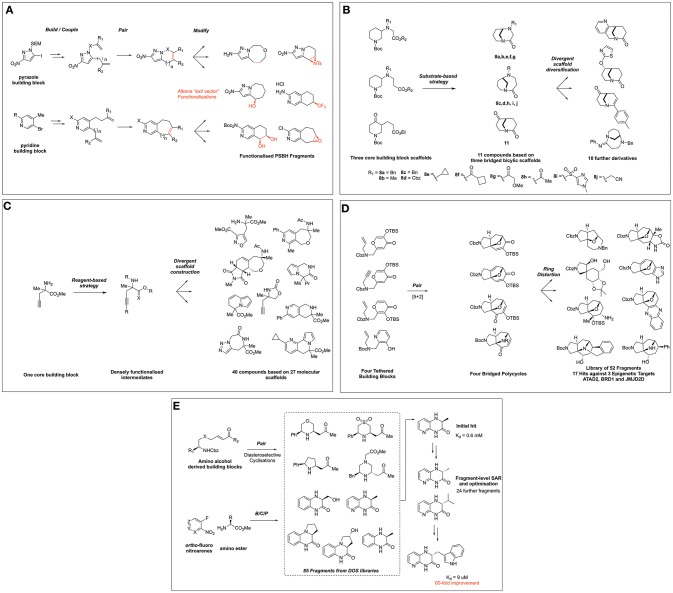
Fragment collections derived from DOS and their application to FBDD. (A) Twigg et al. (2016) DOS of partially saturated bicyclic heteroaromatic fragments. (B) Hassan et al. (2018) DOS fragment library based on twisted amides. (C) Mateu et al. (2018) DOS fragment library based on α,α-disubstituted amino esters. (D) Foley et al. (2017) synthesis of scaffolds distantly related to natural products. (E) Wang et al. (2016) DOS fragment evolution strategy against GSK3.

References

    1. Aldrich L. N., Kuo S. Y., Castoreno A. B., Goel G., Kuballa P., Rees M. G., et al. (2015). Discovery of a small-molecule probe for V-ATPase function. J. Am. Chem. Soc. 137, 5563–5568. 10.1021/jacs.5b02150 - DOI - PMC - PubMed
    1. Antermite D., Dominic P. A., Bull J. A. (2018). Regio- and stereoselective palladium-catalyzed C(sp3)–H arylation of pyrrolidines and piperidines with C(3) directing groups. Organ. Lett. 20, 3948–3952. 10.1021/acs.orglett.8b01521 - DOI - PubMed
    1. Beckmann H. S., Nie F., Hagerman C. E., Johansson H., Tan Y. S., Wilcke D., et al. (2013). A strategy for the diversity-oriented synthesis of macrocyclic scaffolds using multidimensional coupling. Nat. Chem. 5, 861–867. 10.1038/nchem.1729 - DOI - PubMed
    1. Blakemore D. C., Castro L., Churcher I., Rees D. C., Thomas A. W., Wilson D. M., et al. (2018). Organic synthesis provides opportunities to transform drug discovery. Nat. Chem. 10, 383–394. 10.1038/s41557-018-0021-z - DOI - PubMed
    1. Bollag G., Tsai J., Zhang J., Zhang C., Ibrahim P., Nolop K., et al. (2012). Vemurafenib: the first drug approved for BRAF-mutant cancer. Nat. Rev. Drug Discov. 11, 873–886. 10.1038/nrd3847 - DOI - PubMed

LinkOut - more resources