Review
. 2019 Dec;25(6):583-596.
doi: 10.1177/1073858418809074. Epub 2018 Nov 2.

Low Back Pain: The Potential Contribution of Supraspinal Motor Control and Proprioception

Affiliations
Review

Low Back Pain: The Potential Contribution of Supraspinal Motor Control and Proprioception

Michael Lukas Meier et al. Neuroscientist. 2019 Dec.

Abstract

Motor control, which relies on constant communication between motor and sensory systems, is crucial for spine posture, stability and movement. Adaptions of motor control occur in low back pain (LBP) while different motor adaption strategies exist across individuals, probably to reduce LBP and risk of injury. However, in some individuals with LBP, adapted motor control strategies might have long-term consequences, such as increased spinal loading that has been linked with degeneration of intervertebral discs and other tissues, potentially maintaining recurrent or chronic LBP. Factors contributing to motor control adaptations in LBP have been extensively studied on the motor output side, but less attention has been paid to changes in sensory input, specifically proprioception. Furthermore, motor cortex reorganization has been linked with chronic and recurrent LBP, but underlying factors are poorly understood. Here, we review current research on behavioral and neural effects of motor control adaptions in LBP. We conclude that back pain-induced disrupted or reduced proprioceptive signaling likely plays a pivotal role in driving long-term changes in the top-down control of the motor system via motor and sensory cortical reorganization. In the outlook of this review, we explore whether motor control adaptations are also important for other (musculoskeletal) pain conditions.

Keywords: chronic pain; low back pain; motor control; motor cortex; muscle spindle; proprioception; somatosensory cortex.


Conflict of interest statement

Declaration of Conflicting Interests: The author(s) declared no potential conflicts of interest with respect to the research, authorship, and/or publication of this article.

Figures

Figure 1.
Figure 1.
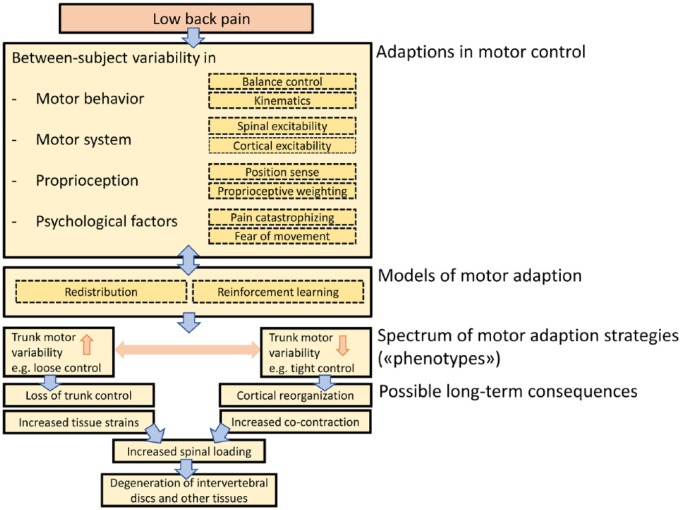
Overview. Low back pain is associated with motor control adaptions that show high between-subject variability in different domains of motor control (motor behavior, motor system, proprioception, psychological factors). Several models have been proposed to account for individual motor control strategies (redistribution theory, reinforcement learning theory). Different motor control strategies (loose and tight control strategies as endpoints of a spectrum) might have positive effects by avoiding further pain or injury. In the long term, however, both strategies might lead to several negative consequences including increased spinal tissue loading and degeneration of intervertebral discs and other tissues. Furthermore, a tight motor control strategy has been linked with cortical reorganization that might prevent or slow down the return to normal motor control patterns.
Figure 2.
Figure 2.
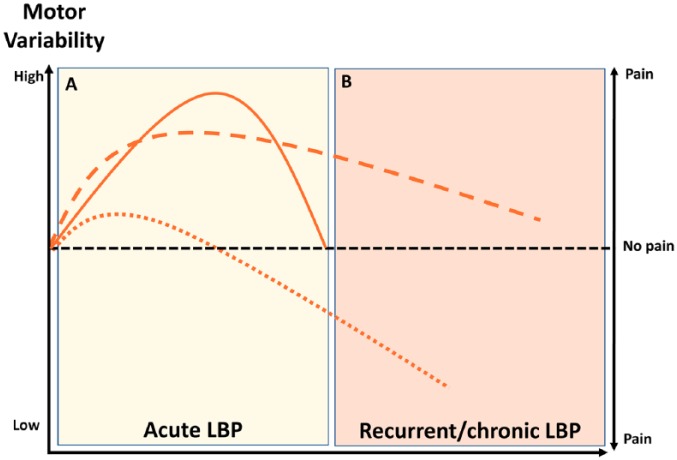
Changes in motor variability during different pain stages (acute, recurrent/chronic low back pain [LBP]) (adapted from Madeleine 2010). Three exemplary cases of many possible and individual-specific motor control adaptions are illustrated. Solid line: Motor variability increases during acute LBP (e.g., loose control), probably to prevent muscle fatigue and to allow for exploration of new pain-free motor control solutions. After successfully adopting the least painful motor control strategy, motor variability decreases and return to a normal motor strategy after pain is expected. Dashed line: Similarly, motor variability increases at the incidence of LBP (e.g., loose control). However, in this case, non-resolution of pain might lead to persistently increased motor variability in the long-term. Consequently, potential loss of trunk control leads to excessive tissue strains and subsequently enhanced spinal tissue loading that has been associated with disc degeneration and persistent pain. Dotted line: Motor variability is reduced during acute LBP (e.g., tight control due to pain catastrophizing). Tight trunk control is associated with increased muscle co-contraction and muscle excitability which might lead to negative long-term consequences such as muscle fatigue, increase spinal tissue loading and cortical reorganization (because of reduced trunk motor variability and proprioceptive input). As a note, a potential immediate reduction of motor variability at the incidence of LBP might be also possible.
Figure 3.
Figure 3.
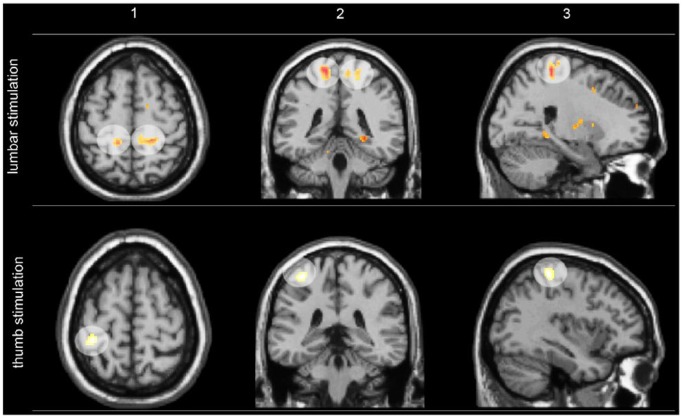
Group activation clusters (overlaid on a standard T1 template) within the S1 evoked by applying manual pressure on lumbar spinous processes and thumb. (lumbar stimulations: P < 0.05; family wise error corrected; minimum cluster size, 10; thumb: P < 0.001; uncorrected; minimum cluster size, 10). Reprinted from Meier and others (2014), with permission from Elsevier.
Figure 4.
Figure 4.
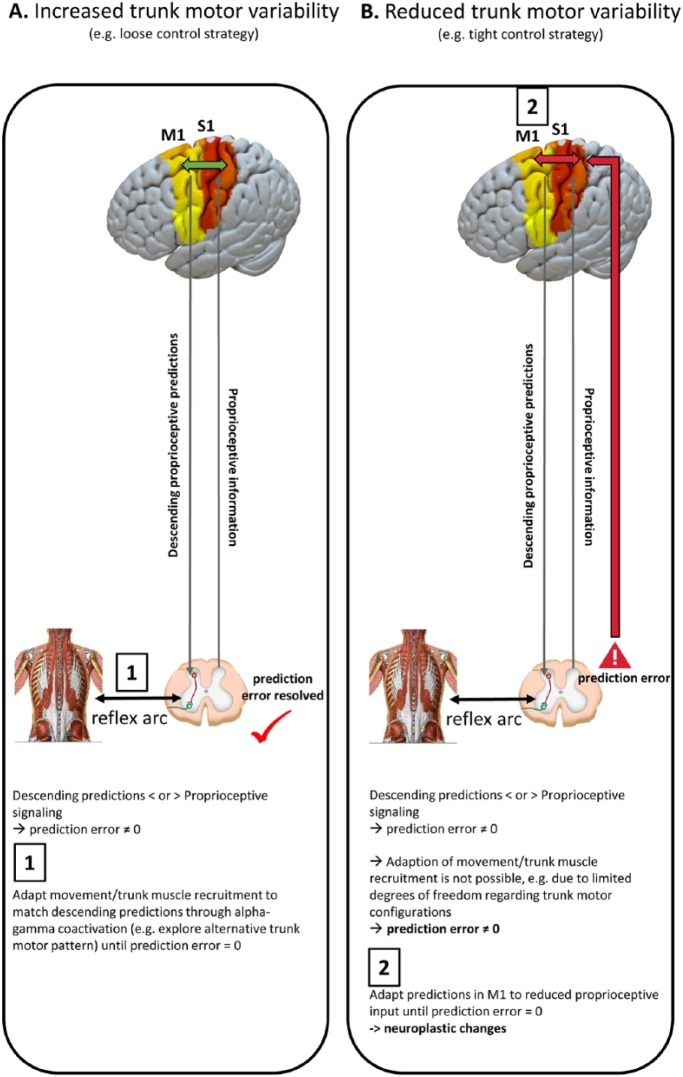
The potential underlying mechanism of motor control adaptions in low back pain (LBP) based on the active inference account of M1 (Adams and others 2013). Proprioceptive prediction errors are generated at the level of the spinal cord by comparing the descending proprioceptive predictions from M1 with proprioceptive input from muscle spindles. Dependent on the level of the proprioceptive prediction error, the rate of firing of alpha motoneurons provokes the desired (predicted) muscle activation/movement, through innervation of extrafusal muscle fibers (classical reflex arc). Simultaneously, the rate of firing of gamma motor neurons optimizes the sensitivity of muscle spindles, though innervation of intrafusal muscle fibers (alpha-gamma coactivation), (Matthews 1959). (A) At the onset of LBP, trunk motor variability might increase (e.g., loose control strategy), offering sufficient degrees of freedom of the motor system to explore new pain-free motor control strategies at the cost of decreased trunk control. Increased prediction errors that might arise from, for example, interference of nociceptive input with muscle spindle afferent signaling will be minimized by spinal circuits through changing movement/trunk muscle recruitment patterns until the prediction error is zero. The proprioceptive information resulting from muscle activity (sensory reafference) is then transmitted to the sensorimotor cortex. Backward projections from M1 to S1 subserve the updating of proprioceptive predictions which do not change as long as no error signals are present (green arrow). Trunk motor variability might be reduced in the chronic LBP stage and/or by adopting a tight control strategy. In this case, potential proprioceptive errors can no longer be minimized through exploring and adapting movement/muscle recruitment patterns because of limited degrees of freedom regarding motor control configurations. Therefore, to minimize the prediction error, the M1 might be forced to match its predictions to the inflow of proprioceptive information (red arrow). In the long-term, this might provide a possible mechanism for neuroplastic changes in sensorimotor cortices that have been observed in recurrent and chronic pain.

References

    1. Abboud J, Daneau C, Nougarou F, Dugas C, Descarreaux M. 2018. Motor adaptations to trunk perturbation: effects of experimental back pain and spinal tissue creep. J Neuro-physiol 120(4):1591–601. doi: 10.1152/jn.00207.2018. - DOI - PMC - PubMed
    1. Abboud J, Nougarou F, Pagé I, Cantin V, Massicotte D, Descarreaux M. 2014. Trunk motor variability in patients with non-specific chronic low back pain. Eur J Appl Physiol 114(12):2645–54. - PubMed
    1. Adams MA, Roughley PJ. 2006. What is intervertebral disc degeneration, and what causes it? Spine 31(18):2151–61. - PubMed
    1. Adams RA, Shipp S, Friston KJ. 2013. Predictions not commands: active inference in the motor system. Brain Struct Funct 218(3):611–43. - PMC - PubMed
    1. Beaudette SM, Larson KJ, Larson DJ, Brown SH. 2016. Low back skin sensitivity has minimal impact on active lumbar spine proprioception and stability in healthy adults. Exp Brain Res 234(8):2215–26. - PubMed

Publication types