


Pilot testing of an online training module about screening for acute HIV infection in adult patients seeking urgent healthcare
- PMID: 30388277
- PMCID: PMC6398591
- DOI: 10.1093/inthealth/ihy077
Pilot testing of an online training module about screening for acute HIV infection in adult patients seeking urgent healthcare
Abstract
Background: Acute HIV infection (AHI) is the phase of HIV infection immediately after acquisition, during which many patients develop symptoms and often seek healthcare. However, clinicians in sub-Saharan Africa are not currently taught about AHI.
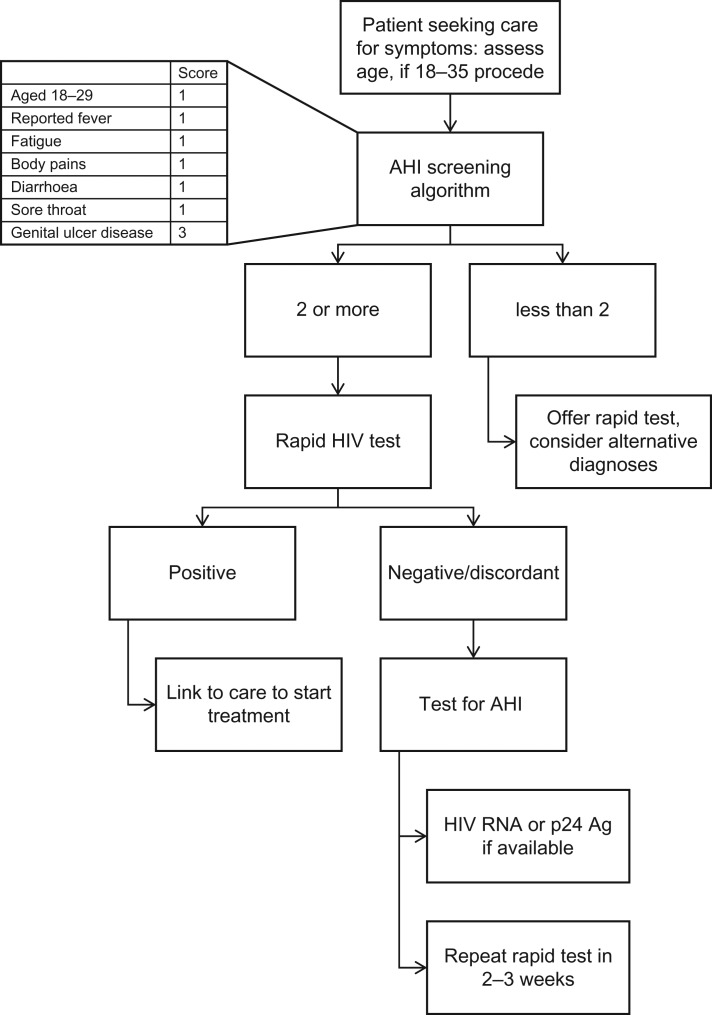
Methods: This study pilot-tested a self-directed AHI training module among clinical officers (COs) in coastal Kenya and assessed knowledge gained and challenges to instituting screening. The training module included four domains: AHI definition and importance of AHI recognition; symptoms and screening algorithms; diagnostic strategies; and management. AHI knowledge was assessed before and immediately after training. Participants' ability to utilize an AHI screening algorithm was evaluated with a case-based exercise.
Results: Self-directed training was completed by 45 COs. Pre-test scores were low (median score 35% IQR 30-45%), but improved significantly after training (median post-test score 75%, IQR 70-85%, Wilcoxon signed-rank test p<0.0001). Participants had challenges in understanding the utility and application of a screening algorithm to identify patients for whom AHI testing would be indicated. Knowledge of AHI was poor at baseline, but improved with self-directed learning. Based on these findings, we revised and improved the AHI training module and pre- and post-assessments, which are now freely available online at www.marps-africa.org.
Conclusions: Guidelines on AHI screening and diagnosis are urgently needed in high HIV transmission areas.
Keywords: acute HIV infection; febrile patient; online learning; screening algorithm; self-directed learning.
© The Author(s) 2018. Published by Oxford University Press Royal Society of Tropical Medicine and Hygiene.
Figures
References
-
- Sanders EJ, Wahome E, Mwangome M, et al. . Most adults seek urgent healthcare when acquiring HIV-1 and are frequently treated for malaria in coastal Kenya. AIDS. 2011;25(9):1219–24. - PubMed
-
- Peters PJ, Westheimer E, Cohen S, et al. . Screening yield of HIV antigen/antibody combination and pooled HIV RNA testing for acute HIV infection in a high-prevalence population. JAMA. 2016; 315(7):682–90. - PubMed
Publication types
MeSH terms
Grants and funding
LinkOut - more resources
Full Text Sources
Medical
