Review
. 2018 Nov 1;10(11):1600.
doi: 10.3390/nu10111600.

Fat Mass and Obesity Associated (FTO) Gene and Hepatic Glucose and Lipid Metabolism

Affiliations
Review

Fat Mass and Obesity Associated (FTO) Gene and Hepatic Glucose and Lipid Metabolism

Tooru M Mizuno. Nutrients. .

Abstract

Common genetic variants of the fat mass and obesity associated (FTO) gene are strongly associated with obesity and type 2 diabetes. FTO is ubiquitously expressed. Earlier studies have focused on the role of hypothalamic FTO in the regulation of metabolism. However, recent studies suggest that expression of hepatic FTO is regulated by metabolic signals, such as nutrients and hormones, and altered FTO levels in the liver affect glucose and lipid metabolism. This review outlines recent findings on hepatic FTO in the regulation of metabolism, with particular focus on hepatic glucose and lipid metabolism. It is proposed that abnormal activity of hepatic signaling pathways involving FTO links metabolic impairments such as obesity, type 2 diabetes and nonalcoholic fatty liver disease (NAFLD). Therefore, a better understanding of these pathways may lead to therapeutic approaches to treat these metabolic diseases by targeting hepatic FTO. The overall goal of this review is to place FTO within the context of hepatic regulation of metabolism.

Keywords: FTO; gluconeogenesis; glucose; insulin; lipogenesis; liver; non-alcoholic fatty liver disease; type 2 diabetes.


Conflict of interest statement

The authors declare no conflicts of interest.

Figures
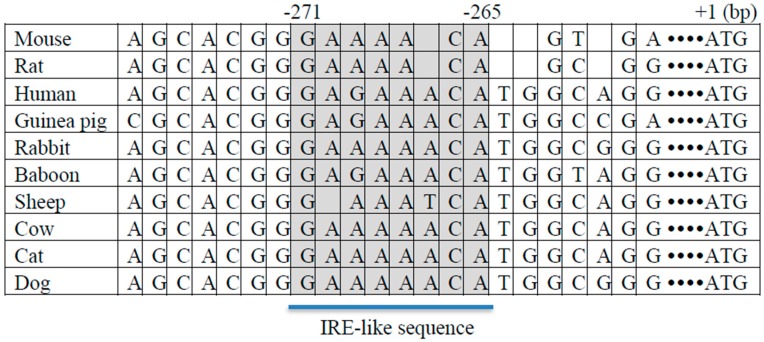
Figure 1
Figure 1
Putative insulin response element (IRE)-like sequence in FTO (Fat mass and obesity-associated) promoter. IRE-like sequence GAAAACA was identified in the mouse FTO gene promoter (271–265 bp upstream of the transcription start site). The putative IRE with surrounding sequence was aligned in 10 species including, mouse, rat, human, guinea pig, rabbit, baboon, sheep, cow, cat, and dog. The shaded region represents the IRE-like sequence.
Figure 2
Figure 2
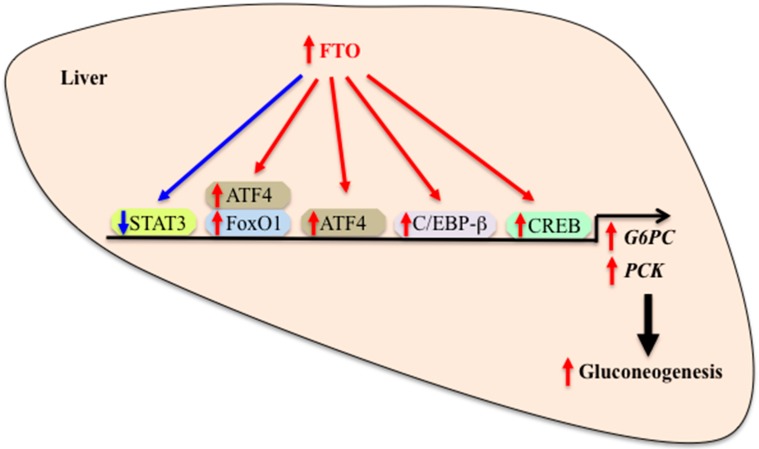
Role of FTO in the regulation of hepatic gluconeogenesis. FTO regulates hepatic gluconeogenic gene expression by altering the activity of and interaction with transcription factors. Increased FTO expression and/or activity causes an increased transcription of genes encoding gluconeogenic enzymes, leading to an increased gluconeogenesis, while reduced FTO expression and/or activity causes the opposite effect. FTO: Fat mass and obesity-associated, G6PC: Glucose-6-phosphatase, PCK: Phosphoenolpyruvate carboxykinase, STAT3: Signal transducers and activators of transcription 3, CREB: cAMP responsive element binding protein, C/EBP-β: CCAAT/enhancer-binding protein-beta, ATF4: Activating transcription factor 4, FoxO1: Forkhead box protein O1. Red arrow: Stimulation. Blue arrow: Inhibition.
Figure 3
Figure 3
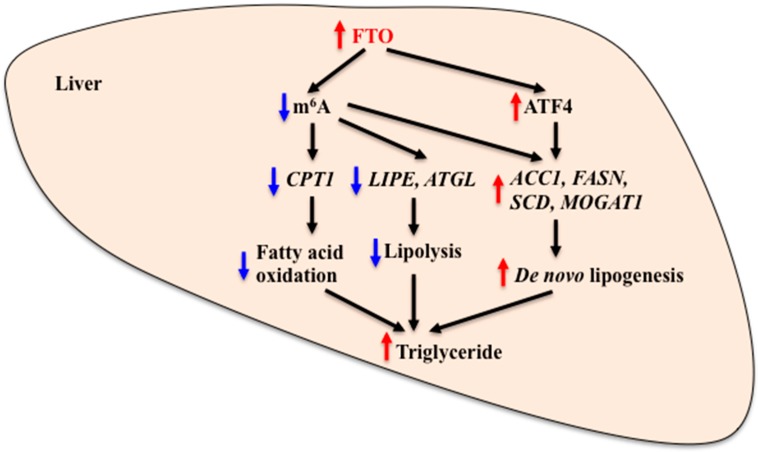
Role of FTO in the regulation of hepatic lipid metabolism. FTO regulates hepatic lipid metabolism by altering the methylation state of genes that are involved in fatty acid oxidation, lipolysis and de novo lipogenesis. FTO also regulates hepatic lipid metabolism by altering the activity of transcription factors. Increased FTO expression and/or activity causes a reduction of m6A levels and reduces CPT1, LIPE and ATGL mRNA expression, leading to reduced fatty acid oxidation and lipolysis. It also causes an increase in ATF4 expression, which then stimulates expression of lipogenic genes, leading to increased de novo lipogenesis in the liver. Reduced FTO expression and/or activity causes the opposite effect. FTO: Fat mass and obesity-associated, m6A: N6-methyladenosine, CPT1: Carnitine palmitoyltransferase 1, LIPE: Hormone sensitive lipase, ATGL: Adipose triglyceride lipase, ACC1: Acetyl-CoA carboxylase 1, FASN: Fatty acid synthase, SCD: Stearoyl-CoA desaturase, MOGAT1: Monoacylglycerol O-acyltransferase 1, ATF4: Activating transcription factor 4. Red arrow: Stimulation. Blue arrow: Inhibition.
Figure 4
Figure 4
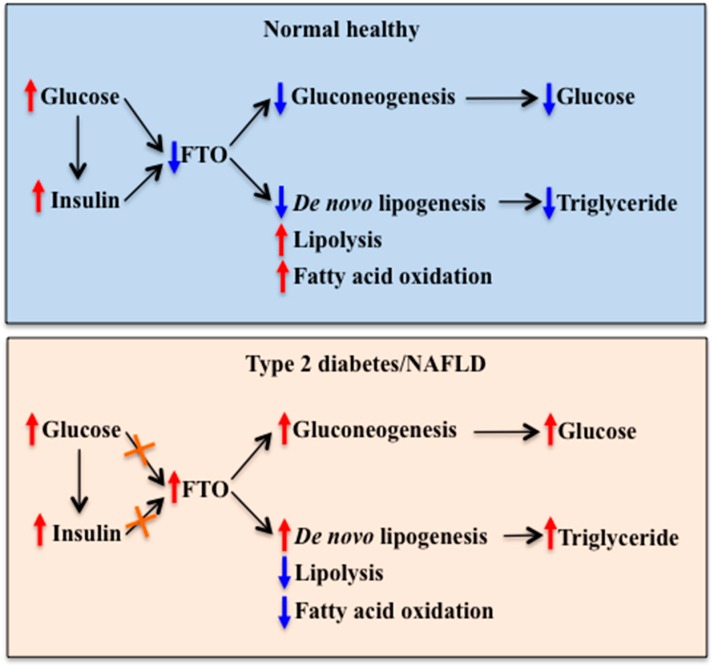
Role of FTO in the mediation of nutritional and hormonal regulation of hepatic glucose and lipid metabolism in health and diseases. Upper panel: In normal healthy individuals, increased blood glucose and insulin levels inhibit FTO expression in the liver. Reduced hepatic FTO expression inhibits gluconeogenesis, leading to reduced hepatic glucose production. It also inhibits de novo lipogenesis, while stimulates lipolysis and fatty acid oxidation, leading to reduced triglyceride deposition in the liver. Lower panel: In individuals with type 2 diabetes or NAFLD, impairments in glucose and insulin regulation of FTO expression may cause an increase in hepatic FTO expression. Increased hepatic FTO expression stimulates gluconeogenesis and de novo lipogenesis and inhibits lipolysis and fatty acid oxidation, leading to abnormally increased hepatic glucose production and triglyceride deposition. FTO: Fat mass and obesity-associated, NAFLD: Non-alcoholic fatty liver disease. Red arrow: Stimulation. Blue arrow: Inhibition. Orange cross: Impaired response.

References

    1. Frayling T.M., Timpson N.J., Weedon M.N., Zeggini E., Freathy R.M., Lindgren C.M., Perry J.R., Elliott K.S., Lango H., Rayner N.W., et al. A common variant in the FTO gene is associated with body mass index and predisposes to childhood and adult obesity. Science. 2007;316:889–894. doi: 10.1126/science.1141634. - DOI - PMC - PubMed
    1. Dina C., Meyre D., Gallina S., Durand E., Korner A., Jacobson P., Carlsson L.M., Kiess W., Vatin V., Lecoeur C., et al. Variation in FTO contributes to childhood obesity and severe adult obesity. Nat. Genet. 2007;39:724–726. doi: 10.1038/ng2048. - DOI - PubMed
    1. Scuteri A., Sanna S., Chen W.M., Uda M., Albai G., Strait J., Najjar S., Nagaraja R., Orru M., Usala G., et al. Genome-wide association scan shows genetic variants in the FTO gene are associated with obesity-related traits. PLoS Genet. 2007;3:e115. doi: 10.1371/journal.pgen.0030115. - DOI - PMC - PubMed
    1. Grunnet L.G., Brons C., Jacobsen S., Nilsson E., Astrup A., Hansen T., Pedersen O., Poulsen P., Quistorff B., Vaag A. Increased recovery rates of phosphocreatine and inorganic phosphate after isometric contraction in oxidative muscle fibers and elevated hepatic insulin resistance in homozygous carriers of the A-allele of FTO rs9939609. J. Clin. Endocrinol. Metab. 2009;94:596–602. doi: 10.1210/jc.2008-1592. - DOI - PubMed
    1. Yeo G.S. The role of the FTO (Fat Mass and Obesity Related) locus in regulating body size and composition. Mol. Cell. Endocrinol. 2014;397:34–41. doi: 10.1016/j.mce.2014.09.012. - DOI - PubMed

MeSH terms

Substances

Grants and funding

LinkOut - more resources