Review
. 2018 Nov 1;10(11):600.
doi: 10.3390/v10110600.

RNA Virus Fidelity Mutants: A Useful Tool for Evolutionary Biology or a Complex Challenge?

Affiliations
Review

RNA Virus Fidelity Mutants: A Useful Tool for Evolutionary Biology or a Complex Challenge?

Tiffany F Kautz et al. Viruses. .

Abstract

RNA viruses replicate with low fidelity due to the error-prone nature of the RNA-dependent RNA polymerase, which generates approximately one mutation per round of genome replication. Due to the large population sizes produced by RNA viruses during replication, this results in a cloud of closely related virus variants during host infection, of which small increases or decreases in replication fidelity have been shown to result in virus attenuation in vivo, but not typically in vitro. Since the discovery of the first RNA virus fidelity mutants during the mid-aughts, the field has exploded with the identification of over 50 virus fidelity mutants distributed amongst 7 RNA virus families. This review summarizes the current RNA virus fidelity mutant literature, with a focus upon the definition of a fidelity mutant as well as methods to confirm any mutational changes associated with the fidelity mutant. Due to the complexity of such a definition, in addition to reports of unstable virus fidelity phenotypes, the future translational utility of these mutants and applications for basic science are examined.

Keywords: fidelity; quasispecies; vaccine; virus evolution.


Conflict of interest statement

The authors declare no conflict of interest.

Figures
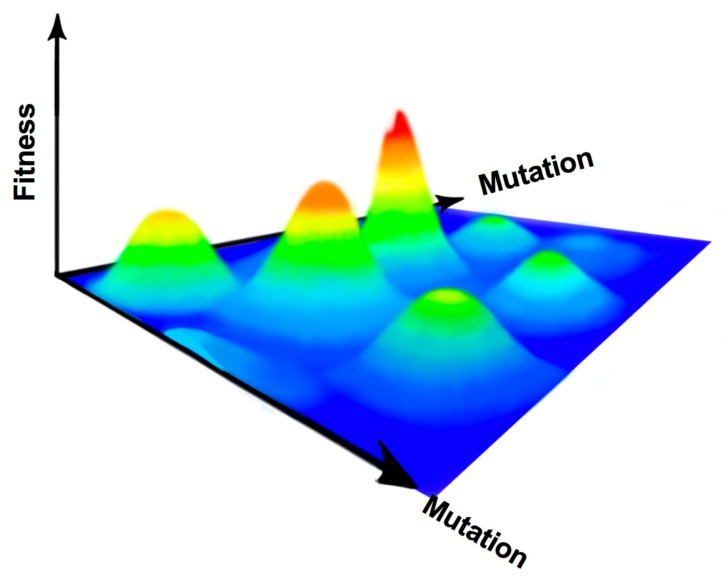
Figure 1
Figure 1
RNA virus mutational spectrum. As RNA viruses mutate, the sequence space is sampled to find areas of higher fitness. This space is hypothesized to be unstable, so it is best for mutation-prone RNA viruses to exist in flatter areas of this space where decreases in fitness are slight.
Figure 2
Figure 2
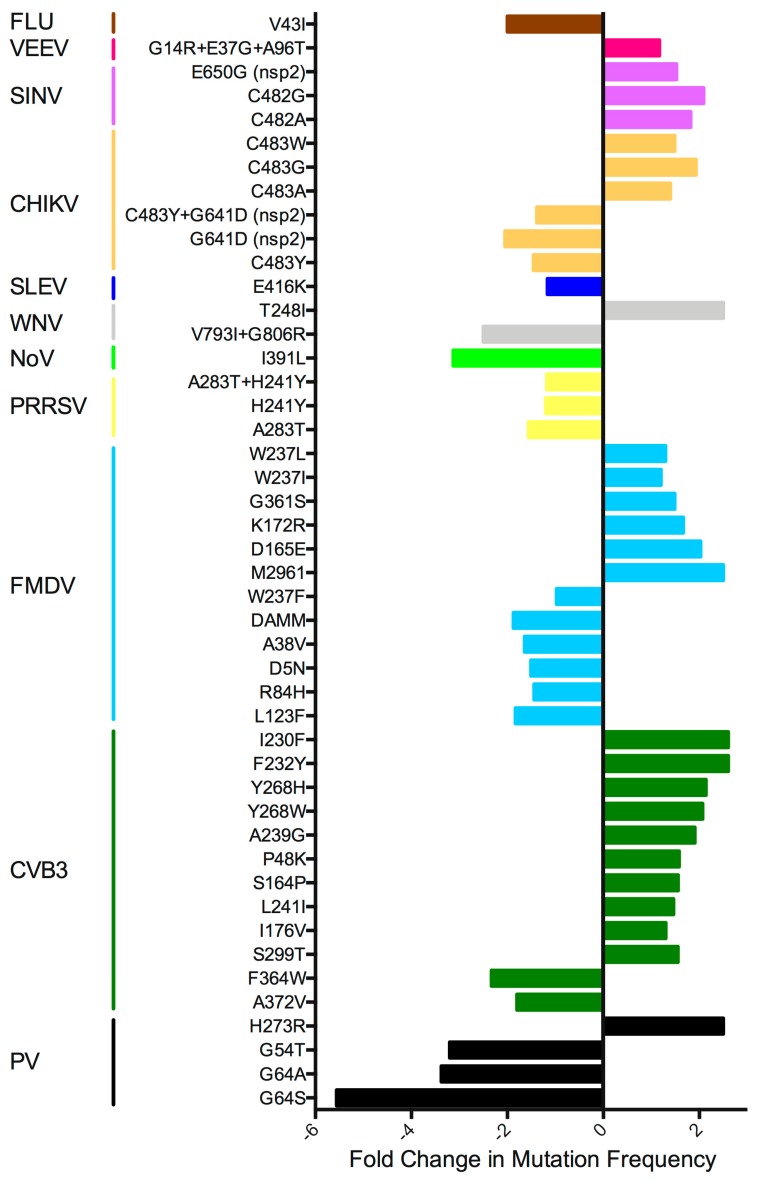
Fold-change in fidelity mutant mutation frequency relative to the wt virus. Most estimates are from TOPO cloning experiments, but if this information was not available, fold-change NGS data was used. Fidelity-altering mutations found outside the RdRp gene are indicated. Coronavirus data was excluded due to exceptional differences during RNA replication compared to the other RNA viruses. HEV71 data was excluded as mutation frequency was only reported for virus in the presence of ribavirin. FLU: influenza virus; VEEV: Venezuelan equine encephalitis virus; SINV: sindbis virus; CHIKV: chikungunya virus; SLEV: St. Louis encephalitis virus; WNV: West Nile virus; NoV: norovirus; PRRSV: porcine reproductive and respiratory syndrome virus; FMDV: foot-and-mouth disease virus; CVB3: coxsackievirus B3; PV: poliovirus.
Figure 3
Figure 3
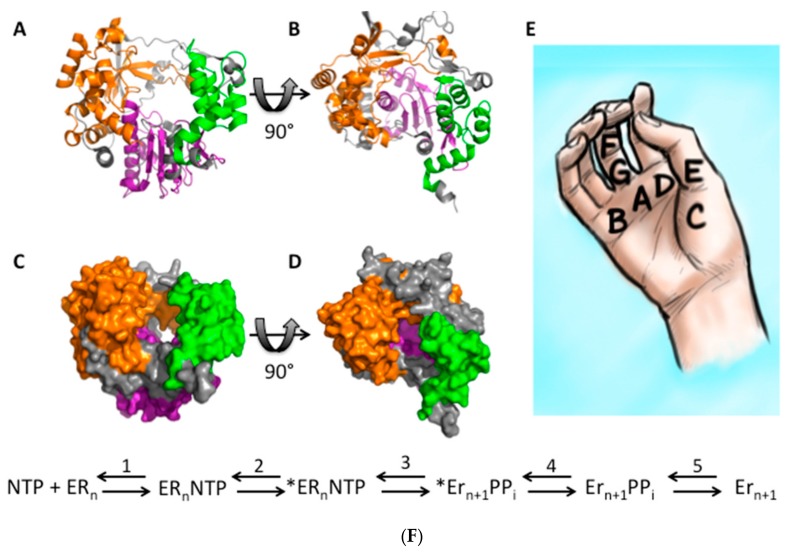
RdRp structure and RdRp kinetics. The FMDV RdRp structure [64] was downloaded from the RCSB PDB and visualized in PyMol v1.8.4.0 [65]. Structure (A,B) and surface models (C,D) are depicted. The RdRp is color-coded with the fingers as orange, the palm as purple, and the thumb as green. Location of conserved RdRp motifs as visualized on a right hand diagram (E). RdRp kinetics steps for NTP addition to an RNA chain (F). First, an NTP binds the RdRp, which causes a conformational change “*” (step 2) and activates the RdRp (step 3). The NTP is then added to the RNA chain, leading to another conformational change and translocation of the RNA (step 4). Finally, the PPi leaving group is released (step 5), allowing the cycle to begin again.
Figure 4
Figure 4
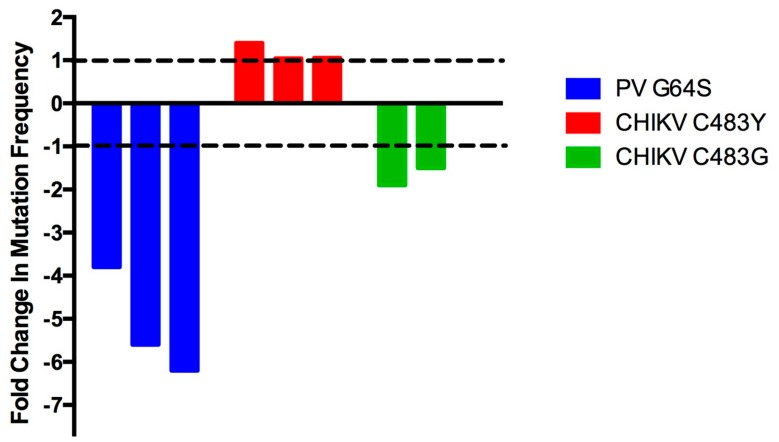
Variation in fidelity mutant mutation frequencies. Variation in the mutation frequency of unaltered virus versus: high-fidelity PV G64S [27,34,35], high-fidelity CHIKV C483Y [44,45,46], or low-fidelity CHIKV C483G [45,46]. Dashed lines indicate equal levels of mutation frequency for control and fidelity mutant viruses.

References

    1. Anthony S.J., Epstein J.H., Murray K.A., Navarrete-Macias I., Zambrana-Torrelio C.M., Solovyov A., Ojeda-Flores R., Arrigo N.C., Islam A., Ali Khan S., et al. A strategy to estimate unknown viral diversity in mammals. mBio. 2013;4:e00598-13. doi: 10.1128/mBio.00598-13. - DOI - PMC - PubMed
    1. Li C.X., Shi M., Tian J.H., Lin X.D., Kang Y.J., Chen L.J., Qin X.C., Xu J., Holmes E.C., Zhang Y.Z. Unprecedented genomic diversity of RNA viruses in arthropods reveals the ancestry of negative-sense RNA viruses. eLife. 2015;4:e05378. doi: 10.7554/eLife.05378. - DOI - PMC - PubMed
    1. Shi M., Lin X.D., Tian J.H., Chen L.J., Chen X., Li C.X., Qin X.C., Li J., Cao J.P., Eden J.S., et al. Redefining the invertebrate RNA virosphere. Nature. 2016;540:539–543. doi: 10.1038/nature20167. - DOI - PubMed
    1. Shi M., Lin X.D., Chen X., Tian J.H., Chen L.J., Li K., Wang W., Eden J.S., Shen J.J., Liu L., et al. The evolutionary history of vertebrate RNA viruses. Nature. 2018;556:197–202. doi: 10.1038/s41586-018-0012-7. - DOI - PubMed
    1. Zhang Y.Z., Shi M., Holmes E.C. Using Metagenomics to Characterize an Expanding Virosphere. Cell. 2018;172:1168–1172. doi: 10.1016/j.cell.2018.02.043. - DOI - PubMed

Publication types

Substances

LinkOut - more resources