Review
. 2018 Nov 1;19(11):3426.
doi: 10.3390/ijms19113426.

Familial Hypercholesterolemia: The Most Frequent Cholesterol Metabolism Disorder Caused Disease

Affiliations
Review

Familial Hypercholesterolemia: The Most Frequent Cholesterol Metabolism Disorder Caused Disease

Asier Benito-Vicente et al. Int J Mol Sci. .

Abstract

Cholesterol is an essential component of cell barrier formation and signaling transduction involved in many essential physiologic processes. For this reason, cholesterol metabolism must be tightly controlled. Cell cholesterol is mainly acquired from two sources: Dietary cholesterol, which is absorbed in the intestine and, intracellularly synthesized cholesterol that is mainly synthesized in the liver. Once acquired, both are delivered to peripheral tissues in a lipoprotein dependent mechanism. Malfunctioning of cholesterol metabolism is caused by multiple hereditary diseases, including Familial Hypercholesterolemia, Sitosterolemia Type C and Niemann-Pick Type C1. Of these, familial hypercholesterolemia (FH) is a common inherited autosomal co-dominant disorder characterized by high plasma cholesterol levels. Its frequency is estimated to be 1:200 and, if untreated, increases the risk of premature cardiovascular disease. This review aims to summarize the current knowledge on cholesterol metabolism and the relation of FH to cholesterol homeostasis with special focus on the genetics, diagnosis and treatment.

Keywords: cholesterol; familial hypercholesterolemia; metabolism.


Conflict of interest statement

The authors declare no conflict of interest.

Figures
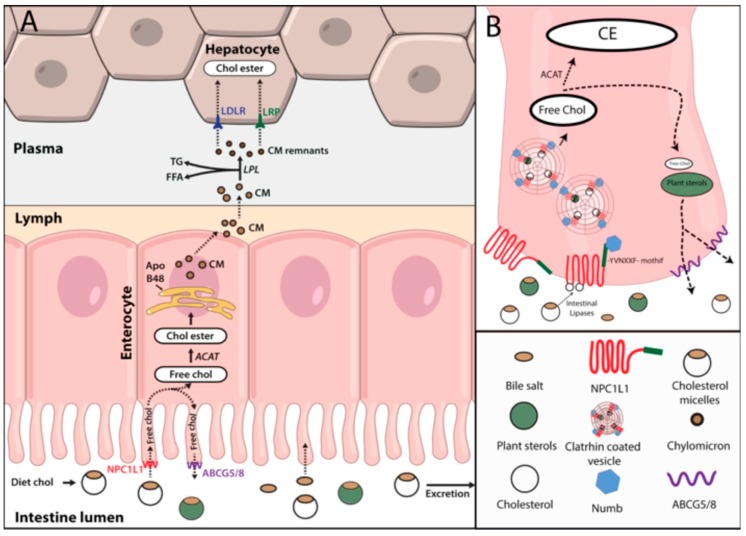
Figure 1
Figure 1
Dietary cholesterol absorption. (A) Diet cholesterol forms micelles in complex with bile acids and travel across the intestinal lumen where it is hydrolyzed and taken up by Niemann-Pick C1-like 1 in the enterocyte membrane. Internalized cholesterol can either be transported back to the intestinal lumen through ABCG5/8 along with plant sterols or esterified by Acyl-CoA acyl-transferase. Esterified cholesterol within other lipids is incorporated into chylomicrons and secreted to the lymph. Once in the lymph they are drained to the plasma where by lipoprotein lipases activity lose their triglycerides and become in chylomicron remnants that are finally taken up by the liver by low density lipoprotein receptor or LDLR related proteins. (B) Free cholesterol binds NPC1L1 and promotes its conformational change. This conformational change allows the binding of Numb adapter protein to YVNXXF motif and promotes its internalization in clathrin coated pits. Abbreviations: NPC1L1: Niemann-Pick C1-like 1; ACAT: Acyl-CoA acyl-transferase; Chol ester: Esterified cholesterol; CM: Chylomicrons; LPL: lipoprotein lipases; TG: Triglycerides; FFA: Free fatty acids; LDLR: low density lipoprotein receptor; LRPs: LDLR related proteins.
Figure 2
Figure 2
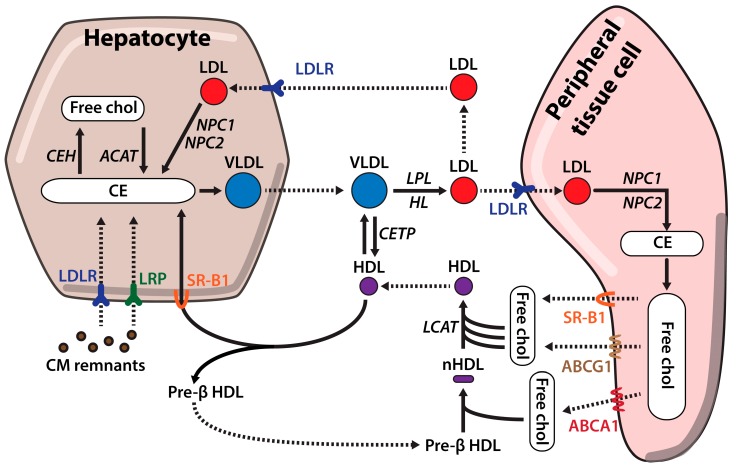
Cholesterol metabolism. Cholesterol is secreted from the liver to peripheral tissues in triglyceride rich lipoproteins, very low density lipoproteins. Once in the bloodstream, VLDL are transformed into cholesterol rich LDL particles by interaction with different proteins as LPL or exchange of lipids and apolipoproteins with high density lipoproteins LDL particles are taken up by peripheral tissue cells through LDLR. Excess cholesterol from peripheral tissues is packaged in HDL lipoproteins for it clearance. First, free cholesterol is transferred to lipid poor pre-β HDL through ABCA1. Second, this first cholesterol loading changes HDL conformation and allow its interaction with ATP-binding cassette subfamily G member 1 and SR-B1 transporters that along with Lecithin-cholesterol acyltransferase produce mature HDL particles that are transported back to the liver for their clearance. Abbreviations: NPC1: Niemann-Pick C1; NPC2: Niemann-Pick C2; ACAT: Acyl-CoA acyl-transferase; CM: Chylomicrons; LPL: lipoprotein lipases; TG: Triglycerides; LDLR: low density lipoprotein receptor; LRPs: LDLR related proteins; VLDL: very low density lipoproteins; HDL: high density lipoproteins; ABCG1: ATP-binding cassette subfamily G member 1; LCAT: Lecithin-cholesterol acyltransferase; HDL: High density lipoproteins.
Figure 3
Figure 3
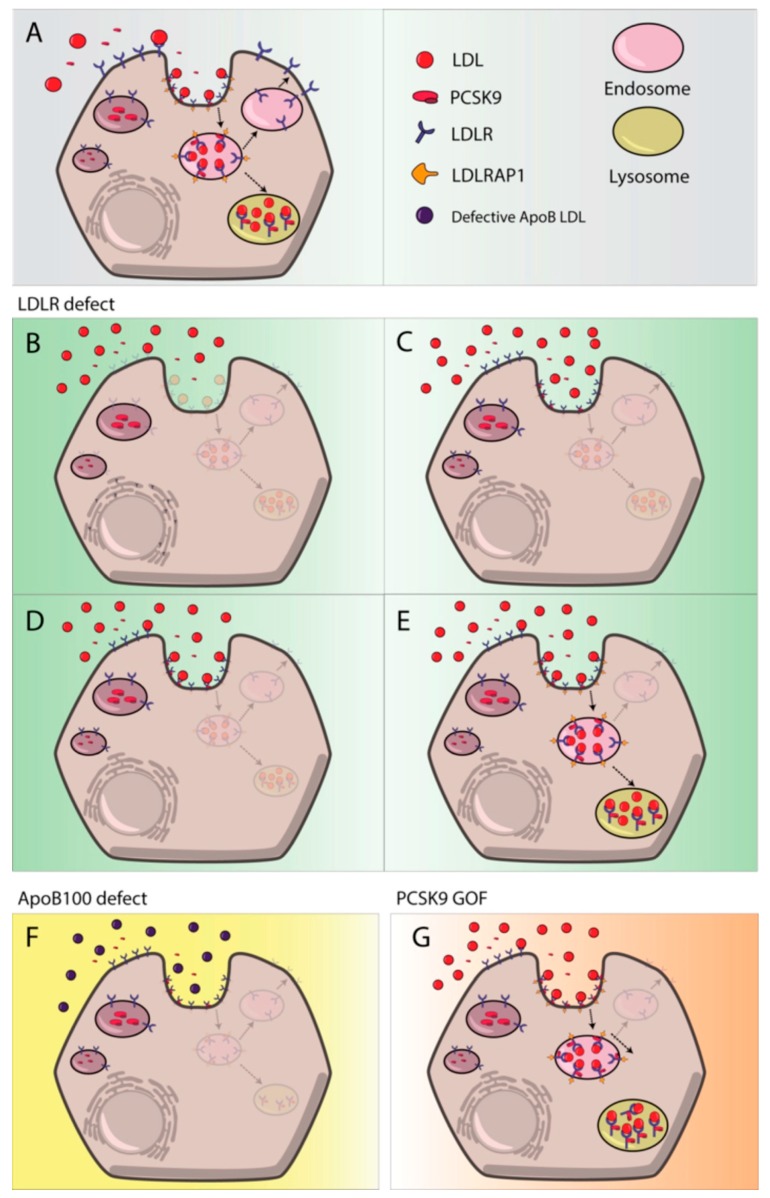
Most frequent LDL catabolism defects. (A) LDL uptake process by LDLR; (B) class 2 LDLR mutants, LDLR retention in the endoplasmic reticulum; (C) Class 3 mutants, no LDL-LDLR binding; (D) class 4 mutants, impaired LDL-LDLR complex internalization; (E) class 5 mutants, recycling defect; (F) defective ApoB-100 derived impaired LDL-LDLR binding; (G) PCSK9 gain of function mutant.
Figure 4
Figure 4
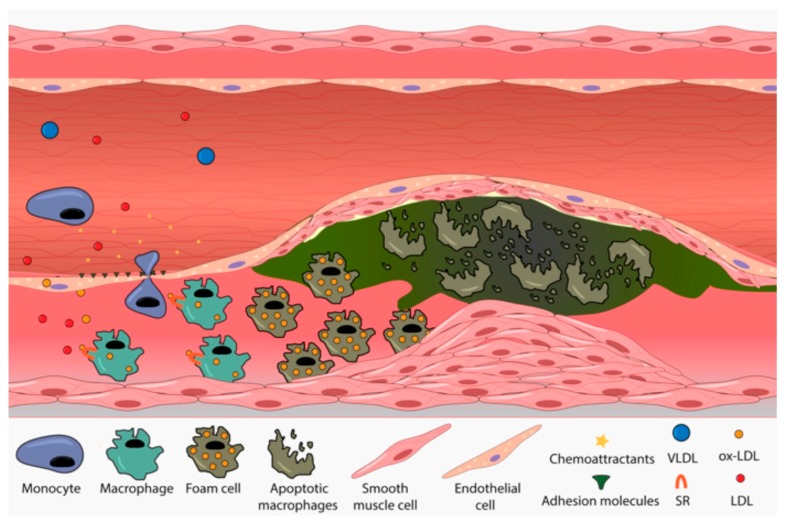
Atherome plaque development. Accumulated LDL particles cross endothelial barrier and get oxidized in subendothelial space. Lipoprotein oxidation activates endothelial cells that increase the synthesis and secretion of chemoattractants and adhesion molecules promoting monocyte recruitment and transedothelial migration. Once at sub-endothelial compartments they are differentiated into machrophages and start to internalize ox-LDL through a non regulated SR-B1 scavenger receptor. Cholesterol excess in macrophages induces foam cell formation and promotes SVMC migration and fibrous cap synthesis. Finally, due to increased macrophage death and impaired efferocytosis, the size of the plaque increases and the diameter of the artery is reduced.

References

    1. Maxfield F.R., Tabas I. Role of cholesterol and lipid organization in disease. Nature. 2005;438:612–621. doi: 10.1038/nature04399. - DOI - PubMed
    1. Cherezov V., Rosenbaum D.M., Hanson M.A., Rasmussen S.G.F., Thian F.S., Kobilka T.S., Choi H.-J., Kuhn P., Weis W.I., Kobilka B.K., et al. High-Resolution Crystal Structure of an Engineered Human 2-Adrenergic G Protein-Coupled Receptor. Science. 2007;318:1258–1265. doi: 10.1126/science.1150577. - DOI - PMC - PubMed
    1. Ikonen E. Cellular cholesterol trafficking and compartmentalization. Nat. Rev. Mol. Cell Biol. 2008;9:125–138. doi: 10.1038/nrm2336. - DOI - PubMed
    1. Grouleff J., Irudayam S.J., Skeby K.K., Schiøtt B. The influence of cholesterol on membrane protein structure, function, and dynamics studied by molecular dynamics simulations. BBA Biomembr. 2015;1848:1783–1795. doi: 10.1016/j.bbamem.2015.03.029. - DOI - PubMed
    1. Yang S.-T., Kreutzberger A.J.B., Lee J., Kiessling V., Tamm L.K. The role of cholesterol in membrane fusion. Chem. Phys. Lipids. 2016;199:136–143. doi: 10.1016/j.chemphyslip.2016.05.003. - DOI - PMC - PubMed