. 2018 Nov 3;18(1):174.
doi: 10.1186/s12866-018-1322-5.

Antibiotic-resistant Escherichia coli from retail poultry meat with different antibiotic use claims

Affiliations

Antibiotic-resistant Escherichia coli from retail poultry meat with different antibiotic use claims

Gregg S Davis et al. BMC Microbiol. .

Abstract

Background: We sought to determine if the prevalence of antibiotic-resistant Escherichia coli differed across retail poultry products and among major production categories, including organic, "raised without antibiotics", and conventional.

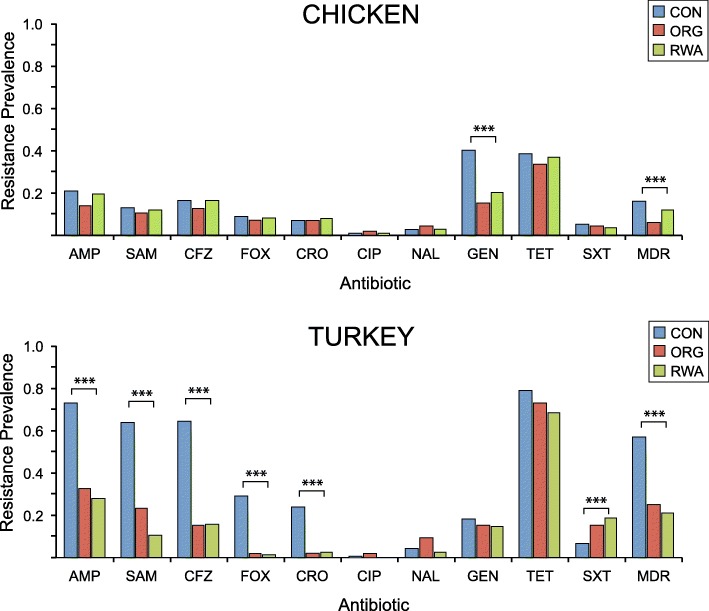
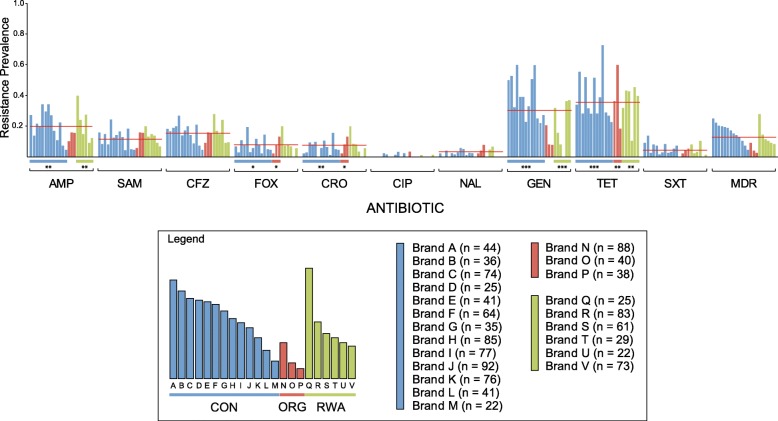
Results: We collected all available brands of retail chicken and turkey-including conventional, "raised without antibiotic", and organic products-every two weeks from January to December 2012. In total, E. coli was recovered from 91% of 546 turkey products tested and 88% of 1367 chicken products tested. The proportion of samples contaminated with E. coli was similar across all three production categories. Resistance prevalence varied by meat type and was highest among E. coli isolates from turkey for the majority of antibiotics tested. In general, production category had little effect on resistance prevalence among E. coli isolates from chicken, although resistance to gentamicin and multidrug resistance did vary. In contrast, resistance prevalence was significantly higher for 6 of the antibiotics tested-and multidrug resistance-among isolates from conventional turkey products when compared to those labelled organic or "raised without antibiotics". E. coli isolates from chicken varied strongly in resistance prevalence among different brands within each production category.

Conclusion: The high prevalence of resistance among E. coli isolates from conventionally-raised turkey meat suggests greater antimicrobial use in conventional turkey production as compared to "raised without antibiotics" and organic systems. However, among E. coli from chicken meat, resistance prevalence was more strongly linked to brand than to production category, which could be caused by brand-level differences during production and/or processing, including variations in antimicrobial use.

Keywords: Antibiotic; Conventional; E. coli; Multidrug resistance; Organic; Poultry; Raised without antibiotics.


Conflict of interest statement

Ethics approval and consent to participate

Not applicable.

Consent for publication

Not applicable.

Competing interests

The authors declare that they have no competing interests.

Publisher’s Note

Springer Nature remains neutral with regard to jurisdictional claims in published maps and institutional affiliations.

Figures
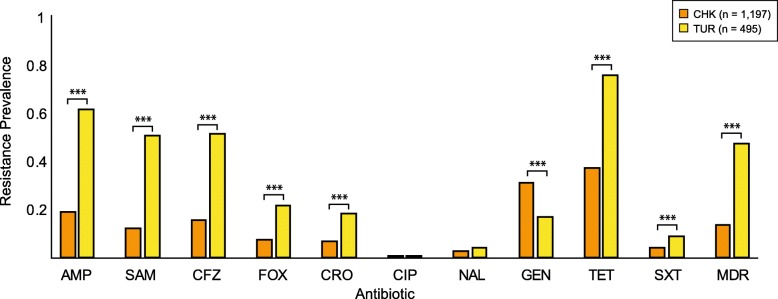
Fig. 1
Fig. 1
Prevalence of antibiotic resistance among E. coli isolates contaminating retail chicken and turkey. Each isolate was tested against: ampicillin (AMP), ampicillin-sulbactam (SAM), cefazolin (CFZ), cefoxitin (FOX), ceftriaxone (CRO), ciprofloxacin (CIP), nalidixic acid (NAL), gentamicin (GEN), tetracycline (TET), trimethoprim-sulfamethoxazole (SXT), amikacin (AMK), and imipenem (IPM). Multidrug resistance (MDR) was defined as resistance to three or more classes of antibiotics. None of the isolates tested were resistant to amikacin (AMK) or imipenem (IPM), which are excluded from the figure. The prevalence of antibiotic resistance was compared among meat types using the two-tailed Fisher’s exact test. (*** P < 0.001)
Fig. 2
Fig. 2
Antibiotic resistance prevalence among E. coli isolates contaminating retail poultry meats raised conventionally (CON), organically (ORG), or “raised without antibiotics” (RWA). Each isolate was tested against: ampicillin (AMP), ampicillin-sulbactam (SAM), cefazolin (CFZ), cefoxitin (FOX), ceftriaxone (CRO), ciprofloxacin (CIP), nalidixic acid (NAL), gentamicin (GEN), tetracycline (TET), trimethoprim-sulfamethoxazole (SXT), amikacin (AMK), and imipenem (IPM), which are excluded from the figure. Multidrug resistance (MDR) was defined as resistance to three or more classes of antibiotics. None of the isolates tested were resistant to amikacin (AMK) or imipenem (IPM). The prevalence of antibiotic resistance was compared among production categories using the two-tailed Fisher’s exact test. (*** P < 0.001, * P < 0.05)
Fig. 3
Fig. 3
Antibiotic resistance prevalence among E. coli isolates contaminating retail brands of chicken meat. Each bar represents a unique brand of chicken, bars are color coded by production category, i.e., conventionally raised (CON), organically raised (ORG), or “raised without antibiotics” (RWA). The horizontal red line indicates the average resistance prevalence across all brands and categories for each antibiotic. Each isolate was tested against: ampicillin (AMP), ampicillin-sulbactam (SAM), cefazolin (CFZ), cefoxitin (FOX), ceftriaxone (CRO), ciprofloxacin (CIP), nalidixic acid (NAL), gentamicin (GEN), tetracycline (TET), trimethoprim-sulfamethoxazole (SXT), amikacin (AMK), and imipenem (IPM). Multidrug resistance (MDR) was defined as resistance to three or more classes of antibiotics. None of the isolates tested were resistant to amikacin (AMK) or imipenem (IPM), which are excluded from the figure. The prevalence of antibiotic resistance, and MDR, was compared across all brands within each production category using the two-tailed Fisher’s exact test. All brands were included in the statistical analysis (Additional file 1: Table S1); however, only brands with more than 20 isolates are included in the figure. (*** P < 0.001, **P < 0.01, * P < 0.05)

References

    1. Alali WQ, Thakur S, Berghaus RD, Martin MP, Gebreyes WA. Prevalence and distribution of Salmonella in organic and conventional broiler poultry farms. Foodborne Pathog Dis. 2010;7(11):1363–1371. doi: 10.1089/fpd.2010.0566. - DOI - PubMed
    1. Cui S, Ge B, Zheng J, Meng J. Prevalence and antimicrobial resistance of Campylobacter spp. and Salmonella serovars in organic chickens from Maryland retail stores. Appl Environ Microbiol. 2005;71(7):4108–4111. doi: 10.1128/AEM.71.7.4108-4111.2005. - DOI - PMC - PubMed
    1. Lazarus B, Paterson DL, Mollinger JL, Rogers BA. Do human Extraintestinal Escherichia coli infections resistant to expanded-Spectrum Cephalosporins originate from food-producing animals? A systematic review. Clin Infect Dis. 2015;60(3):439–452. doi: 10.1093/cid/ciu785. - DOI - PubMed
    1. Luangtongkum T, Morishita TY, Ison AJ, Huang S, McDermott PF, Zhang Q. Effect of conventional and organic production practices on the prevalence and antimicrobial resistance of Campylobacter spp. in poultry. Appl Environ Microbiol. 2006;72(5):3600–3607. doi: 10.1128/AEM.72.5.3600-3607.2006. - DOI - PMC - PubMed
    1. Miranda JM, Guarddon M, Vázquez BI, Fente CA, Barros-Velázquez J, Cepeda A, Franco CM. Antimicrobial resistance in Enterobacteriaceae strains isolated from organic chicken, conventional chicken and conventional Turkey meat: a comparative survey. Food Control. 2008;19(4):412–416. doi: 10.1016/j.foodcont.2007.05.002. - DOI - PubMed

Publication types

MeSH terms

Substances