


Thickness changes in the corneal epithelium and Bowman's layer after overnight wear of silicone hydrogel contact lenses
- PMID: 30390645
- PMCID: PMC6215685
- DOI: 10.1186/s12886-018-0956-2
Thickness changes in the corneal epithelium and Bowman's layer after overnight wear of silicone hydrogel contact lenses
Abstract
Background: To investigate thickness changes in the corneal epithelium and Bowman's layer after overnight silicone hydrogel contact lens (CL) wear by using ultra-high resolution optical coherence tomography (UHROCT).
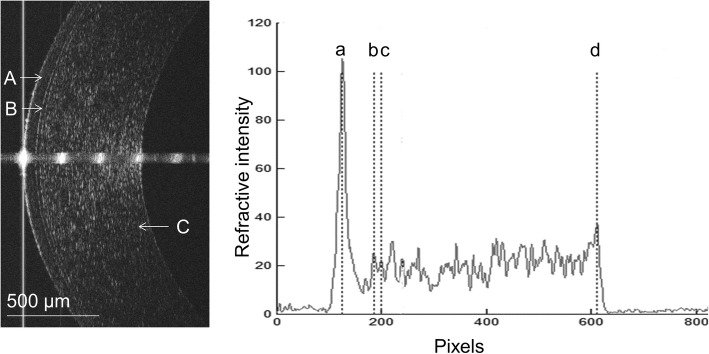
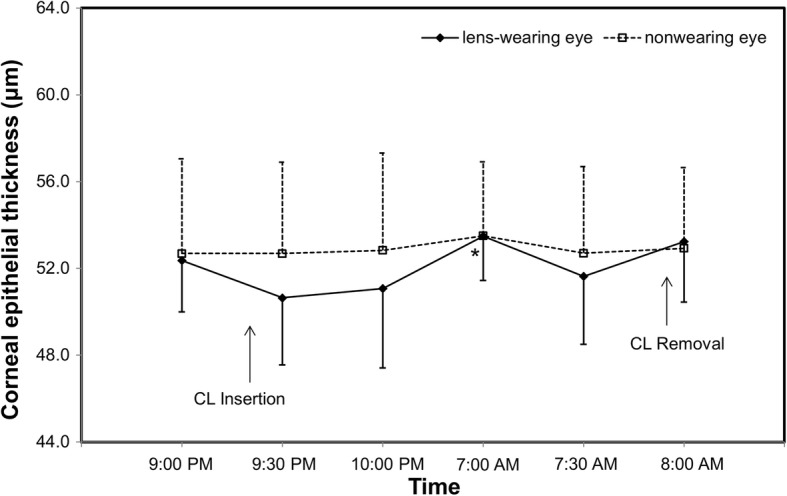
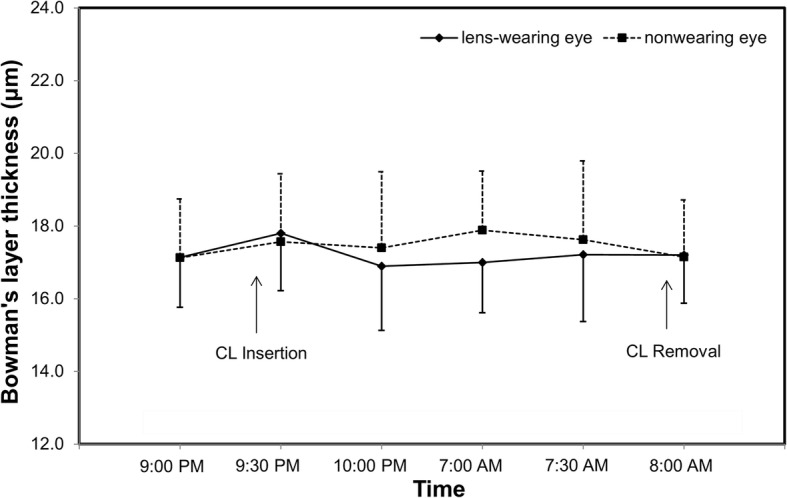
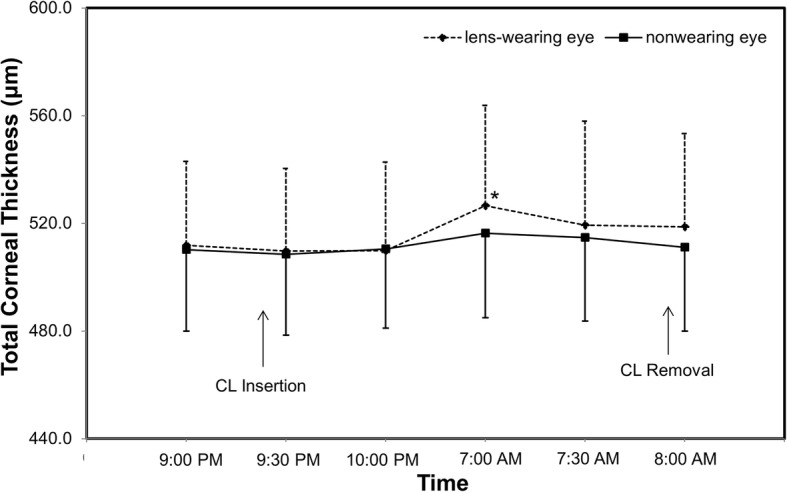
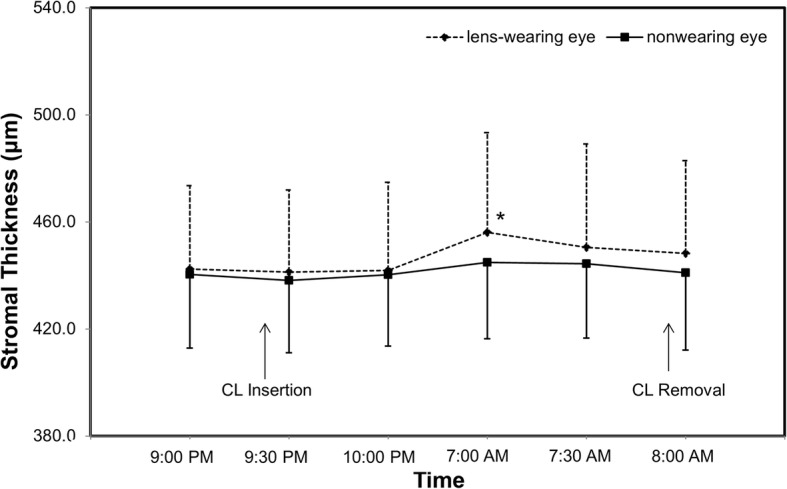
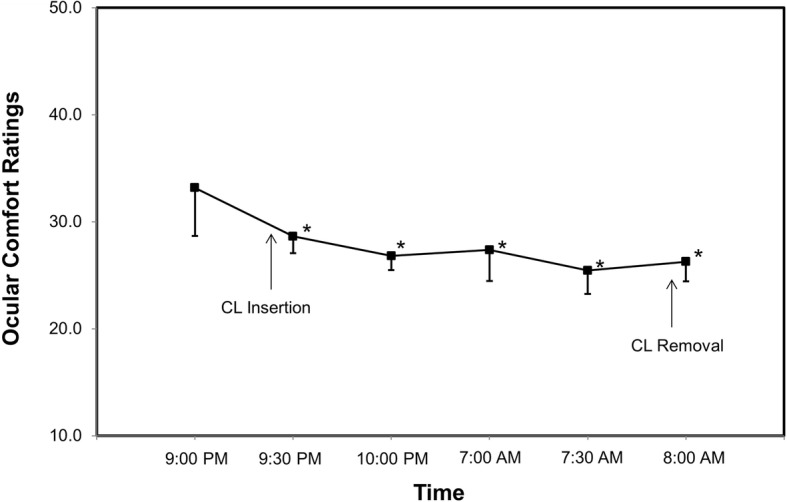
Methods: Eleven subjects without CL wearing history were recruited for this study. An UHROCT was used to measure the thickness of the epithelium (ET), Bowman's layer (BT), stroma (ST), and total cornea (CCT) at the center of both eyes. A silicone hydrogel CL was inserted in the right eye of each subject, and the fellow non-CL wearing left eye served as the control. The lens was inserted at 9:30 pm and removed at 8:00 am the next morning. The subjects were evaluated at 9:00 pm (baseline), 9:30 pm (lens insertion), 10:00 pm (before sleep), 7:00 am (waking), 7:30 am, and 8:00 am (lens removal).
Results: Compared to the lens insertion level, the ET of the lens-wearing eye increased by 5.73% at eye opening (P = 0.001). The ET of the non-CL wearing eye and the BT in both eyes did not change after overnight CL wear. Compared to baseline, the CCT of the lens-wearing eye increased by 2.87% upon waking (P = 0.003) and recovered 30 min later (P = 0.555). In contrast, compared to baseline, the CCT of the non-CL wearing eye did not increase upon waking (P = 0.105).
Conclusions: By using UHROCT, we found that overnight CL wear induced different swelling responses in the various sublayers of the cornea.
Trial registration: Retrospectively registered. Registration number: ChiCTR1800015115 . Registered 07 March 2018.
Keywords: Bowman’s layer; Contact lens; Epithelium; Overnight; Thickness.
Conflict of interest statement
Ethics approval and consent to participate
The study was approved by the human subjects review board at the Eye Hospital of Wenzhou Medical University. Each subject signed a consent form and was treated in accordance with the principles of the Declaration of Helsinki.
Consent for publication
Not Applicable.
Competing interests
The authors declare that they have no competing interests.
Publisher’s Note
Springer Nature remains neutral with regard to jurisdictional claims in published maps and institutional affiliations.
Figures
References
-
- Holden BA, Mertz GW. Critical oxygen levels to avoid corneal edema for daily and extended wear contact lenses. Invest Ophthalmol Vis Sci. 1984;25:1161–1167. - PubMed
Publication types
MeSH terms
Substances
Grants and funding
LinkOut - more resources
Full Text Sources
