


Mitochondrial transplantation prolongs cold ischemia time in murine heart transplantation
- PMID: 30391192
- PMCID: PMC6574228
- DOI: 10.1016/j.healun.2018.09.025
Mitochondrial transplantation prolongs cold ischemia time in murine heart transplantation
Abstract
Background: Cold ischemia time (CIT) causes ischemia‒reperfusion injury to the mitochondria and detrimentally effects myocardial function and tissue viability. Mitochondrial transplantation replaces damaged mitochondria and enhances myocardial function and tissue viability. Herein we investigated the efficacy of mitochondrial transplantation in enhancing graft function and viability after prolonged CIT.
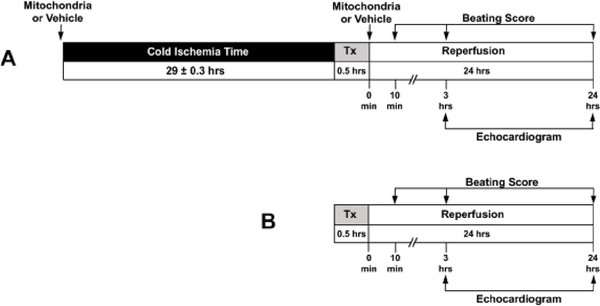
Methods: Heterotopic heart transplantation was performed in C57BL/6J mice. Upon heart harvesting from C57BL/6J donors, 0.5 ml of either mitochondria (1 × 10⁸ in respiration buffer; mitochondria group) or respiration buffer (vehicle group) was delivered antegrade to the coronary arteries via injection to the coronary ostium. The hearts were excised and preserved for 29 ± 0.3 hours in cold saline (4°C). The hearts were then heterotopically transplanted. A second injection of either mitochondria (1 × 10⁸) or respiration buffer (vehicle) was delivered antegrade to the coronary arteries 5 minutes after transplantation. Grafts were analyzed for 24 hours. Beating score, graft function, and tissue injury were measured.
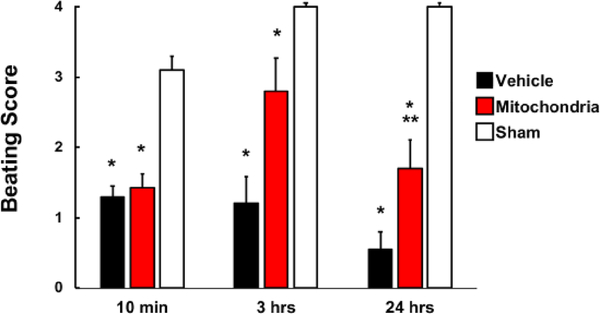
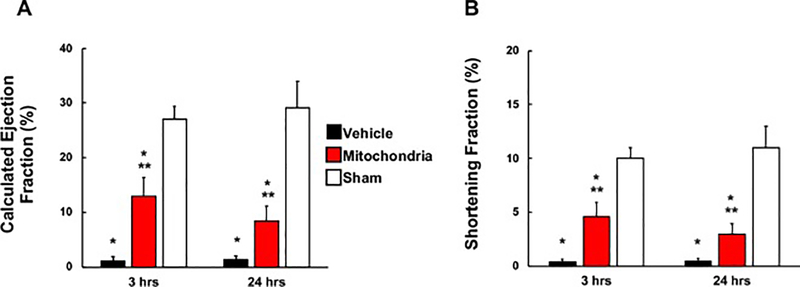
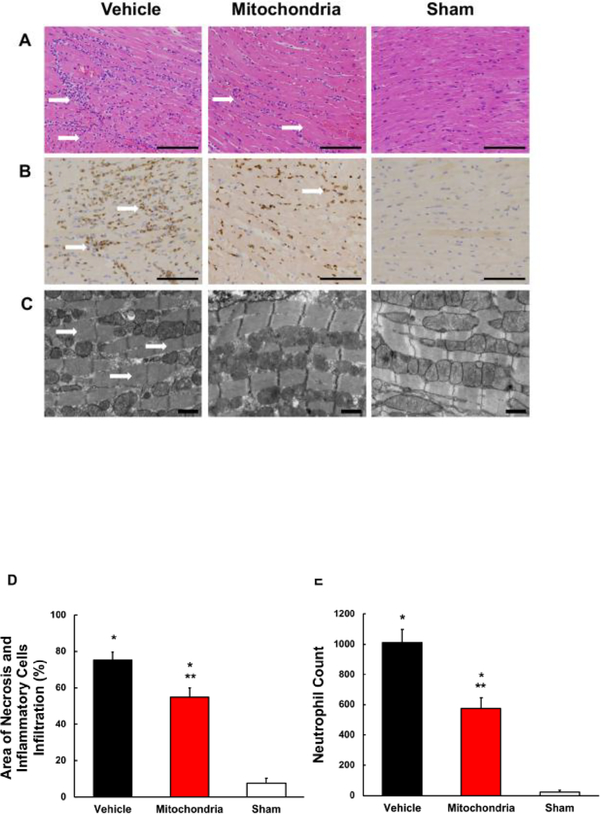
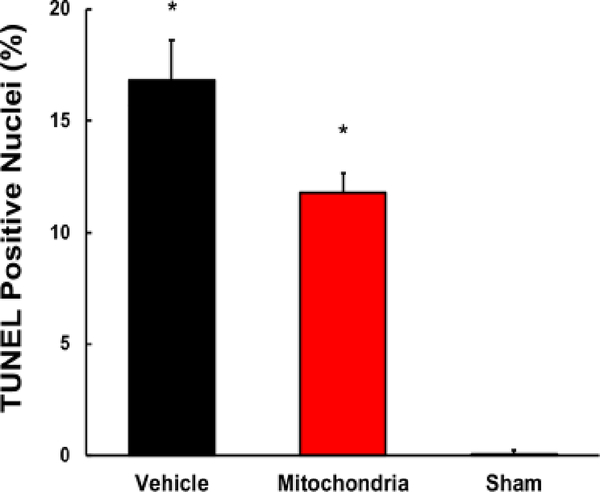
Results: Beating score, calculated ejection fraction, and shortening fraction were significantly enhanced (p < 0.05), whereas necrosis and neutrophil infiltration were significantly decreased (p < 0.05) in the mitochondria group as compared with the vehicle group at 24 hours of reperfusion. Transmission electron microscopy showed the presence of contraction bands in vehicle but not in mitochondria grafts.
Conclusions: Mitochondrial transplantation prolongs CIT to 29 hours in the murine heart transplantation model, significantly enhances graft function, and decreases graft tissue injury. Mitochondrial transplantation may provide a means to reduce graft failure and improve transplantation outcomes after prolonged CIT.
Keywords: cold ischemia time; heart transplantation; ischemia–reperfusion; mitochondria; mitochondrial transplantation.
Copyright © 2018 Elsevier Ltd. All rights reserved.
Conflict of interest statement
Conflict of Interest statement
Dr. McCully, Dr. Cowan and Dr. del Nido have patents pending for the isolation and usage of mitochondria. There are no other conflicts of interest by any of the authors. The authors attest they had full freedom to explore the data, analyze the results independent from any sponsor and that they had sole authority to make the final decision to submit the material for publication.
Figures
Comment in
-
Organ(elle) Transplants.Am J Transplant. 2018 Dec;18(12):2839-2840. doi: 10.1111/ajt.15157. Am J Transplant. 2018. PMID: 30476365 No abstract available.
References
-
- Colvin M, Smith JM, Hadley N, et al. OPTN/SRTR 2016 Annual Data Report: Heart. Am J Transplant 2018;18(Suppl 1):291–362. - PubMed
-
- Subramaniam K Early graft failure after heart transplantation: prevention and treatment. Int Anesthesiol Clin 2012;50:202–227. - PubMed
-
- Lund LH, Khush KK, Cherikh WS, et al. International Society for Heart and Lung Transplantation. The Registry of the International Society for Heart and Lung Transplantation: Thirty-fourth Adult Heart Transplantation Report-2017; Focus Theme: Allograft ischemic time. J Heart Lung Transplant 2017;36:1037–1046. - PubMed
-
- Weiss ES, Allen JG, Kilic A, et al. Development of a quantitative donor risk index to predict short-term mortality in orthotopic heart transplantation. J Heart Lung Transplant 2012;31:266–273. - PubMed
Publication types
MeSH terms
Grants and funding
LinkOut - more resources
Full Text Sources
Other Literature Sources
Medical
