


HPV16 viral characteristics in primary, recurrent and metastatic vulvar carcinoma
- PMID: 30391517
- PMCID: PMC6249404
- DOI: 10.1016/j.pvr.2018.10.008
HPV16 viral characteristics in primary, recurrent and metastatic vulvar carcinoma
Abstract
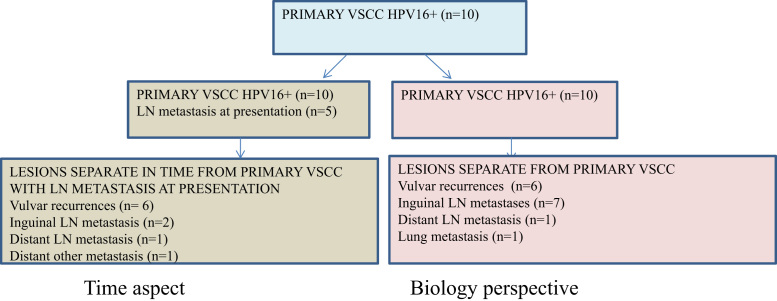
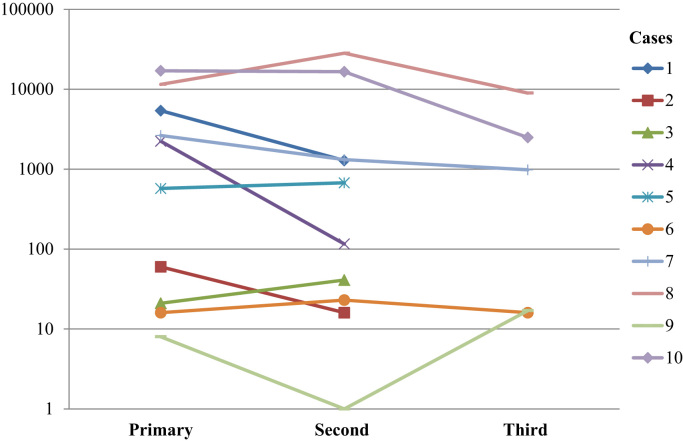
Vulvar carcinoma is the fourth most common gynecological malignancy. Two separate carcinogenic pathways are suggested, where one is associated with the human papillomavirus (HPV) and HPV16 the most common genotype. The aim of this study was to evaluate HPV-markers in a set of primary tumors, metastases and recurrent lesions of vulvar squamous cell carcinomas (VSCC). Ten HPV16-positive VSCC with metastatic regional lymph nodes, distant lymphoid/hematogenous metastases or local recurrent lesions were investigated for HPV genotype, HPV16 variant, HPV16 viral load, HPV16 integration and HPV16 E2BS3 and 4 methylation. In all 10 analyzed case series, the same HPV genotype (HPV16), HPV16 variant and level of viral load were detected in all lesions within a patient case. Primary tumors with a high E2/E6 ratio were found to have fewer vulvar recurrences and/or metastases after diagnosis and treatment. Also, a significantly lower viral load was evident in regional lymph nodes compared to primary tumors. The data presented strengthens the evidence for a clonal HPV-induced pathway for vulvar carcinoma.
Keywords: Human papillomavirus; Integration; Metastases; Recurrences; Viral load; Vulvar carcinoma.
Copyright © 2018 The Authors. Published by Elsevier B.V. All rights reserved.
Figures
References
-
- Del Pino M., Rodriguez-Carunchio L., Ordi J. Pathways of vulvar intraepithelial neoplasia and squamous cell carcinoma. Histopathology. 2013;62(1):161–175. - PubMed
-
- McCluggage W.G. Recent developments in vulvovaginal pathology. Histopathology. 2009;54(2):156–173. - PubMed
-
- De Vuyst H., Clifford G.M., Nascimento M.C., Madeleine M.M., Franceschi S. Prevalence and type distribution of human papillomavirus in carcinoma and intraepithelial neoplasia of the vulva, vagina and anus: a meta-analysis. Int J. Cancer. 2009;124(7):1626–1636. - PubMed
-
- Larsson G.L., Helenius G., Andersson S., Elgh F., Sorbe B., Karlsson M.G. Human papillomavirus (HPV) and HPV 16-variant distribution in vulvar squamous cell carcinoma in Sweden. Int J. Gynecol. Cancer. 2012;22(8):1413–1419. - PubMed
-
- Skamperle M., Kocjan B.J., Maver P.J., Seme K., Poljak M. Human papillomavirus (HPV) prevalence and HPV type distribution in cervical, vulvar, and anal cancers in central and eastern Europe. Acta Dermatovenerol. Alp. Pannonica Adriat. 2013;22(1):1–5. - PubMed
Publication types
MeSH terms
LinkOut - more resources
Full Text Sources
Medical
Molecular Biology Databases
