


The global burden of disease attributable to alcohol and drug use in 195 countries and territories, 1990-2016: a systematic analysis for the Global Burden of Disease Study 2016
- PMID: 30392731
- PMCID: PMC6251968
- DOI: 10.1016/S2215-0366(18)30337-7
The global burden of disease attributable to alcohol and drug use in 195 countries and territories, 1990-2016: a systematic analysis for the Global Burden of Disease Study 2016
Erratum in
-
Correction to Lancet Psychiatry 2018; 5: 987-1012.Lancet Psychiatry. 2019 Jan;6(1):e2. doi: 10.1016/S2215-0366(18)30488-7. Lancet Psychiatry. 2019. PMID: 30579502 Free PMC article. No abstract available.
Abstract
Background: Alcohol and drug use can have negative consequences on the health, economy, productivity, and social aspects of communities. We aimed to use data from the Global Burden of Diseases, Injuries, and Risk Factors Study (GBD) 2016 to calculate global and regional estimates of the prevalence of alcohol, amphetamine, cannabis, cocaine, and opioid dependence, and to estimate global disease burden attributable to alcohol and drug use between 1990 and 2016, and for 195 countries and territories within 21 regions, and within seven super-regions. We also aimed to examine the association between disease burden and Socio-demographic Index (SDI) quintiles.
Methods: We searched PubMed, EMBASE, and PsycINFO databases for original epidemiological studies on alcohol and drug use published between Jan 1, 1980, and Sept 7, 2016, with out language restrictions, and used DisMod-MR 2.1, a Bayesian meta-regression tool, to estimate population-level prevalence of substance use disorders. We combined these estimates with disability weights to calculate years of life lived with disability (YLDs), years of life lost (YLLs), and disability-adjusted life-years (DALYs) for 1990-2016. We also used a comparative assessment approach to estimate burden attributable to alcohol and drug use as risk factors for other health outcomes.
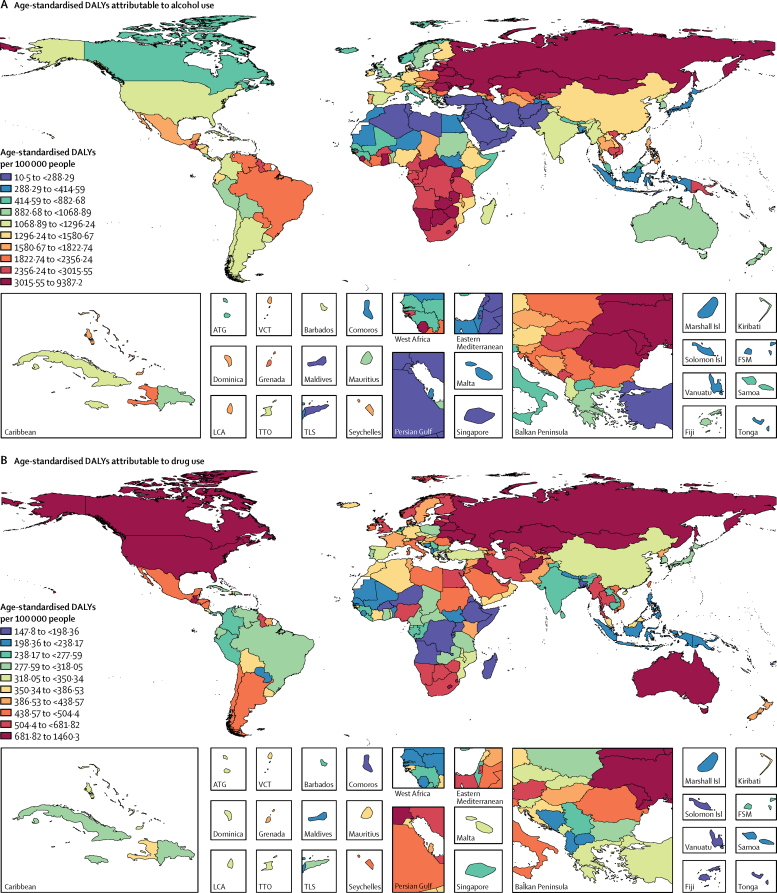
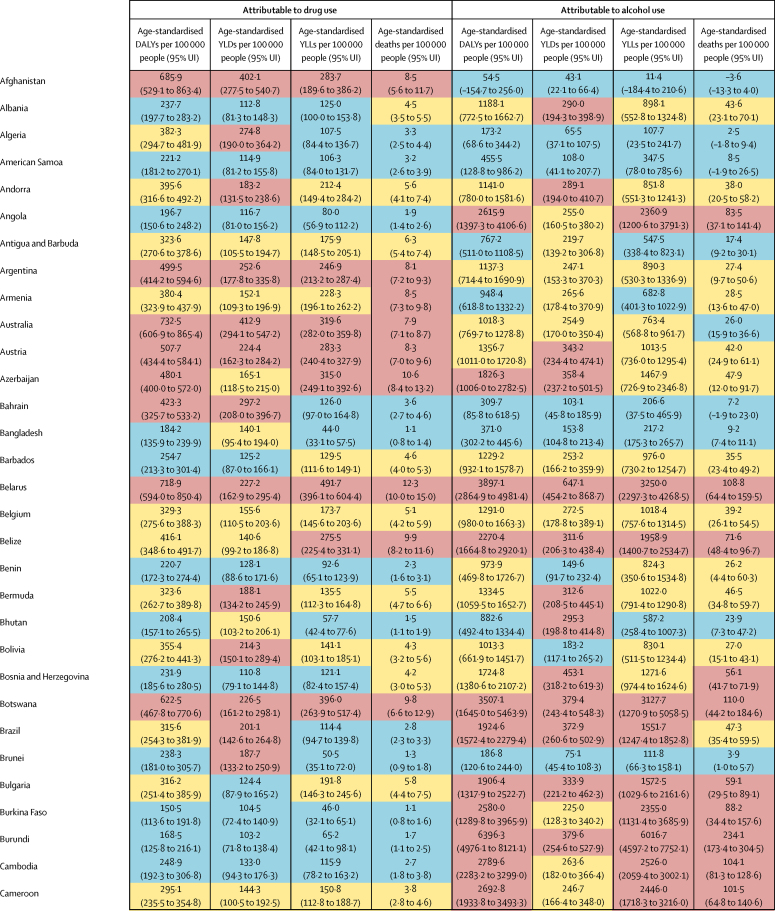
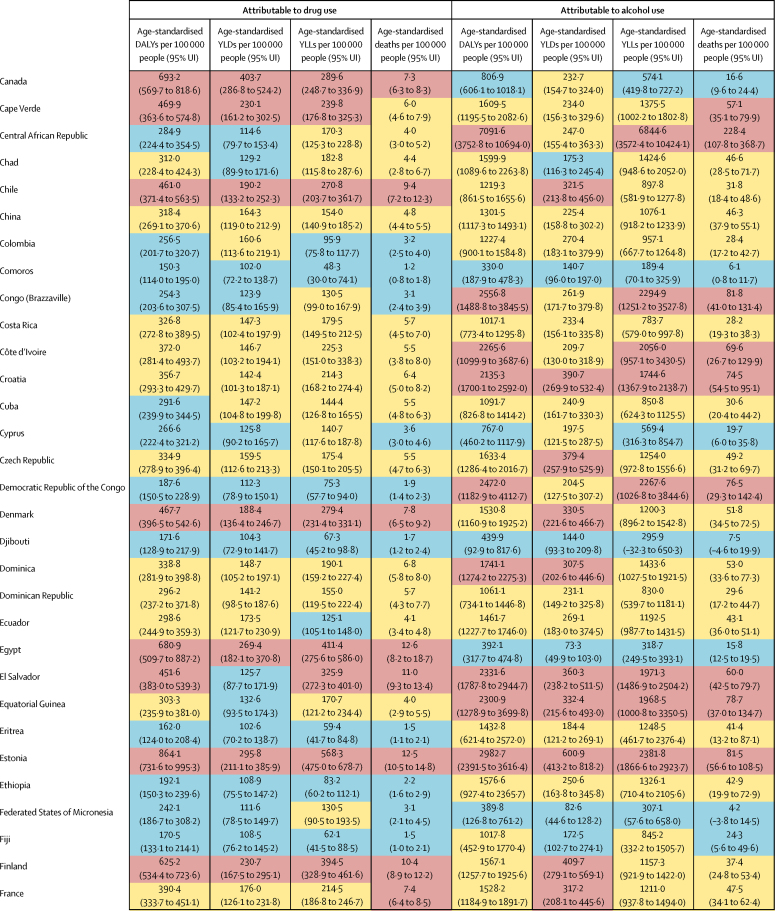
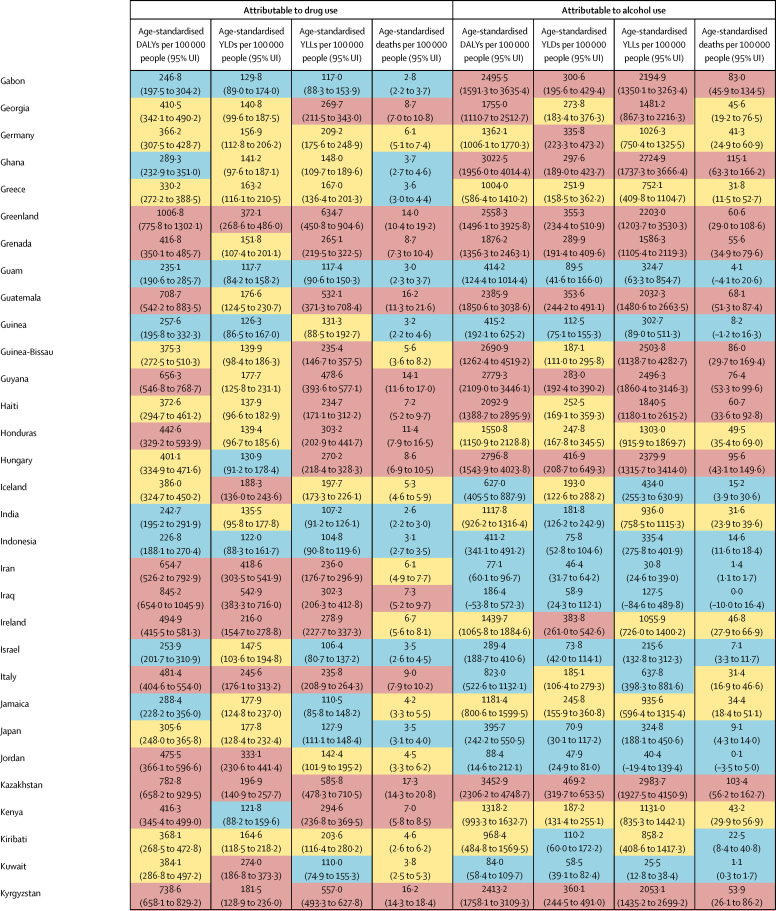
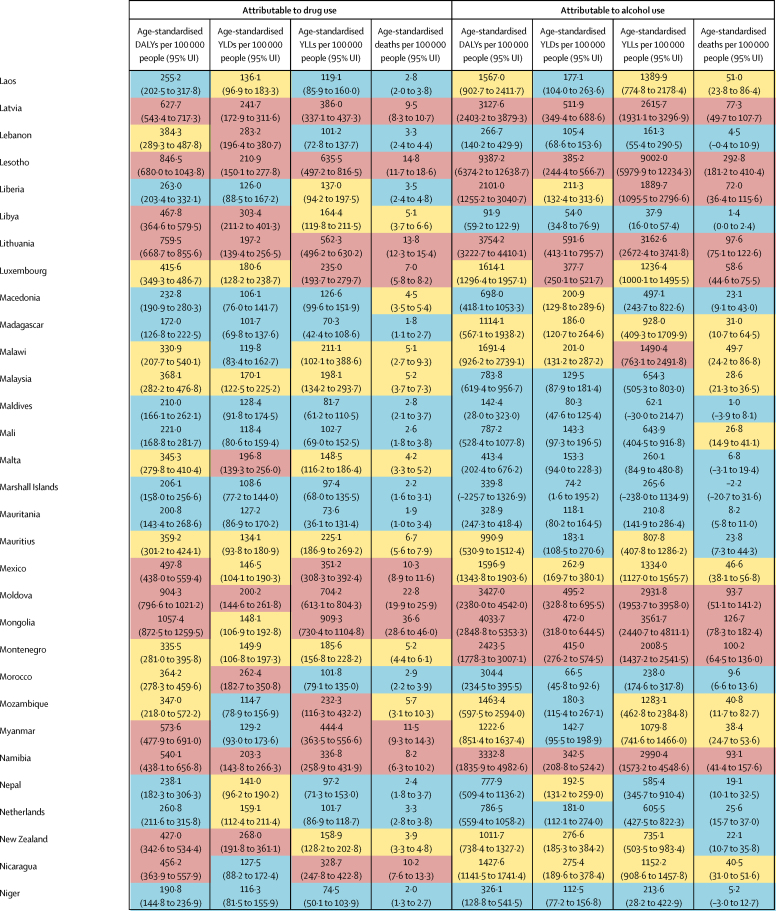
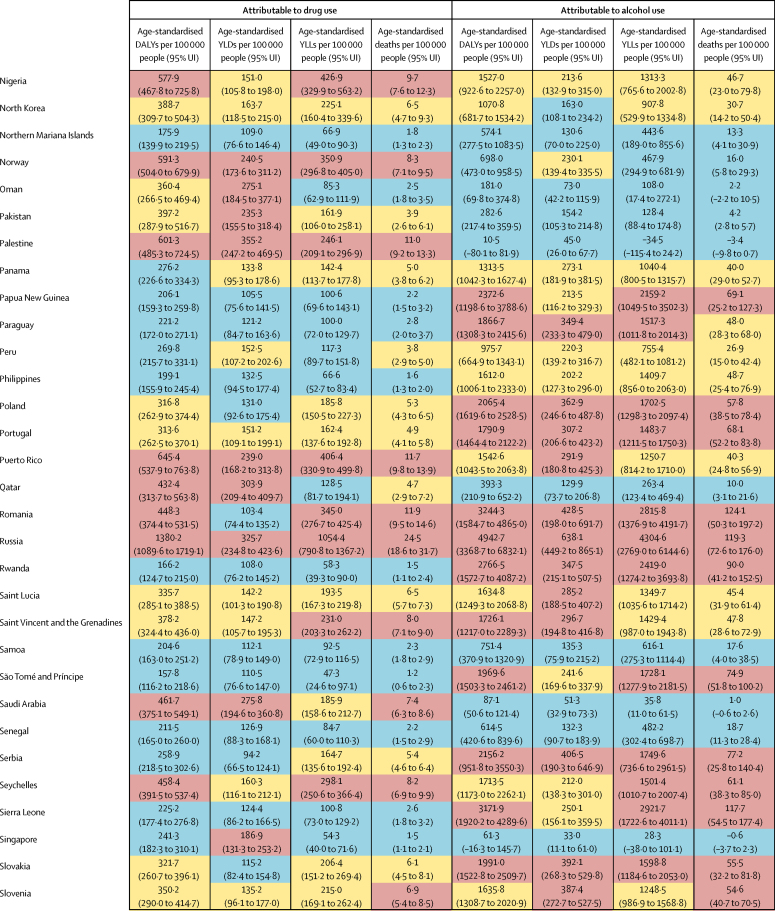
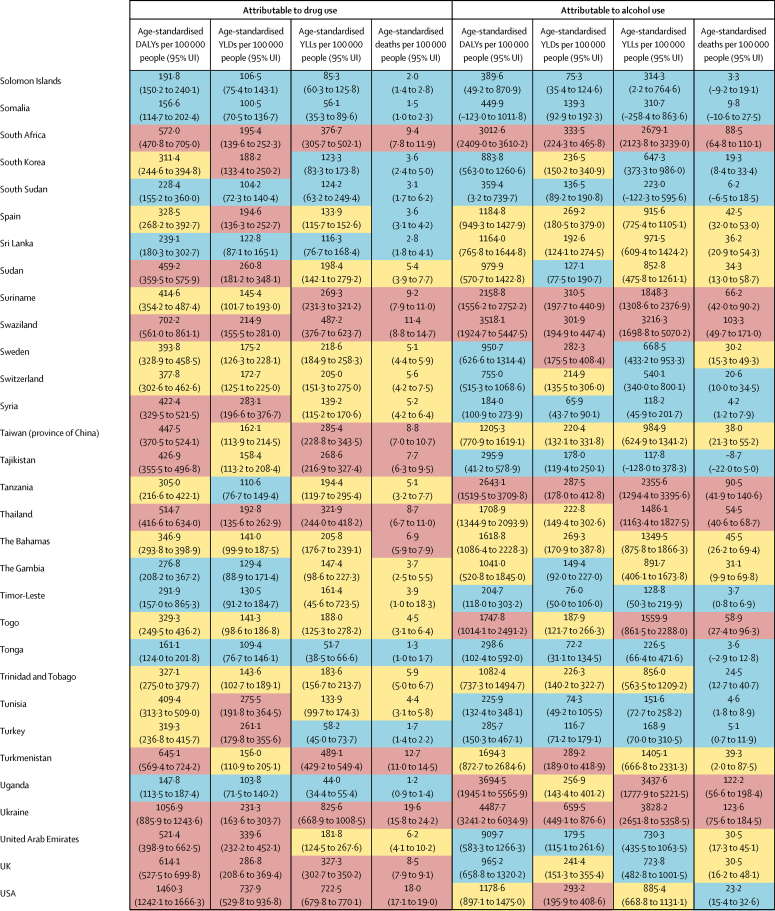
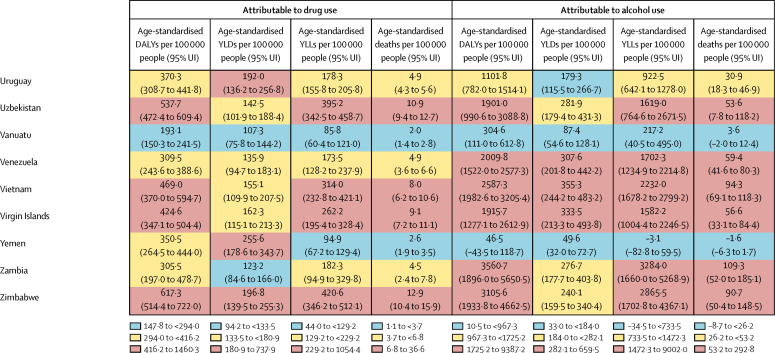
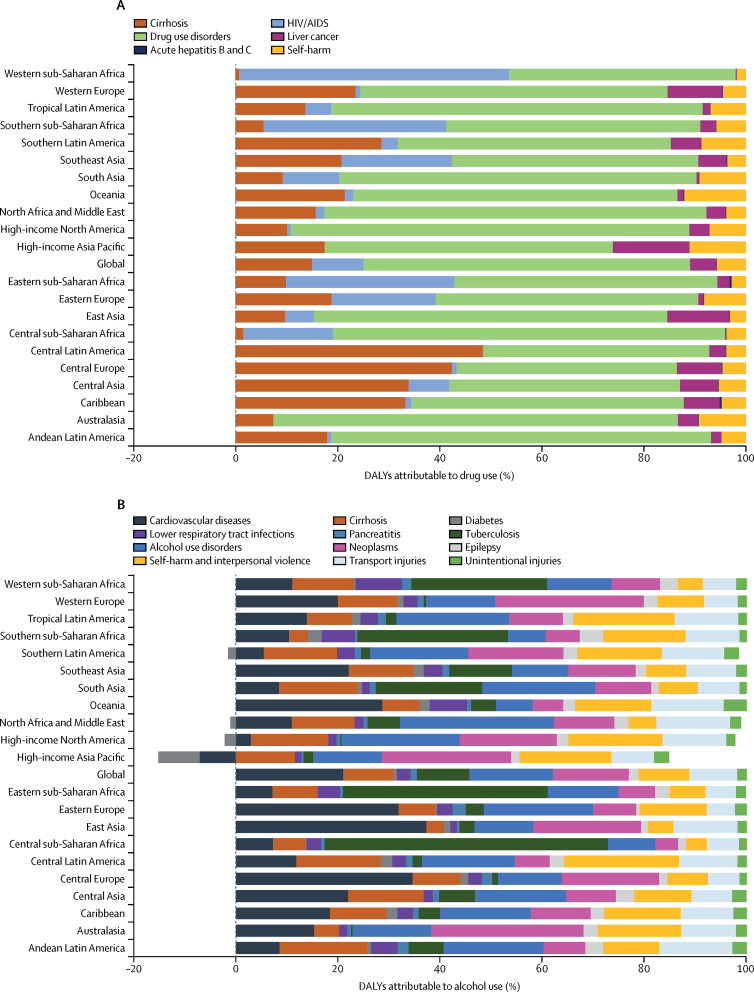
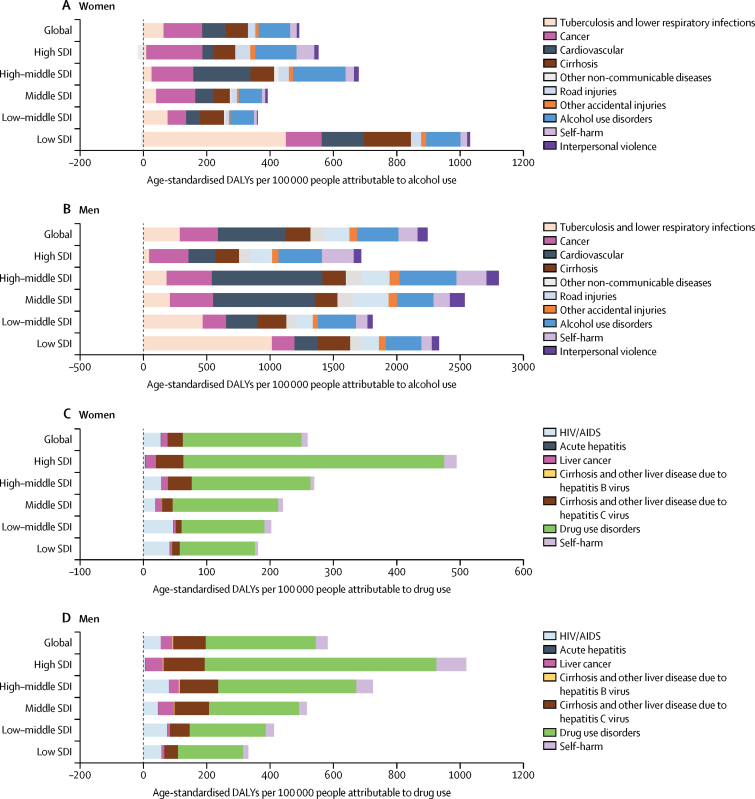
Findings: Globally, alcohol use disorders were the most prevalent of all substance use disorders, with 100·4 million estimated cases in 2016 (age-standardised prevalence 1320·8 cases per 100 000 people, 95% uncertainty interval [95% UI] 1181·2-1468·0). The most common drug use disorders were cannabis dependence (22·1 million cases; age-standardised prevalence 289·7 cases per 100 000 people, 95% UI 248·9-339·1) and opioid dependence (26·8 million cases; age-standardised prevalence 353·0 cases per 100 000 people, 309·9-405·9). Globally, in 2016, 99·2 million DALYs (95% UI 88·3-111·2) and 4·2% of all DALYs (3·7-4·6) were attributable to alcohol use, and 31·8 million DALYs (27·4-36·6) and 1·3% of all DALYs (1·2-1·5) were attributable to drug use as a risk factor. The burden of disease attributable to alcohol and drug use varied substantially across geographical locations, and much of this burden was due to the effect of substance use on other health outcomes. Contrasting patterns were observed for the association between total alcohol and drug-attributable burden and SDI: alcohol-attributable burden was highest in countries with a low SDI and middle-high middle SDI, whereas the burden due to drugs increased with higher S DI level.
Interpretation: Alcohol and drug use are important contributors to global disease burden. Effective interventions should be scaled up to prevent and reduce substance use disease burden.
Funding: Bill & Melinda Gates Foundation and Australian National Health and Medical Research Council.
Copyright © 2018 The Author(s). Published by Elsevier Ltd. This is an Open Access article under the CC BY-NC-ND 4.0 license. Published by Elsevier Ltd.. All rights reserved.
Figures
Comment in
-
Mixed up: alcohol and society.Lancet Psychiatry. 2018 Dec;5(12):970. doi: 10.1016/S2215-0366(18)30432-2. Epub 2018 Nov 1. Lancet Psychiatry. 2018. PMID: 30392728 No abstract available.
-
New data to support much needed policy change.Lancet Psychiatry. 2018 Dec;5(12):947-948. doi: 10.1016/S2215-0366(18)30390-0. Epub 2018 Nov 1. Lancet Psychiatry. 2018. PMID: 30392730 No abstract available.
References
-
- Degenhardt L, Hall W. Extent of illicit drug use and dependence, and their contribution to the global burden of disease. Lancet. 2012;379:55–70. - PubMed
-
- WHO . World Health Organization; Geneva: 1993. The ICD-10 classification of mental and behavioural disorders. Diagnostic criteria for research.
-
- American Psychiatric Association . 4th edn. American Psychiatric Association; Washington DC: 2000. Diagnostic and Statistical Manual of Mental Disorders (DSM-IV-TR)
-
- Larney S, Peacock A, Mathers BM, Hickman M, Degenhardt L. A systematic review of injecting-related injury and disease among people who inject drugs. Drug Alcohol Depend. 2017;171:39–49. - PubMed
