HIV-1 envelope glycan modifications that permit neutralization by germline-reverted VRC01-class broadly neutralizing antibodies
- PMID: 30395637
- PMCID: PMC6237427
- DOI: 10.1371/journal.ppat.1007431
HIV-1 envelope glycan modifications that permit neutralization by germline-reverted VRC01-class broadly neutralizing antibodies
Erratum in
-
Correction: HIV-1 envelope glycan modifications that permit neutralization by germline-reverted VRC01-class broadly neutralizing antibodies.PLoS Pathog. 2019 Mar 26;15(3):e1007646. doi: 10.1371/journal.ppat.1007646. eCollection 2019 Mar. PLoS Pathog. 2019. PMID: 30913265 Free PMC article.
Abstract
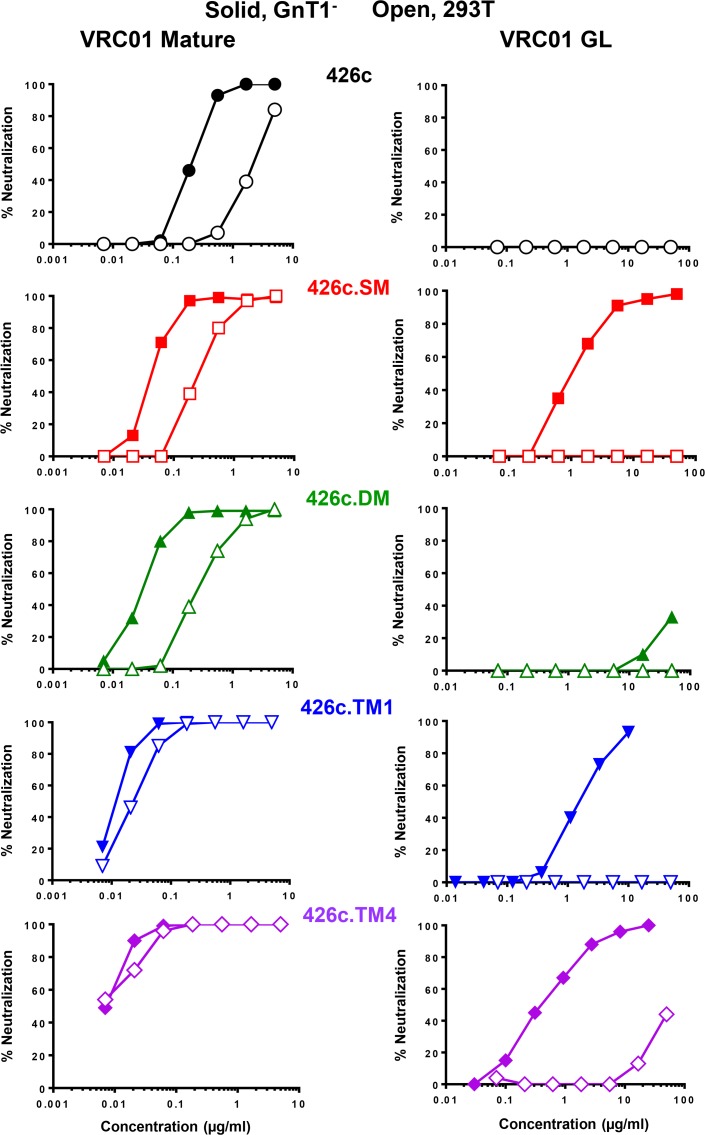
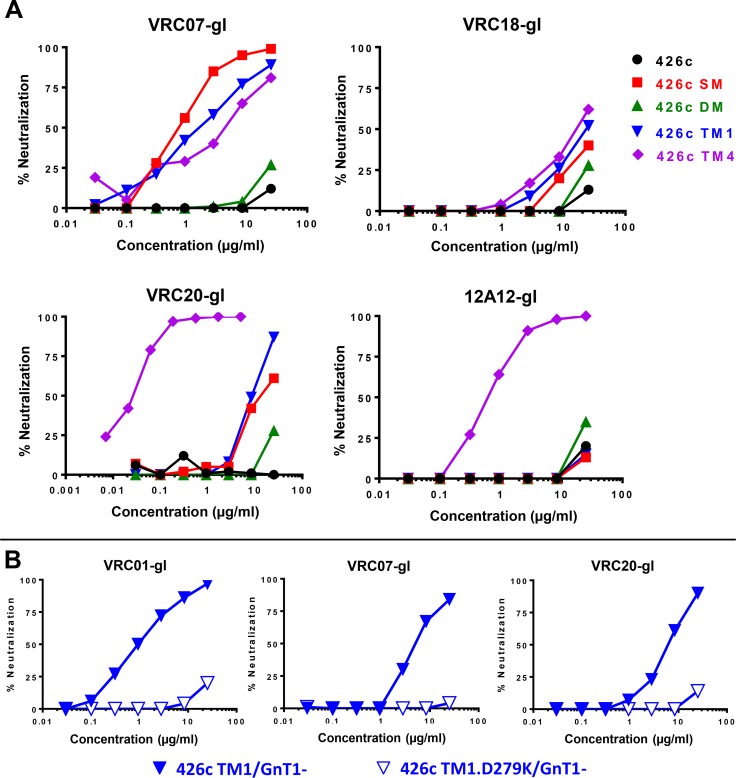
Broadly neutralizing antibody (bnAb) induction is a high priority for effective HIV-1 vaccination. VRC01-class bnAbs that target the CD4 binding site (CD4bs) of trimeric HIV-1 envelope (Env) glycoprotein spikes are particularly attractive to elicit because of their extraordinary breadth and potency of neutralization in vitro and their ability to protect against infection in animal models. Glycans bordering the CD4bs impede the binding of germline-reverted forms of VRC01-class bnAbs and therefore constitute a barrier to early events in initiating the correct antibody lineages. Deleting a subset of these glycans permits Env antigen binding but not virus neutralization, suggesting that additional barriers impede germline-reverted VRC01-class antibody binding to functional Env trimers. We investigated the requirements for functional Env trimer engagement of VRC01-class naïve B cell receptors by using virus neutralization and germline-reverted antibodies as surrogates for the interaction. Targeted deletion of a subset of N-glycans bordering the CD4bs, combined with Man5 enrichment of remaining N-linked glycans that are otherwise processed into larger complex-type glycans, rendered HIV-1 426c Env-pseudotyped virus (subtype C, transmitted/founder) highly susceptible to neutralization by near germline forms of VRC01-class bnAbs. Neither glycan modification alone rendered the virus susceptible to neutralization. The potency of neutralization in some cases rivaled the potency of mature VRC01 against wildtype viruses. Neutralization by the germline-reverted antibodies was abrogated by the known VRC01 resistance mutation, D279K. These findings improve our understanding of the restrictions imposed by glycans in eliciting VRC01-class bnAbs and enable a neutralization-based strategy to monitor vaccine-elicited early precursors of this class of bnAbs.
Conflict of interest statement
The authors have declared that no competing interests exist
Figures
References
-
- McClure MO, Sattentau QJ, Beverley PC, Hearn JP, Fitzgerald AK, Zuckerman AJ, et al. HIV infection of primate lymphocytes and conservation of the CD4 receptor. Nature. 1987;330(6147):487–9. 10.1038/330487a0 . - DOI - PubMed
-
- Bonsignori M, Zhou T, Sheng Z, Chen L, Gao F, Joyce MG, et al. Maturation Pathway from Germline to Broad HIV-1 Neutralizer of a CD4-Mimic Antibody. Cell. 2016;165(2):449–63. 10.1016/j.cell.2016.02.022 ; PubMed Central PMCID: PMC4826291. - DOI - PMC - PubMed
-
- Corti D, Langedijk JP, Hinz A, Seaman MS, Vanzetta F, Fernandez-Rodriguez BM, et al. Analysis of memory B cell responses and isolation of novel monoclonal antibodies with neutralizing breadth from HIV-1-infected individuals. PloS one. 2010;5(1):e8805 10.1371/journal.pone.0008805 ; PubMed Central PMCID: PMC2808385. - DOI - PMC - PubMed
-
- Gristick HB, von Boehmer L, West AP Jr., Schamber M, Gazumyan A, Golijanin J, et al. Natively glycosylated HIV-1 Env structure reveals new mode for antibody recognition of the CD4-binding site. Nature structural & molecular biology. 2016;23(10):906–15. 10.1038/nsmb.3291 ; PubMed Central PMCID: PMC5127623. - DOI - PMC - PubMed
-
- Huang J, Kang BH, Ishida E, Zhou T, Griesman T, Sheng Z, et al. Identification of a CD4-Binding-Site Antibody to HIV that Evolved Near-Pan Neutralization Breadth. Immunity. 2016;45(5):1108–21. 10.1016/j.immuni.2016.10.027 . - DOI - PMC - PubMed
Publication types
MeSH terms
Substances
Grants and funding
LinkOut - more resources
Full Text Sources
Other Literature Sources
Research Materials