


Is traumatic brain injury a risk factor for neurodegeneration? A meta-analysis of population-based studies
- PMID: 30396335
- PMCID: PMC6217762
- DOI: 10.1186/s12883-018-1187-0
Is traumatic brain injury a risk factor for neurodegeneration? A meta-analysis of population-based studies
Abstract
Background: To determine the association of prior traumatic brain injury (TBI) with subsequent diagnosis of neurodegeneration disease.
Methods: All studies from 1980 to 2016 reporting TBI as a risk factor for diagnoses of interest were identified by searching PubMed, Embase, study references, and review articles. The data and study design were assessed by 2 investigators independently. A meta-analysis was performed by RevMan 5.3.
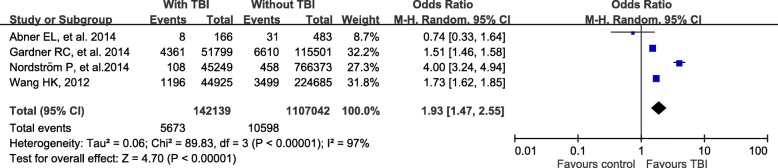
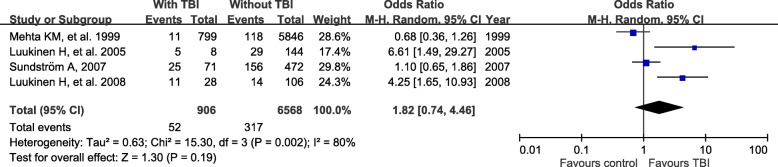
Results: There were 18 studies comprising 3,263,207 patients. Meta-analysis revealed a significant association of prior TBI with subsequent dementia. The pooled odds ratio (OR) for TBI on development of dementia, FTD and TDP-43 associated disease were 1.93 (95% CI 1.47-2.55, p < 0.001), 4.44 (95% CI 3.86-5.10, p < 0.001), and 2.97 (95% CI 1.35-6.53, p < 0.001). However, analyses of individual diagnoses found no evidence that the risk of Alzheimer's disease, and Parkinson's disease in individuals with previous TBI compared to those without TBI.
Conclusions: History of TBI is not associated with the development of subsequent neurodegeneration disease. Care must be taken in extrapolating from these results because no suitable criteria define post TBI neurodegenerative processes. Therefore, further research in this area is needed to confirm these questions and uncover the link between TBI and neurodegeneration disease.
Keywords: Dementia; Meta-analysis; Neurodegeneration; TBI.
Conflict of interest statement
Ethics approval and consent to participate
This study was based in part on data from the Medical Literature Analysis and Retrieval System Online (MEDLINE®)/PubMed (US National Library of Medicine, National Institutes of Health, Bethesda, MD;
Consent for publication
Not applicable.
Competing interests
The authors report no conflict of interest concerning the materials or methods used in this study or the findings specified in this paper.
Publisher’s Note
Springer Nature remains neutral with regard to jurisdictional claims in published maps and institutional affiliations.
Figures




References
Publication types
MeSH terms
LinkOut - more resources
Full Text Sources
Other Literature Sources
Medical
