. 2018 Dec 21;63(1):e01542-18.
doi: 10.1128/AAC.01542-18. Print 2019 Jan.

Daptomycin Resistance and Tolerance Due to Loss of Function in Staphylococcus aureus dsp1 and asp23

Affiliations

Daptomycin Resistance and Tolerance Due to Loss of Function in Staphylococcus aureus dsp1 and asp23

Elaine M Barros et al. Antimicrob Agents Chemother. .

Abstract

Lipopeptide daptomycin is a last-line cell-membrane-targeting antibiotic to treat multidrug-resistant Staphylococcus aureus Alarmingly, daptomycin-resistant S. aureus isolates have emerged. The mechanisms underlying daptomycin resistance are diverse and share similarities with resistances to cationic antimicrobial peptides and other lipopeptides, but they remain to be fully elucidated. We selected mutants with increased resistance to daptomycin from a library of transposon insertions in sequent type 8 (ST8) S. aureus HG003. Insertions conferring increased daptomycin resistance were localized to two genes, one coding for a hypothetical lipoprotein (SAOUHSC_00362, Dsp1), and the other for an alkaline shock protein (SAOUHSC_02441, Asp23). Markerless loss-of-function mutants were then generated for comparison. All transposon mutants and knockout strains exhibited increased daptomycin resistance compared to those of wild-type and complemented strains. Null and transposon insertion mutants also exhibited increased resistance to cationic antimicrobial peptides. Interestingly, the Δdsp1 mutant also showed increased resistance to vancomycin, a cell-wall-targeting drug with a different mode of action. Null mutations in both dsp1 and asp23 resulted in increased tolerance as reflected by reduced killing to both daptomycin and vancomycin, as well as an increased tolerance to surfactant (Triton X-100). Neither mutant exhibited increased resistance to lysostaphin, a cell-wall-targeting endopeptidase. These findings identified two genes core to the S. aureus species that make previously uncharacterized contributions to antimicrobial resistance and tolerance in S. aureus.

Keywords: Staphylococcus aureus; antibiotic resistance; daptomycin; vancomycin.


Figures

FIG 1
FIG 1
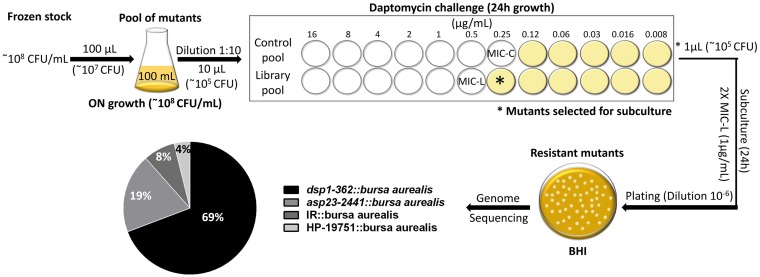
Transposon library antibiotic treatment and transposon mutant identification. A 10-μl aliquot of an overnight culture of the transposon library (library pool) and a pool generated from 10 independent mutants (control pool), each containing 106 CFU, were inoculated into a final volume of 200 μl Muller-Hinton broth in a 96-well plate broth microdilution format. DAP MIC was determined by the growth of the control pool (MIC-C). The contents of the library pool growing at 0.25 μg/ml DAP (1× MIC-C) were subcultured in 1 μg/ml (2× MIC-L). This culture was diluted and plated on BHI plates to recover isolated resistant mutants. Genomic DNA was harvested from individual colonies and subjected to whole-genome sequencing. Interrupted genes by transposon insertion were identified after alignment with the NCTC8325 whole genome.
FIG 2
FIG 2
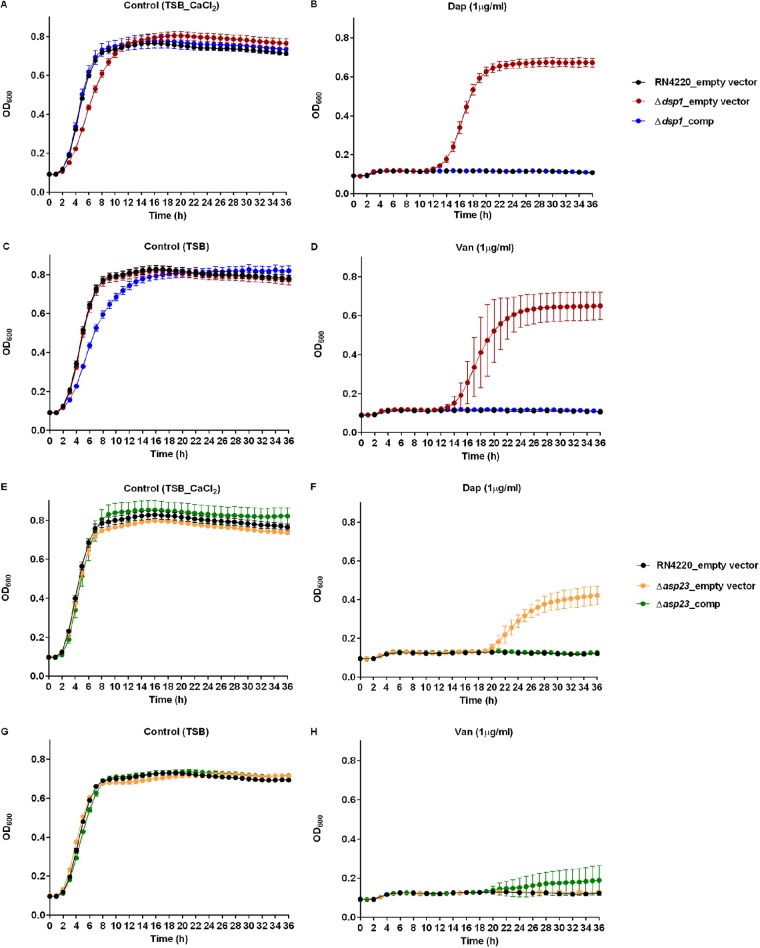
Growth kinetics of Δdsp1 (A to D), Δasp23 (E to H), and complemented strains upon challenge with 1 µg/ml DAP (B and F) or 1 µg/ml VAN (D and H). TSB CaCl2 was used as a control for DAP challenge (A and E), and plain TSB was used as a control for VAN challenge (C and G). The data are median values from three experiments for each condition, and error bars represent the standard deviations.
FIG 3
FIG 3
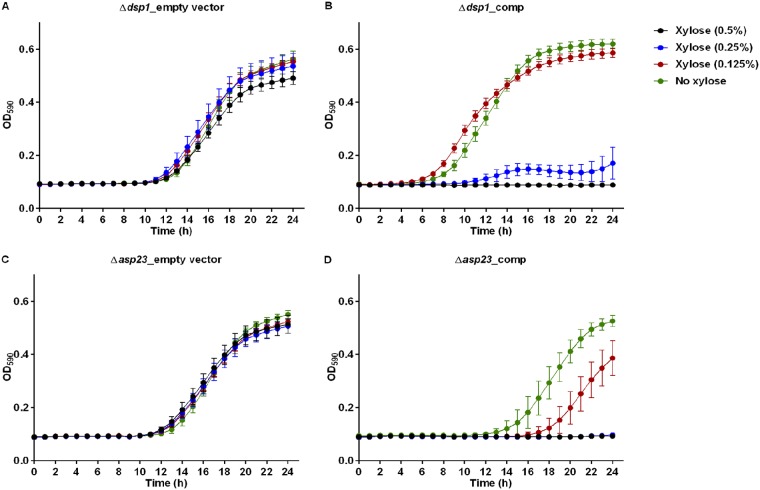
Overexpression of genes dsp1 (B) and asp23 (D) in the complemented strains in the presence of DAP (1 µg/ml). Mutant strains with empty vector pEPSA5 were used as a control (A and C). The data are median values from three experiments for each condition, and error bars represent the standard deviations.
FIG 4
FIG 4
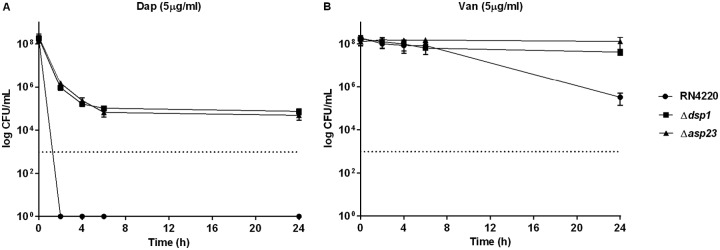
Increased survival of Δdsp1 and Δasp23 mutants in DAP (A) and VAN (B) exposure assays. Unpaired t tests were used to determine statistical significance after 24-h treatments. For daptomycin: Δdsp1, P = 0.0197 and Δasp23, P = 0.0171; for vancomycin: Δdsp1, P = 0.0243 and Δasp23, P = 0.0193. The experiment was performed in three independent replicates; means and standard deviations are indicated. Detection limit, 1,000 CFU/ml.
FIG 5
FIG 5
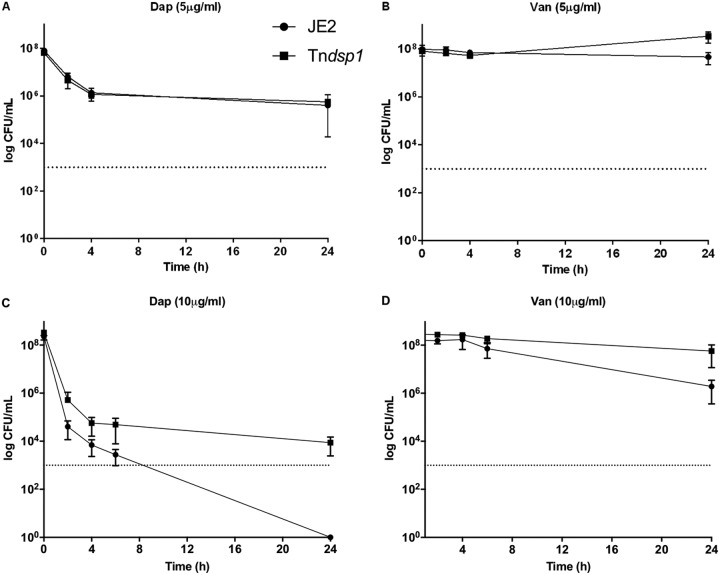
Survival of USA300 wild-type JE2 and mutant Tndsp1 strains in 5 µg/ml and 10 µg/ml DAP (A and C) and 5 µg/ml and 10 µg/ml VAN (B and D) exposure assays. Both JE2 and Tndsp1 strains show similar survival when challenged with 5 µg/ml of antibiotics, while the Tndsp1 strain showed significantly increased tolerance to 10 µg/ml of VAN or DAP. Unpaired t tests were used to determine statistical significance after 24-h treatments. For 10 µg/ml daptomycin: Tndsp1, P = 0.0213; for 10 µg/ml vancomycin: Tndsp1, P = 0.0444. The experiment was performed in three independent replicates; means and standard deviations are indicated. Detection limit, 1,000 CFU/ml.
FIG 6
FIG 6
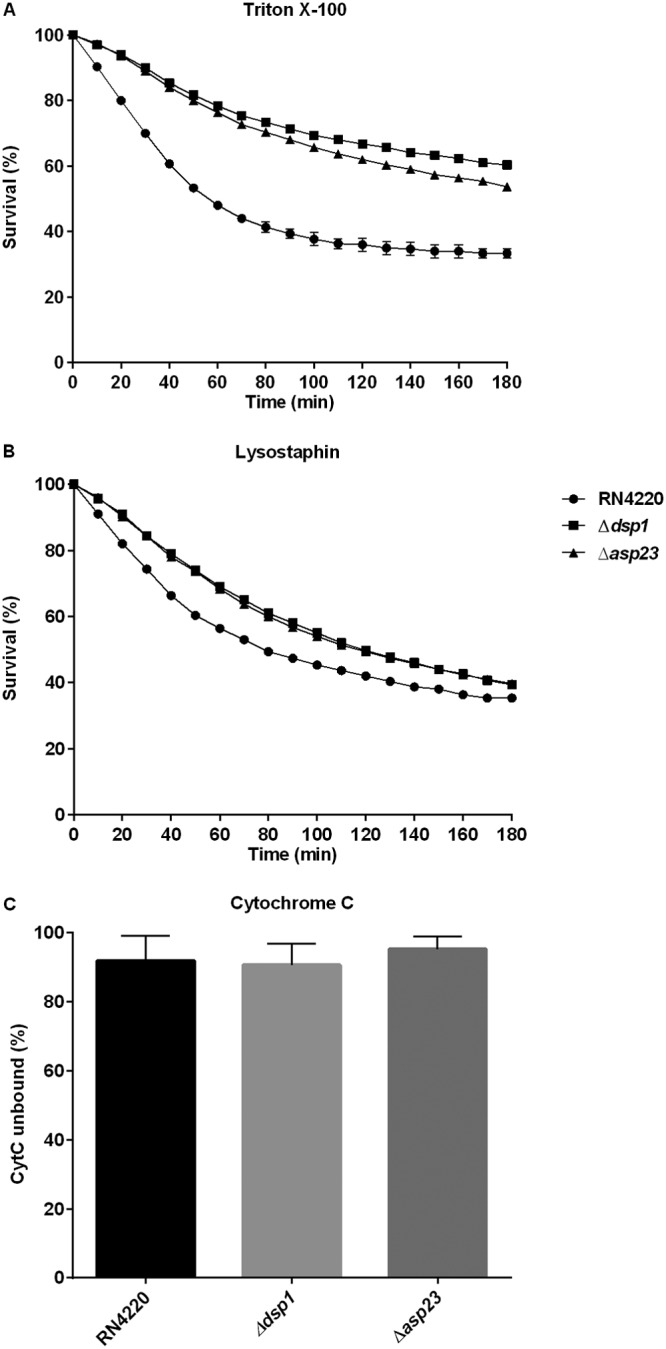
Ability of Δdsp1 and Δasp23 mutants to induced autolysis in the presence of lysostaphin (A) or Triton X-100 (B) and to repulse cationic cytochrome c (C). Unpaired t tests were used to determine statistical significance after 24-h treatment with Triton X-100. Δdsp1, P < 0.0001 and Δasp23, P < 0.0001. The data are mean values from three experiments for each condition, and error bars represent the standard deviations.

References

    1. Rivera AM, Boucher HW. 2011. Current concepts in antimicrobial therapy against select Gram-positive organisms: methicillin-resistant Staphylococcus aureus, penicillin-resistant pneumococci, and vancomycin-resistant enterococci. Mayo Clin Proc 86:1230–1243. doi: 10.4065/mcp.2011.0514. - DOI - PMC - PubMed
    1. Sievert DM, Rudrik JT, Patel JB, McDonald LC, Wilkins MJ, Hageman JC. 2008. Vancomycin-resistant Staphylococcus aureus in the United States, 2002–2006. Clin Infect Dis 46:668–674. doi: 10.1086/527392. - DOI - PubMed
    1. Sader HS, Mendes RE, Duncan LR, Pfaller MA, Flamm RK. 2018. Antimicrobial activity of dalbavancin against Staphylococcus aureus with decreased susceptibility to glycopeptides, daptomycin, and/or linezolid from U.S. medical centers. Antimicrob Agents Chemother 62: e02397-17. doi: 10.1128/AAC.02397-17. - DOI - PMC - PubMed
    1. Joana S, Pedro P, Elsa G, Filomena M. 2013. Is vancomycin MIC creep a worldwide phenomenon? Assessment of S. aureus vancomycin MIC in a tertiary university hospital. BMC Res Notes 6:65. doi: 10.1186/1756-0500-6-65. - DOI - PMC - PubMed
    1. Lai CC, Sheng WH, Wang JT, Cheng A, Chuang YC, Chen YC, Chang SC. 2013. Safety and efficacy of high-dose daptomycin as salvage therapy for severe gram-positive bacterial sepsis in hospitalized adult patients. BMC Infect Dis 13:66. doi: 10.1186/1471-2334-13-66. - DOI - PMC - PubMed

Publication types

MeSH terms