. 2018 Nov 20;115(47):11994-11999.
doi: 10.1073/pnas.1811269115. Epub 2018 Nov 5.

Decomposition responses to climate depend on microbial community composition

Affiliations

Decomposition responses to climate depend on microbial community composition

Sydney I Glassman et al. Proc Natl Acad Sci U S A. .

Abstract

Bacteria and fungi drive decomposition, a fundamental process in the carbon cycle, yet the importance of microbial community composition for decomposition remains elusive. Here, we used an 18-month reciprocal transplant experiment along a climate gradient in Southern California to disentangle the effects of the microbial community versus the environment on decomposition. Specifically, we tested whether the decomposition response to climate change depends on the microbial community. We inoculated microbial decomposers from each site onto a common, irradiated leaf litter within "microbial cages" that prevent microbial exchange with the environment. We characterized fungal and bacterial composition and abundance over time and investigated the functional consequences through litter mass loss and chemistry. After 12 months, microbial communities altered both decomposition rate and litter chemistry. Further, the functional measurements depended on an interaction between the community and its climate in a manner not predicted by current theory. Moreover, microbial ecologists have traditionally considered fungi to be the primary agents of decomposition and for bacteria to play a minor role. Our results indicate that not only does climate change and transplantation have differential legacy effects among bacteria and fungi, but also that bacterial communities might be less functionally redundant than fungi with regards to decomposition. Thus, it may be time to reevaluate both the role of microbial community composition in its decomposition response to climate and the relative roles of bacterial and fungal communities in decomposition.

Keywords: bacteria; elevation gradient; fungi; leaf litter decomposition; reciprocal transplant.


Conflict of interest statement

The authors declare no conflict of interest.

Figures
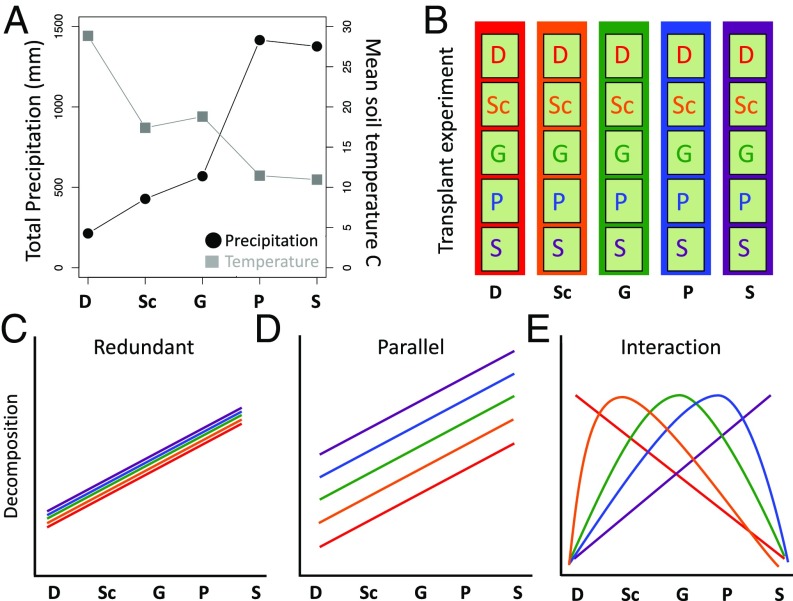
Fig. 1.
Fig. 1.
(A) Total precipitation (in millimeters) and mean annual soil temperature (in degrees Celsius) at the five sites along the elevation gradient. Sites are represented in increasing precipitation order in the same color scheme: desert (D) = red, scrubland (Sc) = orange, grassland (G) = green, pine–oak (P) = blue, and subalpine (S) = purple. (B) Schematic of microbial transplant experiment. Microbial communities from all sites were placed in a common garden experiment in all sites using a common substrate (irradiated grassland litter represented with light green box; n = 5 inocula × 5 sites × 4 plots × 3 time points = 300 litterbags). Three possibilities for decomposition responses are: (C) redundant, in which all microbes function similarly in every site and are only affected by abiotic conditions; (D) parallel, in which microbes differentially affect decomposition, but respond to climate in a proportional manner; and (E) and interaction, in which decomposition is a result of an interaction between microbial communities and their environment. While any interaction is possible, we illustrate an example in which a community decomposes most in its home site (home-field advantage).
Fig. 2.
Fig. 2.
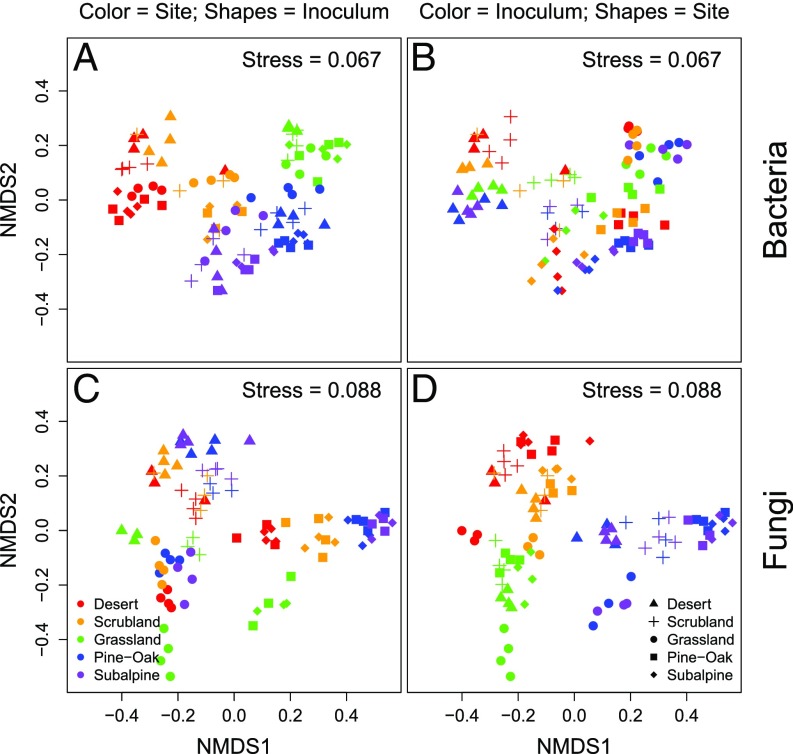
NMDS of Bray–Curtis microbial community composition at 18 mo for (A) bacteria colored by site and shapes by inoculum and (B) bacteria colored by inoculum and shapes by site. The Bottom two panels are both fungal community composition with either (C) colored by site and shapes by inoculum or (D) colored by inoculum and shapes by site.
Fig. 3.
Fig. 3.
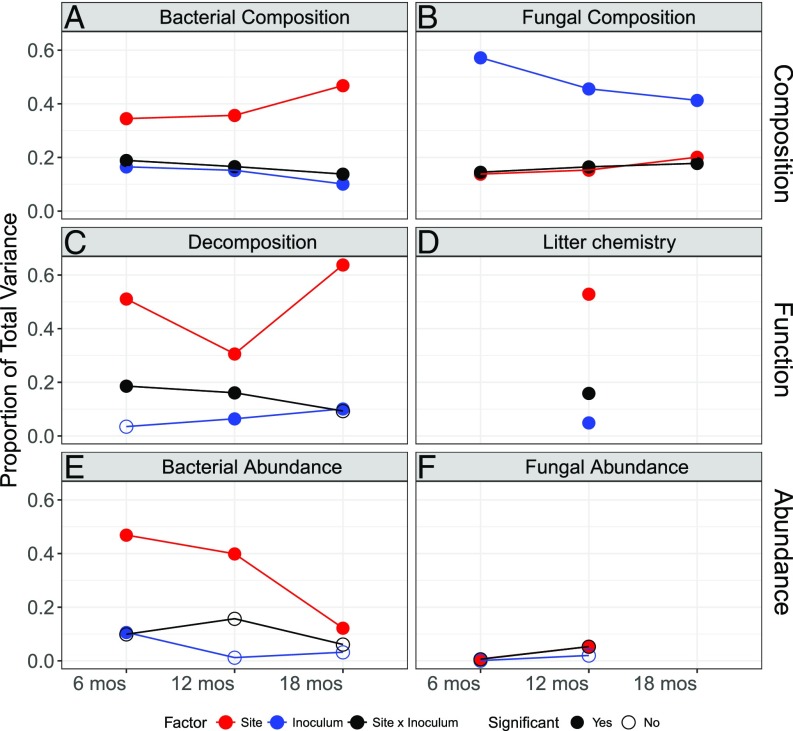
Proportion of variance explained by the treatments (site, inoculum, site x inoculum) on (A) bacterial community composition, (B) fungal community composition, (C) decomposition, (D) litter chemistry, (E) bacterial abundance, and (F) fungal abundance. The proportions for bacterial and fungal community composition and litter chemistry are calculated based on variance estimates from PERMANOVA (SI Appendix, Tables S4, S5, and S7), whereas those for microbial abundance and decomposition are calculated from the total variance explained by two-way ANOVA multiplied by the partial eta-squares for each explanatory variable (SI Appendix, Tables S6 and S9).
Fig. 4.
Fig. 4.
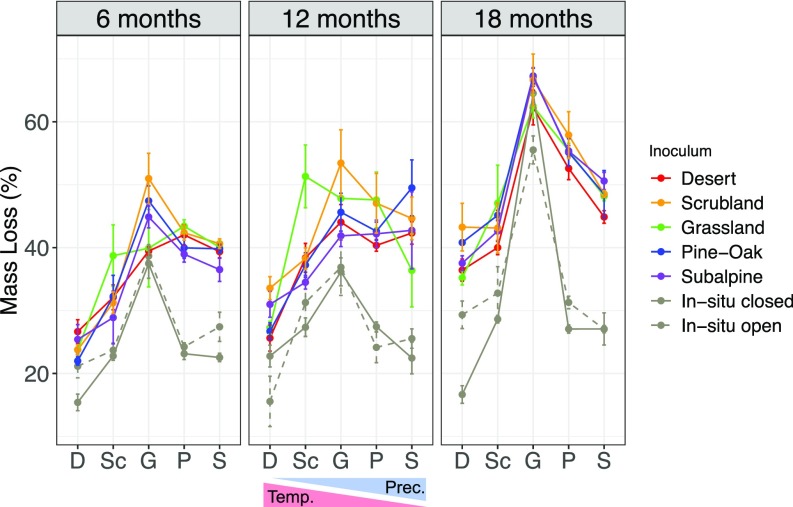
Variation in leaf litter decomposition (mean ± SE percent mass loss) for the full factorial transplant experiment (5 inoculum treatments × 5 sites) along the gradient across the three time points. Sites ordered in order of increasing precipitation: D, desert; G, grassland; P, pine–oak; S, subalpine; and Sc, scrubland. In addition to transplant litterbags, we included open or closed in situ litterbags for comparison.
Fig. 5.
Fig. 5.
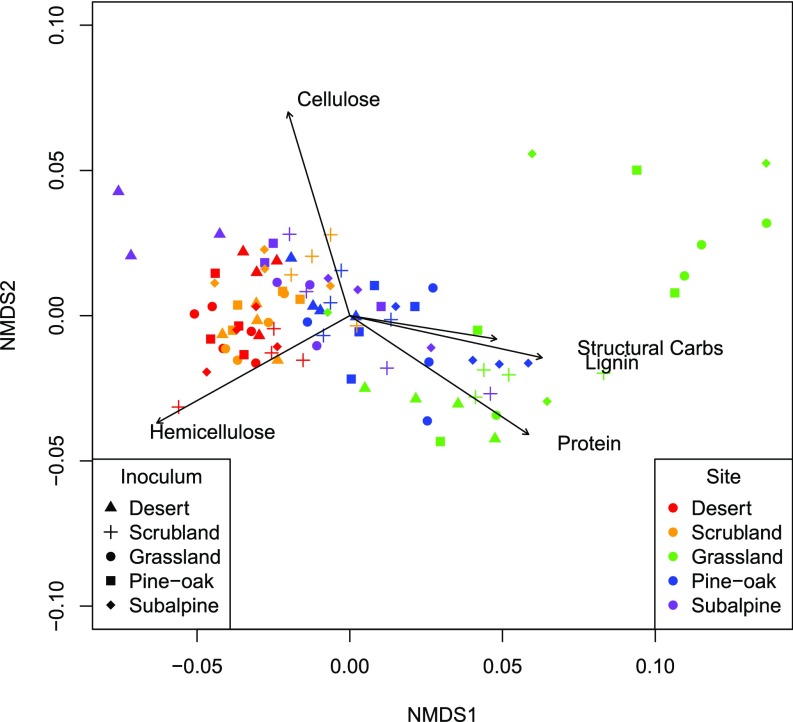
NMDS of litter chemistry of transplanted litterbags at 12 mo. Each point represents the chemical composition of the litter from each litterbag for each site (color) and inoculum (shape) combination (4 plots × 4 inocula × 5 sites = 100). Each vector represents whether each of the five organic compounds (cellulose, crude proteins, hemicellulose, lignin, and structural carbohydrates) increases or decreases in abundance in that site. Stress = 0.045.

References

    1. McGuire KL, Treseder KK. Microbial communities and their relevance for ecosystem models: Decomposition as a case study. Soil Biol Biochem. 2010;42:529–535.
    1. Wang S, Ruan H, Han Y. Effects of microclimate, litter type, and mesh size on leaf litter decomposition along an elevation gradient in the Wuyi Mountains, China. Ecol Res. 2010;25:1113–1120.
    1. Currie WS, et al. Cross-biome transplants of plant litter show decomposition models extend to a broader climatic range but lose predictability at the decadal time scale. Glob Change Biol. 2010;16:1744–1761.
    1. Makkonen M, et al. Highly consistent effects of plant litter identity and functional traits on decomposition across a latitudinal gradient. Ecol Lett. 2012;15:1033–1041. - PubMed
    1. Handa IT, et al. Consequences of biodiversity loss for litter decomposition across biomes. Nature. 2014;509:218–221. - PubMed

Publication types