. 2018 Oct 24;4(10):eaau0766.
doi: 10.1126/sciadv.aau0766. eCollection 2018 Oct.

Minimal PAM specificity of a highly similar SpCas9 ortholog

Affiliations

Minimal PAM specificity of a highly similar SpCas9 ortholog

Pranam Chatterjee et al. Sci Adv. .

Abstract

RNA-guided DNA endonucleases of the CRISPR-Cas system are widely used for genome engineering and thus have numerous applications in a wide variety of fields. CRISPR endonucleases, however, require a specific protospacer adjacent motif (PAM) flanking the target site, thus constraining their targetable sequence space. In this study, we demonstrate the natural PAM plasticity of a highly similar, yet previously uncharacterized, Cas9 from Streptococcus canis (ScCas9) through rational manipulation of distinguishing motif insertions. To this end, we report affinity to minimal 5'-NNG-3' PAM sequences and demonstrate the accurate editing capabilities of the ortholog in both bacterial and human cells. Last, we build an automated bioinformatics pipeline, the Search for PAMs by ALignment Of Targets (SPAMALOT), which further explores the microbial PAM diversity of otherwise overlooked Streptococcus Cas9 orthologs. Our results establish that ScCas9 can be used both as an alternative genome editing tool and as a functional platform to discover novel Streptococcus PAM specificities.


Figures
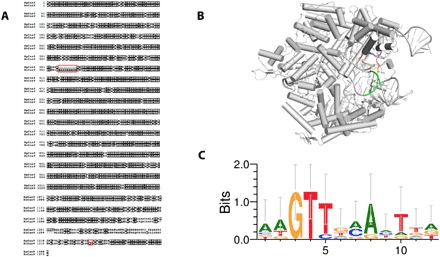
Fig. 1
Fig. 1. In silico characterization of ScCas9.
(A) Global pairwise sequence alignment of SpCas9 and ScCas9. Despite sharing 89.2% sequence homology to SpCas9, ScCas9 contains two notable insertions, one positive-charged insertion in the REC domain (367 to 376) and another KQ insertion in the PAM-interacting domain (PID; 1337 and 1338), as indicated. (B) Insertion of novel REC motif into PDB 4OO8 (18). The 367 to 376 insertion demonstrates a loop-like structure (red). Several of its positive-charged residues (yellow) come in close proximity to the target DNA near the PAM (green). (C) WebLogo (22) for sequences found at the 3′ end of protospacer targets identified in plasmid and viral genomes using type II spacer sequences within S. canis as BLAST (21) queries.
Fig. 2
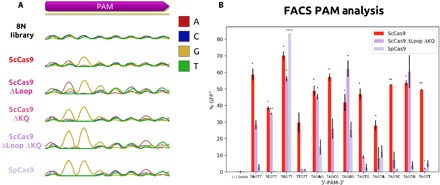
Fig. 2. PAM determination of engineered ScCas9 variants.
(A) PAM binding enrichment on a 5′-NNNNNNNN-3′ (8N) PAM library. PAM profiles are represented by Sanger sequencing chromatograms via amplification of PAM region following plasmid extraction of GFP+ E. coli cells. (B) Examination of PAM preference for ScCas9. For individual PAMs, all four bases were iterated at a single position (2, 4, 5). Each PAM-containing plasmid was electroporated in duplicates, subjected to FACS analysis, and gated for GFP expression. Subsequently, GFP expression levels were averaged. SD was used to calculate error bars, and statistical significance analysis was conducted using a two-tailed Student’s t test as compared to the negative control.
Fig. 3
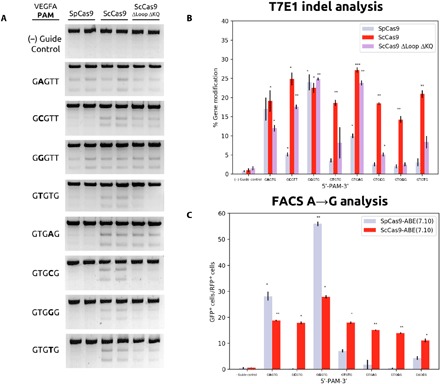
Fig. 3. ScCas9 PAM specificity in human cells.
(A) T7E1 analysis of indels produced at VEGFA loci with indicated PAM sequences. The Cas9 used is indicated above each lane. All samples were performed in biological duplicates. As a background control, SpCas9, ScCas9, and ScCas9 ΔLoop ΔKQ were transfected without targeting guide RNA vectors [(−) guide control]. (B) Quantitative analysis of T7E1 products. Unprocessed gel images were quantified by line scan analysis using Fiji (41), the total intensity of cleaved bands were calculated as a fraction of total product, and percent gene modification was calculated. All samples were performed in duplicates, and quantified modification values were averaged. SD was used to calculate error bars, and statistical significance analysis was conducted using a two-tailed Student’s t test as compared to the negative control. (C) ScCas9-mediated AG base editing. GFP+ cells were calculated as a percentage of mCherry+ (RFP+) cells for indicated PAM sequences using the TLR (25) with an early stop codon. All samples were performed in duplicates, and quantified percentages were averaged. SD was used to calculate error bars, and statistical significance analysis was conducted using a two-tailed Student’s t test. RFP+, red fluorescent protein–positive.
Fig. 4
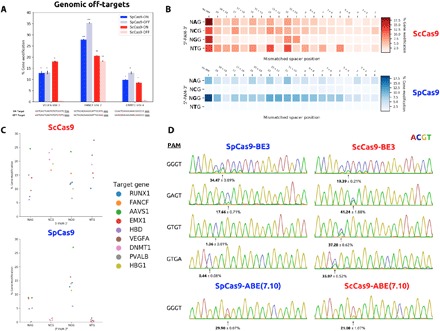
Fig. 4. ScCas9 performance as a genome editing tool.
(A) Quantitative analysis of T7E1 products for indicated genomic on- and off-target editing. All samples were performed in duplicates, and quantified modification values were averaged. SD was used to calculate error bars, and statistical significance analysis was conducted using a two-tailed Student’s t test as compared to each negative control (table S2). Mismatched positions within the spacer sequence are highlighted in red. (B) Efficiency heatmap of mismatch tolerance assay. Quantified modification efficiencies, as assessed by the T7E1 assay, are exhibited for each labeled single or double mismatch in the sgRNA sequence for each indicated PAM (table S1). (C) Dot plot of on-target modification percentages at various gene targets for indicated PAM, as assessed by the T7E1 assay. Duplicate modification percentages were averaged (table S2). (D) Genomic base-editing characterization. For each indicated PAM, a representative Sanger sequencing chromatogram is shown, demonstrating the most efficiently edited base in the target sequence. Percent edited values, as quantified by BEEP in comparison to an unedited negative control, were averaged, and SD was subsequently calculated.
Fig. 5
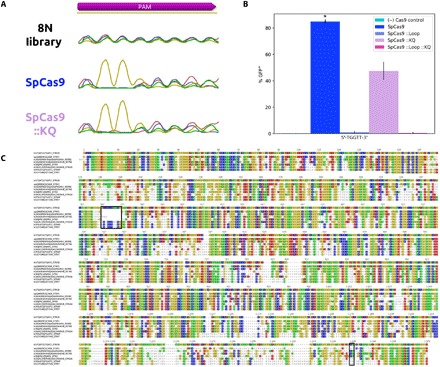
Fig. 5. Relationship of ScCas9 to other Streptococcus orthologs.
(A) PAM binding enrichment on a 5′-NNNNNNNN-3′ PAM library of ScCas9-like SpCas9 variants. The PAM-SCANR screen (23) was applied to variants of SpCas9 containing the loop, KQ insertions, or both. SpCas9 ::Loop and SpCas9 ::Loop ::KQ failed to demonstrate PAM binding and thus GFP expression. (B) FACS analysis of binding at 5′-NGG-3′ PAM. All samples were performed in duplicates and averaged. SD was used to calculate error bars. (C) Sequence conservation of Streptococcus orthologs with ScCas9 as a reference. Each ortholog is referred to by its UniProt ID (16). The loop (367 to 376) and KQ (1337 and 1338) insertion alignments are indicated.
Fig. 6
Fig. 6. SPAMALOT PAM predictions for Streptococcus Cas9 orthologs.
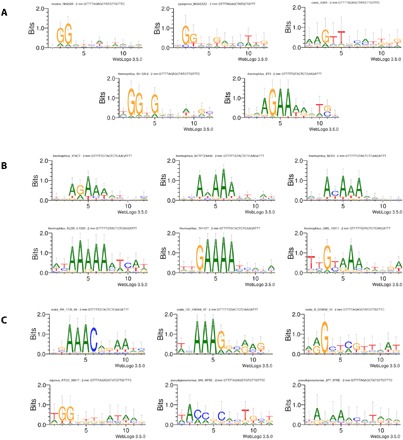
Spacer sequences found within the type II CRISPR cassettes associated with Cas9 ORFs from specified Streptococcus genomes were aligned to S. phage genomes to generate spacer-protospacer mappings. WebLogos (22), labeled with the relevant species, genome, and CRISPR repeat, were generated for sequences found at the 3′ end of candidate protospacer targets with no more than two mismatches (2 mm). (A) PAM predictions for experimentally validated Cas9 PAM sequences in previous studies. (B) Novel PAM predictions of alternate S. thermophilus Cas9 orthologs with putative divergent specificities. (C) Novel PAM predictions of uncharacterized Streptococcus orthologs with distinct specificities.

References

    1. Jinek M., Chylinski K., Fonfara I., Hauer M., Doudna J. A., Charpentier E., A programmable dual-RNA–guided DNA endonuclease in adaptive bacterial immunity. Science 337, 816–821 (2012). - PMC - PubMed
    1. Zetsche B., Gootenberg J. S., Abudayyeh O. O., Slaymaker I. M., Makarova K. S., Essletzbichler P., Volz S. E., Joung J., van der Oost J., Regev A., Koonin E. V., Zhang F., Cpf1 is a single RNA-guided endonuclease of a class 2 CRISPR-Cas system. Cell 163, 759–771 (2015). - PMC - PubMed
    1. Qi L. S., Larson M. H., Gilbert L. A., Doudna J. A., Weissman J. S., Arkin A. P., Lim W. A., Repurposing CRISPR as an RNA-guided platform for sequence-specific control of gene expression. Cell 152, 1173–1183 (2013). - PMC - PubMed
    1. Barrangou R., Horvath P., A decade of discovery: CRISPR functions and applications. Nat. Microbiol. 2, 17092 (2017). - PubMed
    1. Mojica F. J., Díez-Villaseñor C., García-Martínez J., Almendros C., Short motif sequences determine the targets of the prokaryotic CRISPR defense system. Microbiology 155, 733–740 (2009). - PubMed

Publication types

Substances