


Exaggerated systemic oxidative-inflammatory-nitrosative stress in chronic mountain sickness is associated with cognitive decline and depression
- PMID: 30397919
- PMCID: PMC6332753
- DOI: 10.1113/JP276898
Exaggerated systemic oxidative-inflammatory-nitrosative stress in chronic mountain sickness is associated with cognitive decline and depression
Abstract
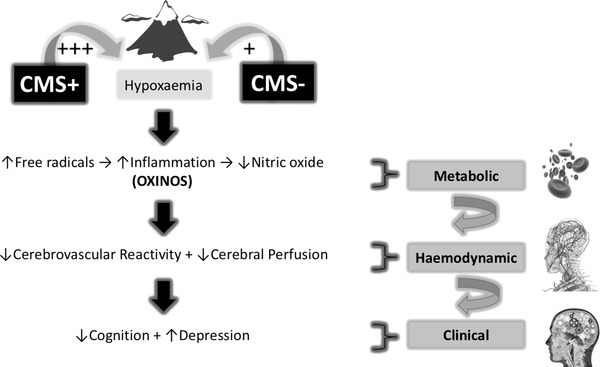
Key points: Chronic mountain sickness (CMS) is a maladaptation syndrome encountered at high altitude (HA) characterised by severe hypoxaemia that carries a higher risk of stroke and migraine and is associated with increased morbidity and mortality. We examined if exaggerated oxidative-inflammatory-nitrosative stress (OXINOS) and corresponding decrease in vascular nitric oxide bioavailability in patients with CMS (CMS+) is associated with impaired cerebrovascular function and adverse neurological outcome. Systemic OXINOS was markedly elevated in CMS+ compared to healthy HA (CMS-) and low-altitude controls. OXINOS was associated with blunted cerebral perfusion and vasoreactivity to hypercapnia, impaired cognition and, in CMS+, symptoms of depression. These findings are the first to suggest that a physiological continuum exists for hypoxaemia-induced systemic OXINOS in HA dwellers that when excessive is associated with accelerated cognitive decline and depression, helping identify those in need of more specialist neurological assessment and targeted support.
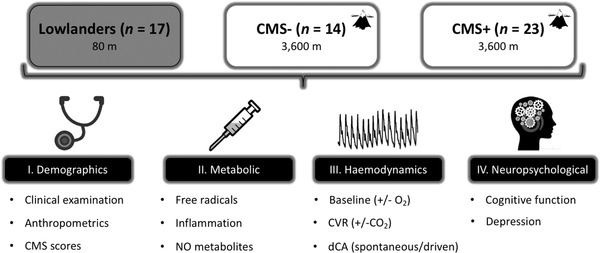
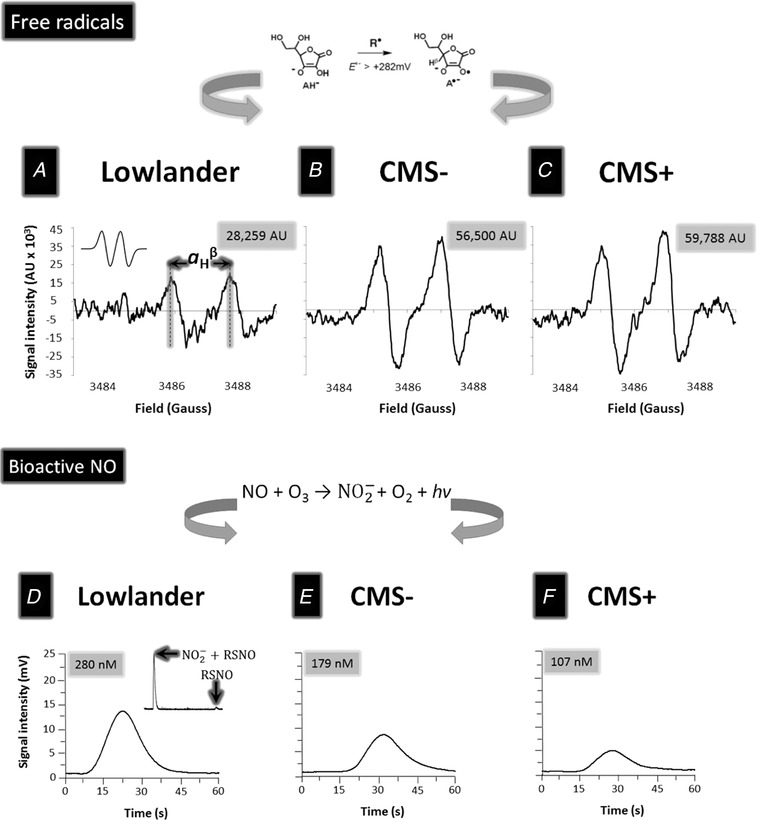
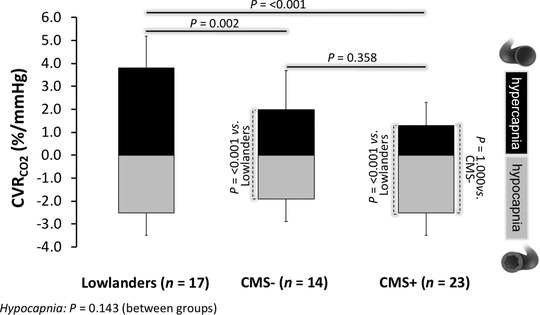
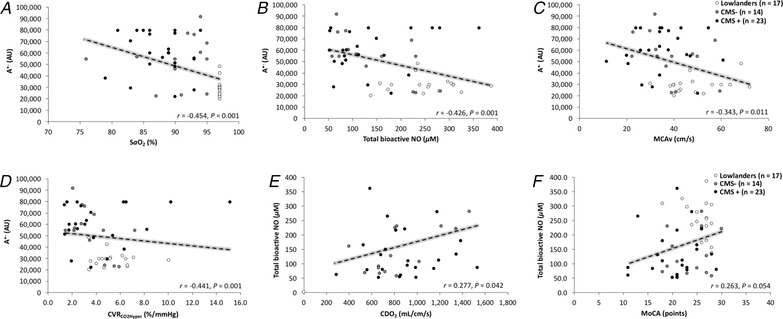
Abstract: Chronic mountain sickness (CMS) is a maladaptation syndrome encountered at high altitude (HA) characterised by severe hypoxaemia that carries a higher risk of stroke and migraine and is associated with increased morbidity and mortality. The present cross-sectional study examined to what extent exaggerated systemic oxidative-inflammatory-nitrosative stress (OXINOS), defined by an increase in free radical formation and corresponding decrease in vascular nitric oxide (NO) bioavailability, is associated with impaired cerebrovascular function, accelerated cognitive decline and depression in CMS. Venous blood was obtained from healthy male lowlanders (80 m, n = 17), and age- and gender-matched HA dwellers born and bred in La Paz, Bolivia (3600 m) with (CMS+, n = 23) and without (CMS-, n = 14) CMS. We sampled blood for oxidative (electron paramagnetic resonance spectroscopy, HPLC), nitrosative (ozone-based chemiluminescence) and inflammatory (fluorescence) biomarkers. We employed transcranial Doppler ultrasound to measure cerebral blood flow (CBF) and reactivity. We utilised psychometric tests and validated questionnaires to assess cognition and depression. Highlanders exhibited elevated systemic OXINOS (P < 0.05 vs. lowlanders) that was especially exaggerated in the more hypoxaemic CMS+ patients (P < 0.05 vs. CMS-). OXINOS was associated with blunted cerebral perfusion and vasoreactivity to hypercapnia, impaired cognition and, in CMS+, symptoms of depression. Collectively, these findings are the first to suggest that a physiological continuum exists for hypoxaemia-induced OXINOS in HA dwellers that when excessive is associated with accelerated cognitive decline and depression, helping identify those in need of specialist neurological assessment and support.
Keywords: cerebrovascular function; chronic mountain sickness; cognition; dementia; depression; free radicals.
© 2018 The Authors. The Journal of Physiology © 2018 The Physiological Society.
Figures

References
-
- War Department Adjutant General's Office (1944). Army Individual Test Battery. Manual of Directions and Scoring. War Department Adjutant General's Office, Washington, DC.
-
- Alle H, Roth A & Geiger JR (2009). Energy‐efficient action potentials in hippocampal mossy fibers. Science 325, 1405–1408. - PubMed
-
- Bailey DM, Evans KA, James PE, McEneny J, Young IS, Fall L, Gutowski M, Kewley E, McCord JM, Moller K & Ainslie PN (2009a). Altered free radical metabolism in acute mountain sickness: implications for dynamic cerebral autoregulation and blood–brain barrier function. J Physiol 587, 73–85. - PMC - PubMed
-
- Bailey DM, Evans KA, McEneny J, Young IS, Hullin DA, James PE, Ogoh S, Ainslie PN, Lucchesi C, Rockenbauer A, Culcasi M & Pietri S (2011). Exercise‐induced oxidative‐nitrosative stress is associated with impaired dynamic cerebral autoregulation and blood‐brain barrier leakage. Exp Physiol 96, 1196–1207. - PubMed
Publication types
MeSH terms
LinkOut - more resources
Full Text Sources
Other Literature Sources
Medical
