Projection of Diabetes Prevalence in Korean Adults for the Year 2030 Using Risk Factors Identified from National Data
- PMID: 30398038
- PMCID: PMC6387874
- DOI: 10.4093/dmj.2018.0043
Projection of Diabetes Prevalence in Korean Adults for the Year 2030 Using Risk Factors Identified from National Data
Erratum in
-
Corrigenda: Omission of the Description of Informed Consent.Diabetes Metab J. 2019 Jun;43(3):381. doi: 10.4093/dmj.2018.0100. Diabetes Metab J. 2019. PMID: 31210039 Free PMC article.
Abstract
Background: A number of studies have reported future prevalence estimates for diabetes mellitus (DM), but these studies have been limited for the Korean population. The present study aimed to construct a forecasting model that includes risk factors for type 2 DM using individual- and national-level data for Korean adults to produce prevalence estimates for the year 2030.
Methods: Time series data from the Korea National Health and Nutrition Examination Survey and national statistics from 2005 to 2013 were used. The study subjects were 13,908 male and 18,697 female adults aged 30 years or older who were free of liver cirrhosis. Stepwise logistic regression analysis was used to select significant factors associated with DM prevalence.
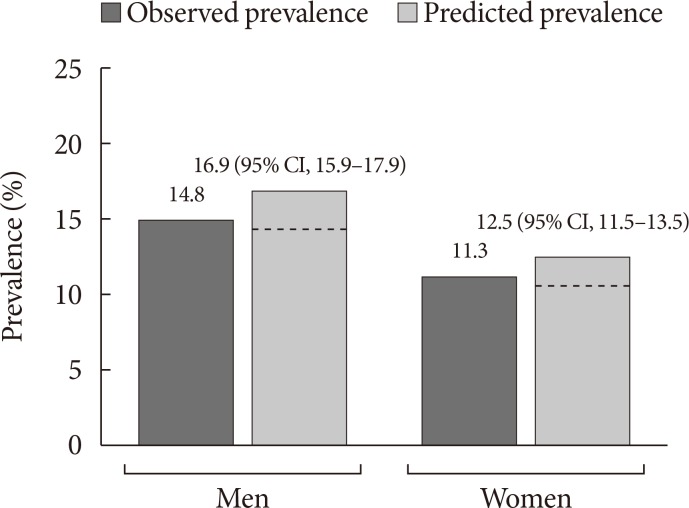
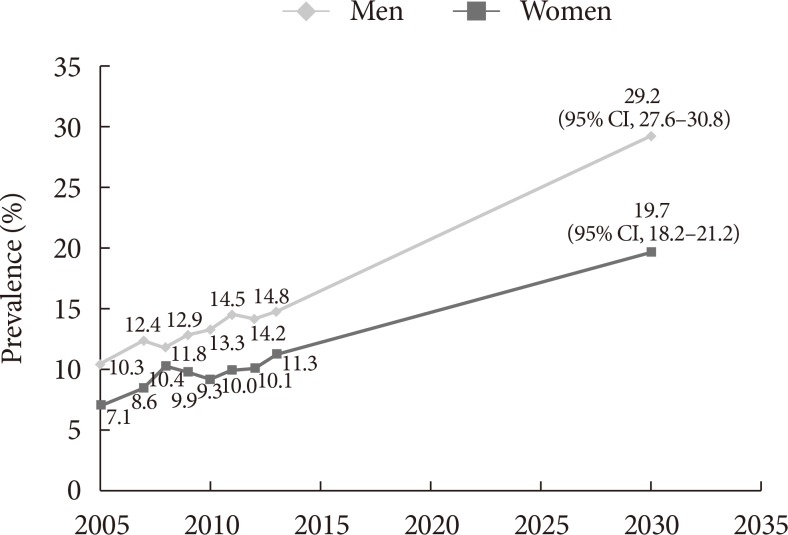
Results: The results showed that survey year, age, sex, marital, educational, or occupational status, the presence of obesity or hypertension, smoking status, alcohol consumption, sleep duration, psychological distress or depression, and fertility rate significantly contributed to the 8-year trend in DM prevalence (P<0.05). Based on sex-specific forecasting models that included the above factors, DM prevalence for the year 2030 was predicted to be 29.2% (95% confidence interval [CI], 27.6% to 30.8%) in men and 19.7% (95% CI, 18.2% to 21.2%) in women.
Conclusion: The present study projected a two-fold increase in the prevalence of DM in 2030 compared with that for the years 2013 and 2014 in Korean adults. Modifiable factors contributing to this increase in DM prevalence, such as obesity, smoking, and psychological factors, may require attention in order to reduce national and individual costs associated with DM.
Keywords: Diabetes mellitus; Forecasting; Prevalence; Risk factors.
Copyright © 2018 Korean Diabetes Association.
Conflict of interest statement
No potential conflict of interest relevant to this article was reported.
Figures
Comment in
-
Letter: Projection of Diabetes Prevalence in Korean Adults for the Year 2030 Using Risk Factors Identified from National Data (Diabetes Metab J 2019;43:90-6).Diabetes Metab J. 2019 Apr;43(2):242-243. doi: 10.4093/dmj.2019.0056. Diabetes Metab J. 2019. PMID: 30993940 Free PMC article. No abstract available.
-
Response: Projection of Diabetes Prevalence in Korean Adults for the Year 2030 Using Risk Factors Identified from National Data (Diabetes Metab J 2019;43:90-6).Diabetes Metab J. 2019 Apr;43(2):244-245. doi: 10.4093/dmj.2019.0060. Diabetes Metab J. 2019. PMID: 30993941 Free PMC article. No abstract available.
References
-
- World Health Organization. Global report on diabetes. Geneva: World Health Organization; 2016.
-
- Ministry of Health and Welfare, Korea Centers for Disease Control and Prevention. Korea health statistics 2015: Korea National Health and Nutrition Examination Survey (KNHANES VI-3) Sejong: Korea Centers for Disease Control and Prevention; 2016.
-
- National Statistics Office. Population projections for Korea: 2015-2065. Seoul: Government of Korea; 2016.
-
- Whiting DR, Guariguata L, Weil C, Shaw J. IDF diabetes atlas: global estimates of the prevalence of diabetes for 2011 and 2030. Diabetes Res Clin Pract. 2011;94:311–321. - PubMed
-
- Brinks R, Tamayo T, Kowall B, Rathmann W. Prevalence of type 2 diabetes in Germany in 2040: estimates from an epidemiological model. Eur J Epidemiol. 2012;27:791–797. - PubMed
Publication types
MeSH terms
Grants and funding
LinkOut - more resources
Full Text Sources
Medical