Return to Learn After Sport-Related Concussion: A Survey of Secondary School and Collegiate Athletic Trainers
- PMID: 30398928
- PMCID: PMC6263072
- DOI: 10.4085/1062-6050-234-17
Return to Learn After Sport-Related Concussion: A Survey of Secondary School and Collegiate Athletic Trainers
Abstract
Context: Recent recommendations have emphasized return-to-learn (RTL) protocols to aid athletes in recovery from sport-related concussion (SRC) but have been based primarily on anecdotal evidence.
Objective: To investigate the RTL practices of certified athletic trainers (ATs) after an SRC.
Design: Cross-sectional study.
Setting: Online survey.
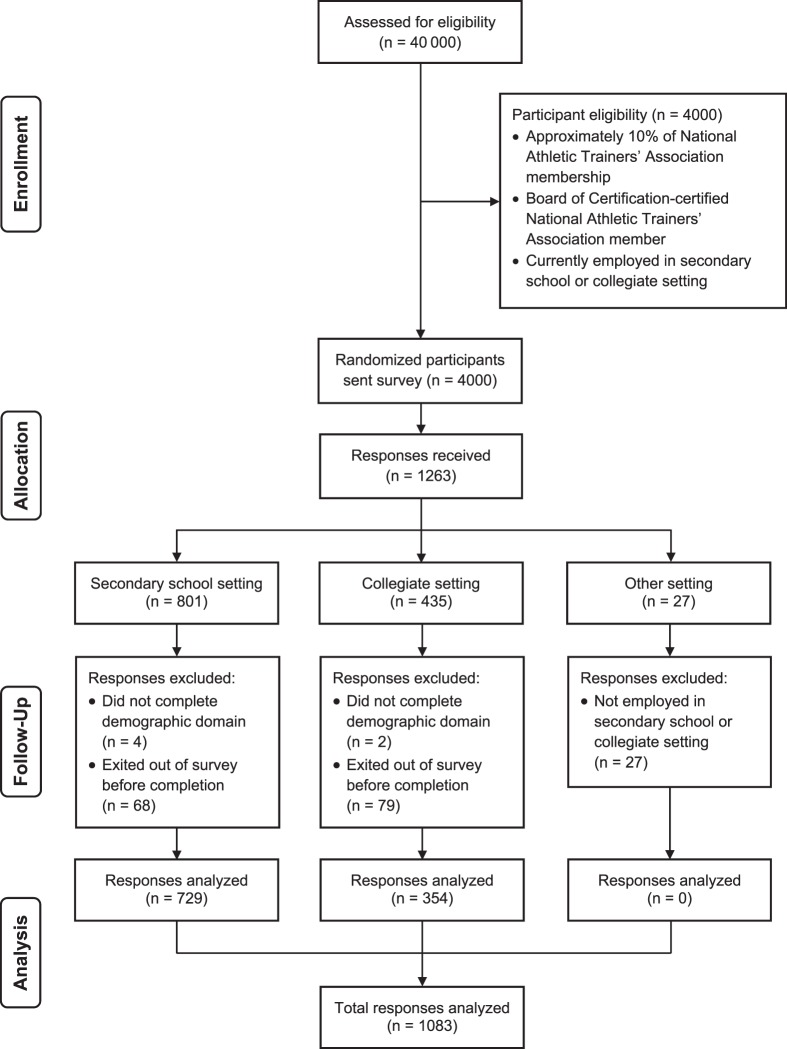
Patients or other participants: A total of 1083 individuals (27%) from a random sample of 4000 ATs in the National Athletic Trainers' Association membership database completed an electronic survey. Participants consisted of 729 self-identified secondary school ATs (SSATs; 67.3%; experience = 14.0 ± 9.7 years) and 354 self-identified collegiate ATs (CATs; 32.7%; experience = 13.4 ± 9.7 years).
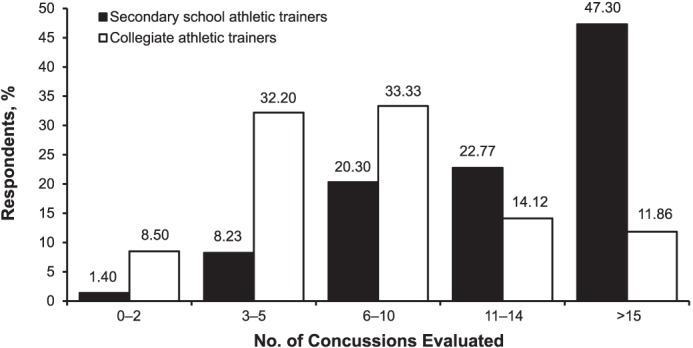
Main outcome measure(s): We used χ2 analyses to assess respondent differences related to current knowledge, current practices, and available resources. Independent t tests were used to compare SSATs and CATs on years of certification and annual number of SRCs evaluated.
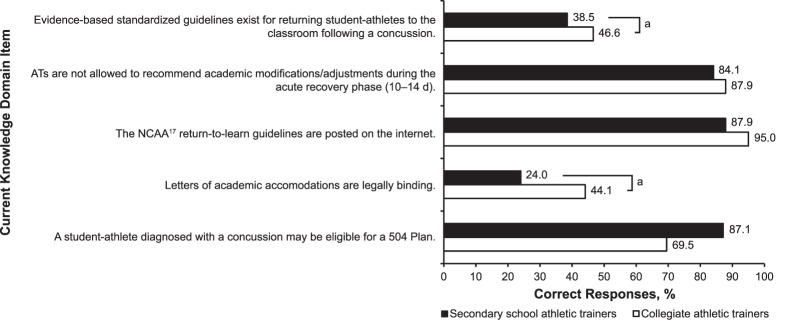
Results: Of our total respondents, 41.2% (n = 446) correctly indicated the absence of evidence-based RTL guidelines. Whereas most (73.9%, n = 800) respondents had an established RTL policy, only 38.1% (n = 413) used such guidelines in their clinical practice. Most (97.1%, n = 708) SSATs and 82.2% (n = 291) of CATs had access to (a) mental health professional(s); however, minorities of SSATs (21.4%, n = 156) and CATs (37.0%, n = 131) never accessed these resources to care for concussed student-athletes.
Conclusions: Our results suggested that, despite the absence of empirical evidence, most surveyed ATs incorporated some form of RTL protocol in their SRC management policy. The varying AT knowledge, clinical practices, and resources highlighted by our results should be considered when creating or refining an RTL protocol.
Keywords: academic accommodations; concussion management; student-athletes.
Figures
References
-
- McCrory P, Meeuwisse W, Dvorak J, et al. Consensus statement on concussion in sport: the 5th International Conference on Concussion in Sport held in Berlin, October 2016. Br J Sports Med. 2017;5(11):838–847. - PubMed
-
- Halstead ME, McAvoy K, Devore CD, et al. Returning to learning following a concussion. Pediatrics. 2013;132(5):948–957. - PubMed
-
- McCrory P, Meeuwisse WH, Echemendia RJ, Iverson GL, Dvorak J, Kutcher JS. What is the lowest threshold to make a diagnosis of concussion? Br J Sports Med. 2013;47(5):268–271. - PubMed
-
- Covassin T, Elbin RJ, Harris W, Parker T, Kontos A. The role of age and sex in symptoms, neurocognitive performance, and postural stability in athletes after concussion. Am J Sports Med. 2012;40(6):1303–1312. - PubMed
-
- Covassin T, Bay E. Are there gender differences in cognitive function, chronic stress, and neurobehavioral symptoms after mild-to-moderate traumatic brain injury? J Neurosci Nurs. 2012;44(3):124–133. - PubMed
MeSH terms
LinkOut - more resources
Full Text Sources
Medical
Miscellaneous